

266
6 Wave Transformation in Shallow Water
Continuation of this process disturbs the applicability of the initial assumptions introduced in the model under consideration. According to the
estimation of Zakharov (1968), the possibility of using the kinetic equation
(6.17) can be defined by the inequality: w" (k) I i:J..k 1 2 » TNVR, where i:J..kis
the spectrum width over the wave number; and N is the integral wave action. Using the estimation N"' m 0 gjky'g[I, where m 0 is the spectrum zero
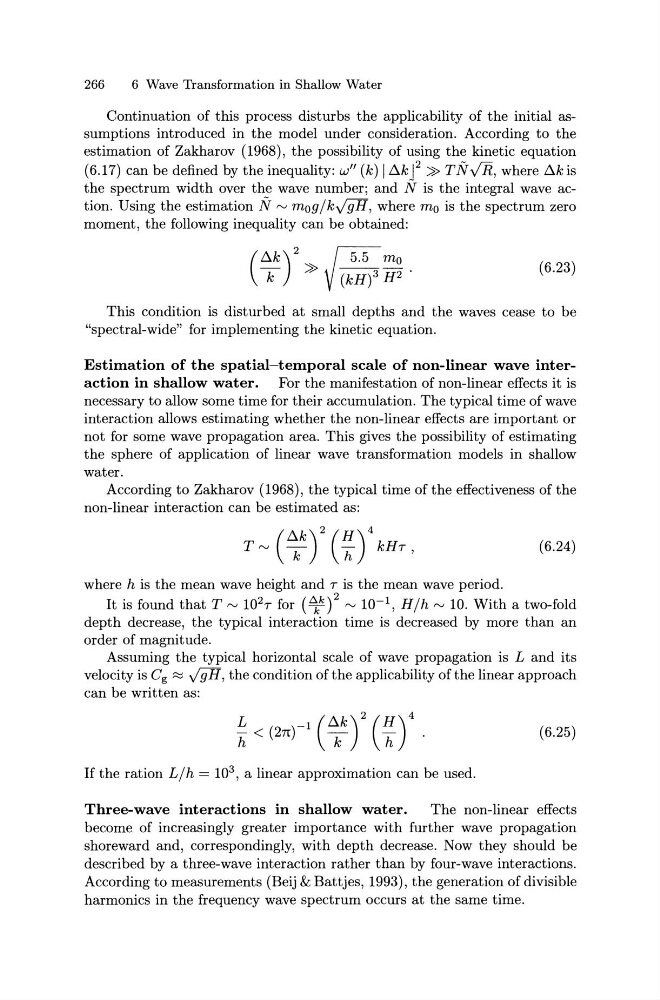
moment, the following inequality can be obtained:
f:J..k
5.5 mo
(
) 2
~
k
» (kH)3 H2 .
(6.23)
This condition is disturbed at small depths and the waves cease to be
"spectral-wide" for implementing the kinetic equation.
Estimation of the spatial-temporal scale of non-linear wave interaction in shallow water. For the manifestation of non-linear effects it is
necessary to allow some time for their accumulation. The typical time of wave
interaction allows estimating whether the non-linear effects are important or
not for some wave propagation area. This gives the possibility of estimating
the sphere of application of linear wave transformation models in shallow
water.
According to Zakharov (1968), the typical time of the effectiveness of the
non-linear interaction can be estimated as:
( f:J..k)
2
(H)
4
Trv k
h kHr,
(6.24)
where h is the mean wave height and T is the mean wave period.
It is found that T"' 10 2 r for ( ~k) 2 "'10-1, Hjh"' 10. With a two-fold
depth decrease, the typical interaction time is decreased by more than an
order of magnitude.
Assuming the typical horizontal scale of wave propagation is L and its
velocity is Cg ~ y'g[I, the condition of the applicability of the linear approach
can be written as:
(6.25)
If the ration L/h = 103, a linear approximation can be used.
Three-wave interactions in shallow water.
The non-linear effects
become of increasingly greater importance with further wave propagation
shoreward and, correspondingly, with depth decrease. Now they should be
described by a three-wave interaction rather than by four-wave interactions.
According to measurements (Beij & Battjes, 1993), the generation of divisible
harmonics in the frequency wave spectrum occurs at the same time.
6 Wave Transformation in Shallow Water
Continuation of this process disturbs the applicability of the initial assumptions introduced in the model under consideration. According to the
estimation of Zakharov (1968), the possibility of using the kinetic equation
(6.17) can be defined by the inequality: w" (k) I i:J..k 1 2 » TNVR, where i:J..kis
the spectrum width over the wave number; and N is the integral wave action. Using the estimation N"' m 0 gjky'g[I, where m 0 is the spectrum zero
moment, the following inequality can be obtained:
f:J..k
5.5 mo
(
) 2
~
k
» (kH)3 H2 .
(6.23)
This condition is disturbed at small depths and the waves cease to be
"spectral-wide" for implementing the kinetic equation.
Estimation of the spatial-temporal scale of non-linear wave interaction in shallow water. For the manifestation of non-linear effects it is
necessary to allow some time for their accumulation. The typical time of wave
interaction allows estimating whether the non-linear effects are important or
not for some wave propagation area. This gives the possibility of estimating
the sphere of application of linear wave transformation models in shallow
water.
According to Zakharov (1968), the typical time of the effectiveness of the
non-linear interaction can be estimated as:
( f:J..k)
2
(H)
4
Trv k
h kHr,
(6.24)
where h is the mean wave height and T is the mean wave period.
It is found that T"' 10 2 r for ( ~k) 2 "'10-1, Hjh"' 10. With a two-fold
depth decrease, the typical interaction time is decreased by more than an
order of magnitude.
Assuming the typical horizontal scale of wave propagation is L and its
velocity is Cg ~ y'g[I, the condition of the applicability of the linear approach
can be written as:
(6.25)
If the ration L/h = 103, a linear approximation can be used.
Three-wave interactions in shallow water.
The non-linear effects
become of increasingly greater importance with further wave propagation
shoreward and, correspondingly, with depth decrease. Now they should be
described by a three-wave interaction rather than by four-wave interactions.
According to measurements (Beij & Battjes, 1993), the generation of divisible
harmonics in the frequency wave spectrum occurs at the same time.