

6.2 Weak Non-Linear Wave Interaction in Shallow Water
267
One of the first attempts to describe this effect theoretically was undertaken in the paper by Abreu et al. (1992). A solution for the shallow-water
approximation is obtained, although wave dispersion is excluded, limiting the
use of this result in the models. In the paper by Zaslavskii (1998) a formula
describing three-wave interactions in finite depth water was derived. The socalled "quasi-kinetic" equation is obtained, where the conservatism condition
is not fulfilled for a non-linear wave interaction in shallow water.
A simplified energy formula for three-wave interactions, which can be used
for coastal wind wave models, has been proposed (Eldeberky & Battjes, 1995).
The model is one-dimensional and called the Discrete Trial Approximations
(DTA). It is tested using data from laboratory experiments displaying good
agreement for describing the principal features of energy transfer from the
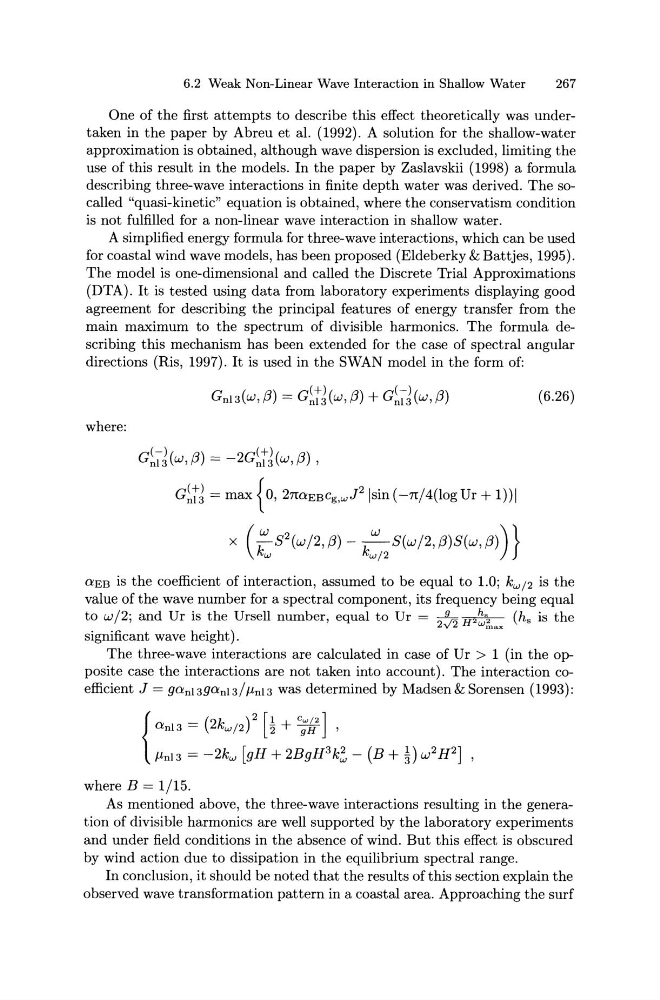
main maximum to the spectrum of divisible harmonics. The formula describing this mechanism has been extended for the case of spectral angular
directions (Ris, 1997). It is used in the SWAN model in the form of:
(6.26)
where:
G~~~(w,/3) = -2G~ii(w,f3),
c~i ~ = max { 0, 27TO:EBCg,w1 2 I sin ( -n/ 4(log Ur + 1)) I
x (~ S 2 (w/2,/3)- k:; 2 S(w/2,f3)S(w,f3))}
O:EB is the coefficient of interaction, assumed to be equal to 1.0; kw; 2 is the
value of the wave number for a spectral component, its frequency being equal
to w/2; and Uris the Ursell number, equal toUr = 9 ~<> H 2 hs2
(hs is the
2v2
Wmax
significant wave height).
The three-wave interactions are calculated in case of Ur > 1 (in the opposite case the interactions are not taken into account). The interaction coefficient J = go:nl3go:nl3 / f.Lnl3 was determined by Madsen & Sorensen ( 1993):
{
O:nJ3 = (2kw;2) 2 [~ + c;//] ,
f.Lnl3 = -2kw [gH + 2BgH 3 k~- (B + ~) w 2 H 2 ]
where B = 1/15.
As mentioned above, the three-wave interactions resulting in the generation of divisible harmonics are well supported by the laboratory experiments
and under field conditions in the absence of wind. But this effect is obscured
by wind action due to dissipation in the equilibrium spectral range.
In conclusion, it should be noted that the results of this section explain the
observed wave transformation pattern in a coastal area. Approaching the surf
267
One of the first attempts to describe this effect theoretically was undertaken in the paper by Abreu et al. (1992). A solution for the shallow-water
approximation is obtained, although wave dispersion is excluded, limiting the
use of this result in the models. In the paper by Zaslavskii (1998) a formula
describing three-wave interactions in finite depth water was derived. The socalled "quasi-kinetic" equation is obtained, where the conservatism condition
is not fulfilled for a non-linear wave interaction in shallow water.
A simplified energy formula for three-wave interactions, which can be used
for coastal wind wave models, has been proposed (Eldeberky & Battjes, 1995).
The model is one-dimensional and called the Discrete Trial Approximations
(DTA). It is tested using data from laboratory experiments displaying good
agreement for describing the principal features of energy transfer from the
main maximum to the spectrum of divisible harmonics. The formula describing this mechanism has been extended for the case of spectral angular
directions (Ris, 1997). It is used in the SWAN model in the form of:
(6.26)
where:
G~~~(w,/3) = -2G~ii(w,f3),
c~i ~ = max { 0, 27TO:EBCg,w1 2 I sin ( -n/ 4(log Ur + 1)) I
x (~ S 2 (w/2,/3)- k:; 2 S(w/2,f3)S(w,f3))}
O:EB is the coefficient of interaction, assumed to be equal to 1.0; kw; 2 is the
value of the wave number for a spectral component, its frequency being equal
to w/2; and Uris the Ursell number, equal toUr = 9 ~<> H 2 hs2
(hs is the
2v2
Wmax
significant wave height).
The three-wave interactions are calculated in case of Ur > 1 (in the opposite case the interactions are not taken into account). The interaction coefficient J = go:nl3go:nl3 / f.Lnl3 was determined by Madsen & Sorensen ( 1993):
{
O:nJ3 = (2kw;2) 2 [~ + c;//] ,
f.Lnl3 = -2kw [gH + 2BgH 3 k~- (B + ~) w 2 H 2 ]
where B = 1/15.
As mentioned above, the three-wave interactions resulting in the generation of divisible harmonics are well supported by the laboratory experiments
and under field conditions in the absence of wind. But this effect is obscured
by wind action due to dissipation in the equilibrium spectral range.
In conclusion, it should be noted that the results of this section explain the
observed wave transformation pattern in a coastal area. Approaching the surf