

6.2 Weak Non-Linear Wave Interaction in Shallow Water
265
figure also shows values of the non-linear transfer function in the deep water
case at t = 5 x 10 4 s after the evolution begins. The function maximum is
displaced to the left at the frequency w = 0. 725, and the minimum at the
frequency w = 0.83. The maximum of the non-linear energy transfer value is
decreased by an order of magnitude and the minimum by a factor of 5. The
second minimum disappears at the same time. The results reveal an intensive
decrease of the non-linear energy transfer and its influence on the spectrum
and displacement of the latter to the low-frequency area. Due to the spectrum maximum frequency decrease, the value of the non-linear transfer becomes smaller and the spectrum shape is stabilized. This is also in agreement
with the estimates obtained from the dimensional ratio Gnl "' S~axw~ax/ g 4 ,
showing a strong dependence of the non-linear mechanism on the spectrum
maximum frequency. The waves become longer and smoother with the same
mean height, i.e. their steepness and non-linearity are decreased.
The behaviour of the non-linear transfer in the wave spectrum (see
Fig. 6.5) in a finite depth basin is partly analogous to the case of infinite
depth. However, the value of the function GNL is larger in the finite depth
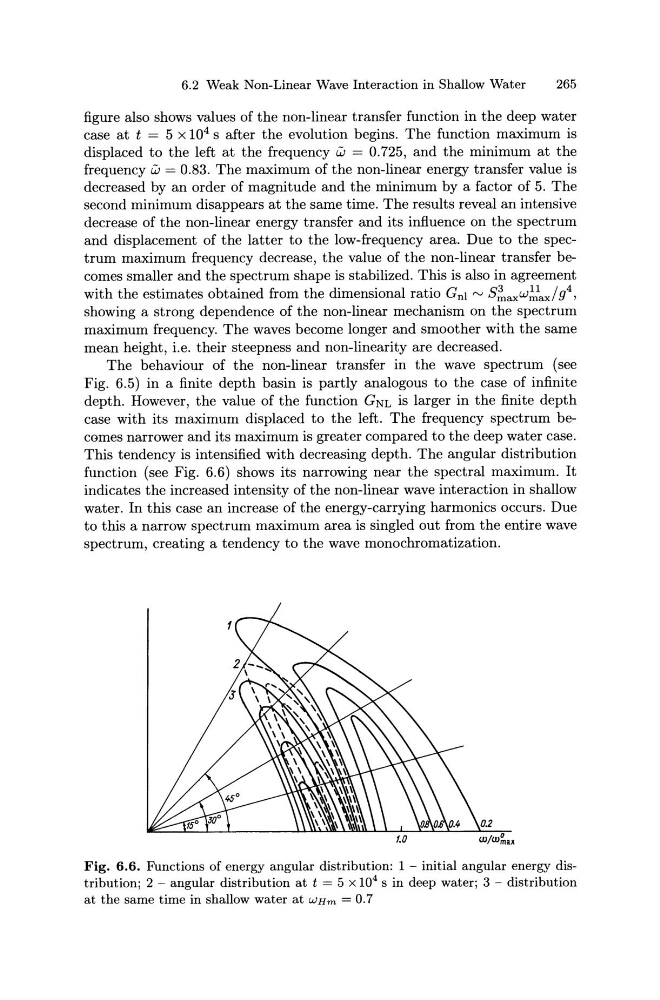
case with its maximum displaced to the left. The frequency spectrum becomes narrower and its maximum is greater compared to the deep water case.
This tendency is intensified with decreasing depth. The angular distribution
function (see Fig. 6.6) shows its narrowing near the spectral maximum. It
indicates the increased intensity of the non-linear wave interaction in shallow
water. In this case an increase of the energy-carrying harmonics occurs. Due
to this a narrow spectrum maximum area is singled out from the entire wave
spectrum, creating a tendency to the wave monochromatization.
0.2
Fig. 6.6. Functions of energy angular distribution: 1 - initial angular energy distribution; 2 - angular distribution at t = 5 X 10 4 s in deep water; 3 - distribution
at the same time in shallow water at WHm = 0.7
265
figure also shows values of the non-linear transfer function in the deep water
case at t = 5 x 10 4 s after the evolution begins. The function maximum is
displaced to the left at the frequency w = 0. 725, and the minimum at the
frequency w = 0.83. The maximum of the non-linear energy transfer value is
decreased by an order of magnitude and the minimum by a factor of 5. The
second minimum disappears at the same time. The results reveal an intensive
decrease of the non-linear energy transfer and its influence on the spectrum
and displacement of the latter to the low-frequency area. Due to the spectrum maximum frequency decrease, the value of the non-linear transfer becomes smaller and the spectrum shape is stabilized. This is also in agreement
with the estimates obtained from the dimensional ratio Gnl "' S~axw~ax/ g 4 ,
showing a strong dependence of the non-linear mechanism on the spectrum
maximum frequency. The waves become longer and smoother with the same
mean height, i.e. their steepness and non-linearity are decreased.
The behaviour of the non-linear transfer in the wave spectrum (see
Fig. 6.5) in a finite depth basin is partly analogous to the case of infinite
depth. However, the value of the function GNL is larger in the finite depth
case with its maximum displaced to the left. The frequency spectrum becomes narrower and its maximum is greater compared to the deep water case.
This tendency is intensified with decreasing depth. The angular distribution
function (see Fig. 6.6) shows its narrowing near the spectral maximum. It
indicates the increased intensity of the non-linear wave interaction in shallow
water. In this case an increase of the energy-carrying harmonics occurs. Due
to this a narrow spectrum maximum area is singled out from the entire wave
spectrum, creating a tendency to the wave monochromatization.
0.2
Fig. 6.6. Functions of energy angular distribution: 1 - initial angular energy distribution; 2 - angular distribution at t = 5 X 10 4 s in deep water; 3 - distribution
at the same time in shallow water at WHm = 0.7