

6.1 Spectrum Transformation Due to Wave Refraction in Shallow Water
259
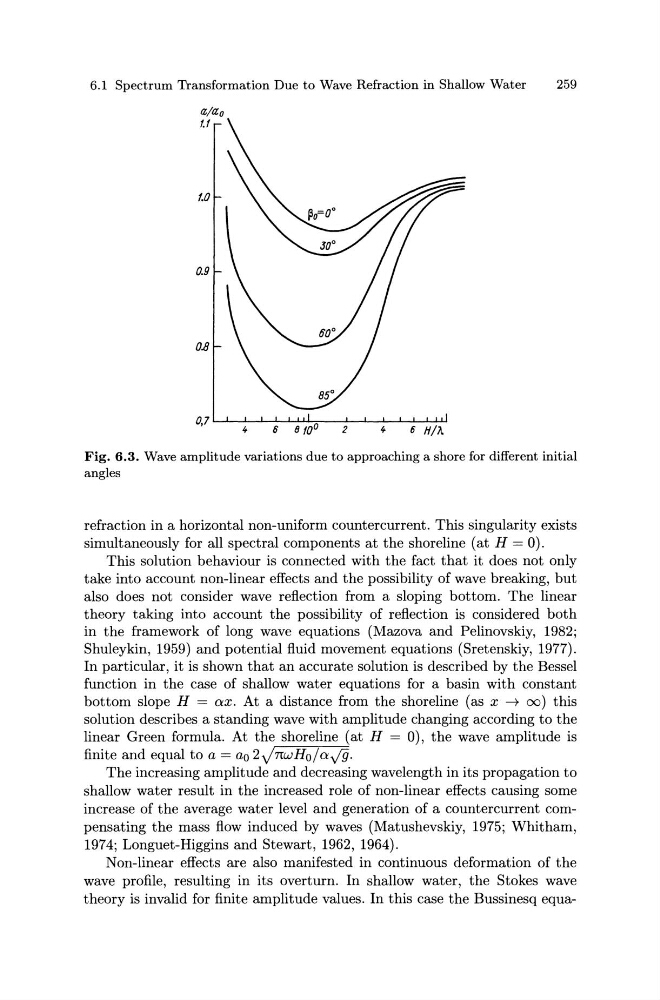
Fig. 6.3. Wave amplitude variations due to approaching a shore for different initial
angles
refraction in a horizontal non-uniform countercurrent. This singularity exists
simultaneously for all spectral components at the shoreline (at H = 0).
This solution behaviour is connected with the fact that it does not only
take into account non-linear effects and the possibility of wave breaking, but
also does not consider wave reflection from a sloping bottom. The linear
theory taking into account the possibility of reflection is considered both
in the framework of long wave equations (Mazova and Pelinovskiy, 1982;
Shuleykin, 1959) and potential fluid movement equations (Sretenskiy, 1977).
In particular, it is shown that an accurate solution is described by the Bessel
function in the case of shallow water equations for a basin with constant
bottom slope H = ax. At a distance from the shoreline (as x -+ oo) this
solution describes a standing wave with amplitude changing according to the
linear Green formula. At the shoreline (at H = 0), the wave amplitude is
finite and equal to a= ao 2JnwHo/a.j9.
The increasing amplitude and decreasing wavelength in its propagation to
shallow water result in the increased role of non-linear effects causing some
increase of the average water level and generation of a countercurrent compensating the mass flow induced by waves (Matushevskiy, 1975; Whitham,
1974; Longuet-Higgins and Stewart, 1962, 1964).
Non-linear effects are also manifested in continuous deformation of the
wave profile, resulting in its overturn. In shallow water, the Stokes wave
theory is invalid for finite amplitude values. In this case the Bussinesq equa-
259
Fig. 6.3. Wave amplitude variations due to approaching a shore for different initial
angles
refraction in a horizontal non-uniform countercurrent. This singularity exists
simultaneously for all spectral components at the shoreline (at H = 0).
This solution behaviour is connected with the fact that it does not only
take into account non-linear effects and the possibility of wave breaking, but
also does not consider wave reflection from a sloping bottom. The linear
theory taking into account the possibility of reflection is considered both
in the framework of long wave equations (Mazova and Pelinovskiy, 1982;
Shuleykin, 1959) and potential fluid movement equations (Sretenskiy, 1977).
In particular, it is shown that an accurate solution is described by the Bessel
function in the case of shallow water equations for a basin with constant
bottom slope H = ax. At a distance from the shoreline (as x -+ oo) this
solution describes a standing wave with amplitude changing according to the
linear Green formula. At the shoreline (at H = 0), the wave amplitude is
finite and equal to a= ao 2JnwHo/a.j9.
The increasing amplitude and decreasing wavelength in its propagation to
shallow water result in the increased role of non-linear effects causing some
increase of the average water level and generation of a countercurrent compensating the mass flow induced by waves (Matushevskiy, 1975; Whitham,
1974; Longuet-Higgins and Stewart, 1962, 1964).
Non-linear effects are also manifested in continuous deformation of the
wave profile, resulting in its overturn. In shallow water, the Stokes wave
theory is invalid for finite amplitude values. In this case the Bussinesq equa-