

260
6 Wave Transformation in Shallow Water
tions should be used as the basic ones. They are valid for rather small and
smoothly changing depth. The Bussinesq non-linear dispersion equations describe knoidal and solitary waves propagating from sea to shallow water.
This problem is investigated with the help of analyses of finite amplitude
wave refraction above a rough bottom. A method similar to non-linear geometrical acoustics, but generalized for the dispersed medium, is used by
Ostrovskii & Pelinovskii (1975).
In the case of waves propagating to deep water, there is the possibility of
the appearance of caustics at some distance from the shoreline (at x = x*).
After turning at the point x = x*, the wave begins propagating in the opposite direction, i.e. to the shore. The angle of wave propagation direction
is determined by the ratio (6.3), from which the location of the caustic as
sin ((3*) = 1 or c (x*) = c0 / sin ((30 ) can be determined. The basin depth at
this point is equal to:
H = H* = ~arcth ( kyc5 ) ,
ky
g sin 2 (fJo)
(6.14)
which can be written asH*= H/ sin 2 ((30 ) in the shallow water case.
The wave amplitude at a caustic tends to infinity, as follows, for example,
from (6.12) when cos ((3) = 0 in the frame of the geometrical optics approximation. The asymptotic method presented in Sect. 5.6 can be easily used for
estimating a wave field near such caustics. The free water surface can be presented in the form (5.47), where a= a0 = const and F = y'gkth(kH(x)).
Proceeding from (5.52), the formula for the maximum wave amplitude
near caustics can be written as:
where
8F 8H - 6 82 F -,
1
1 I
amax = 1.69aojiC:I ( 8H 8x)
( 8k'i)
x=x• '
8 2 F
c
--=..1!..·
8k'i
k '
8F
1
gk
8H
2 cch 2 (kH)
(6.15)
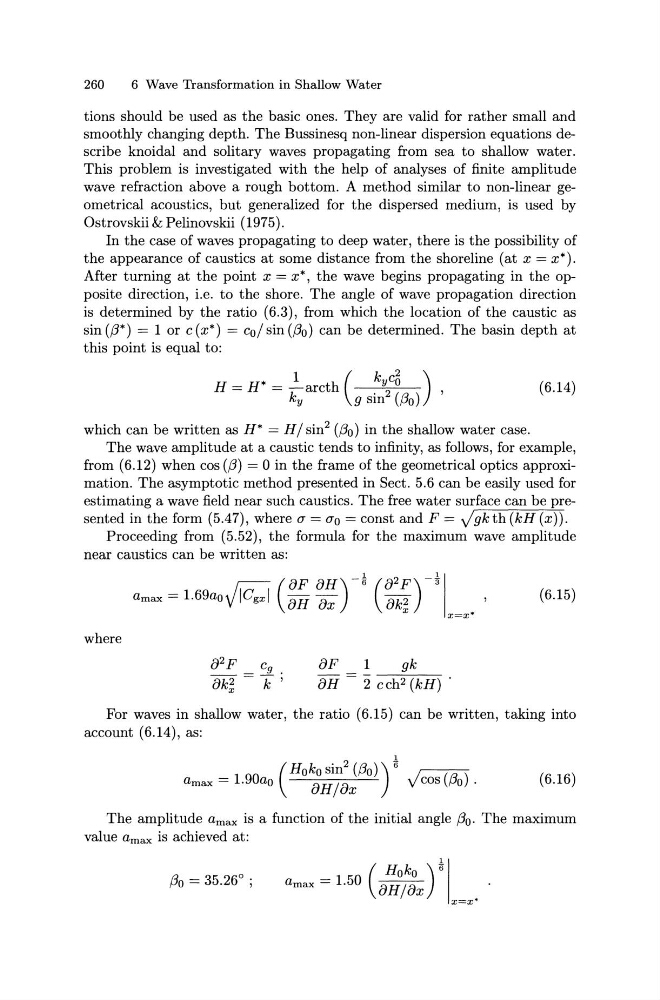
For waves in shallow water, the ratio (6.15) can be written, taking into
account (6.14), as:
1
amax = 1.90ao ( Ho~:;;;fJo))
6 y'cos ((30 ).
(6.16)
The amplitude amax is a function of the initial angle (30 . The maximum
value amax is achieved at:
(30 = 35.26° ;
6 Wave Transformation in Shallow Water
tions should be used as the basic ones. They are valid for rather small and
smoothly changing depth. The Bussinesq non-linear dispersion equations describe knoidal and solitary waves propagating from sea to shallow water.
This problem is investigated with the help of analyses of finite amplitude
wave refraction above a rough bottom. A method similar to non-linear geometrical acoustics, but generalized for the dispersed medium, is used by
Ostrovskii & Pelinovskii (1975).
In the case of waves propagating to deep water, there is the possibility of
the appearance of caustics at some distance from the shoreline (at x = x*).
After turning at the point x = x*, the wave begins propagating in the opposite direction, i.e. to the shore. The angle of wave propagation direction
is determined by the ratio (6.3), from which the location of the caustic as
sin ((3*) = 1 or c (x*) = c0 / sin ((30 ) can be determined. The basin depth at
this point is equal to:
H = H* = ~arcth ( kyc5 ) ,
ky
g sin 2 (fJo)
(6.14)
which can be written asH*= H/ sin 2 ((30 ) in the shallow water case.
The wave amplitude at a caustic tends to infinity, as follows, for example,
from (6.12) when cos ((3) = 0 in the frame of the geometrical optics approximation. The asymptotic method presented in Sect. 5.6 can be easily used for
estimating a wave field near such caustics. The free water surface can be presented in the form (5.47), where a= a0 = const and F = y'gkth(kH(x)).
Proceeding from (5.52), the formula for the maximum wave amplitude
near caustics can be written as:
where
8F 8H - 6 82 F -,
1
1 I
amax = 1.69aojiC:I ( 8H 8x)
( 8k'i)
x=x• '
8 2 F
c
--=..1!..·
8k'i
k '
8F
1
gk
8H
2 cch 2 (kH)
(6.15)
For waves in shallow water, the ratio (6.15) can be written, taking into
account (6.14), as:
1
amax = 1.90ao ( Ho~:;;;fJo))
6 y'cos ((30 ).
(6.16)
The amplitude amax is a function of the initial angle (30 . The maximum
value amax is achieved at:
(30 = 35.26° ;