

258
6 Wave Transformation in Shallow Water
searchers use these measurements for analysing wind wave properties in deep
sea areas (Kostichkova et al., 1990). The frequency spectra obtained using
these measurements are often identified with deep-water spectra without sufficient justification. However, even in the same wind the spectra and other
statistical characteristics far from the coast (in deep water) and near it (in
the coastal area) are different. The results of a linear wave refraction theory,
showing the connection of frequency-angular spectra at two different depth
points, can be used to solve the problem of recalculating the wind wave spectra in the coastal to deep-water areas. However, the validity of this approach
is admissible if the isobaths are rectilinear and the wave fetch between the
points in deep and shallow water is so small that wave generation by wind,
dissipation due to bottom friction and non-linear wave interaction do not
essentially affect the wave spectrum variation.
Wave parameter evolution in a coastal area. The solution (6.8) allows
easily obtaining the ratios describing the evolution of mean wave components
in shallow water. In the general case the spectral expression (6.8) is integrated
over the frequencies w and the directions (3.
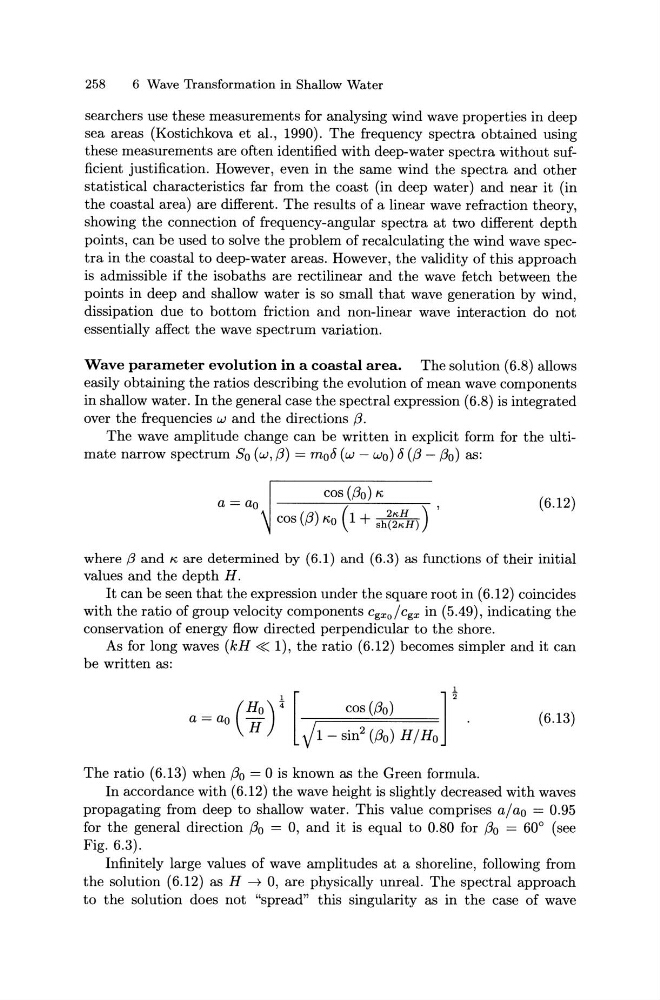
The wave amplitude change can be written in explicit form for the ultimate narrow spectrum 50 (w, (3) = m 0 15 (w- w0 ) 15 ((3- (30 ) as:
a= a0
cos ((30 ) ~
(6.12)
(
2~
values and the depth H.
It can be seen that the expression under the square root in (6.12) coincides
with the ratio of group velocity components Cgx 0 /Cgx in (5.49), indicating the
conservation of energy flow directed perpendicular to the shore.
As for long waves (kH « 1), the ratio (6.12) becomes simpler and it can
be written as:
(6.13)
The ratio (6.13) when (30 = 0 is known as the Green formula.
In accordance with (6.12) the wave height is slightly decreased with waves
propagating from deep to shallow water. This value comprises aja0 = 0.95
for the general direction (30 = 0, and it is equal to 0.80 for (30 = 60° (see
Fig. 6.3).
Infinitely large values of wave amplitudes at a shoreline, following from
the solution (6.12) as H ---+ 0, are physically unreal. The spectral approach
to the solution does not "spread" this singularity as in the case of wave
6 Wave Transformation in Shallow Water
searchers use these measurements for analysing wind wave properties in deep
sea areas (Kostichkova et al., 1990). The frequency spectra obtained using
these measurements are often identified with deep-water spectra without sufficient justification. However, even in the same wind the spectra and other
statistical characteristics far from the coast (in deep water) and near it (in
the coastal area) are different. The results of a linear wave refraction theory,
showing the connection of frequency-angular spectra at two different depth
points, can be used to solve the problem of recalculating the wind wave spectra in the coastal to deep-water areas. However, the validity of this approach
is admissible if the isobaths are rectilinear and the wave fetch between the
points in deep and shallow water is so small that wave generation by wind,
dissipation due to bottom friction and non-linear wave interaction do not
essentially affect the wave spectrum variation.
Wave parameter evolution in a coastal area. The solution (6.8) allows
easily obtaining the ratios describing the evolution of mean wave components
in shallow water. In the general case the spectral expression (6.8) is integrated
over the frequencies w and the directions (3.
The wave amplitude change can be written in explicit form for the ultimate narrow spectrum 50 (w, (3) = m 0 15 (w- w0 ) 15 ((3- (30 ) as:
a= a0
cos ((30 ) ~
(6.12)
(
2~
values and the depth H.
It can be seen that the expression under the square root in (6.12) coincides
with the ratio of group velocity components Cgx 0 /Cgx in (5.49), indicating the
conservation of energy flow directed perpendicular to the shore.
As for long waves (kH « 1), the ratio (6.12) becomes simpler and it can
be written as:
(6.13)
The ratio (6.13) when (30 = 0 is known as the Green formula.
In accordance with (6.12) the wave height is slightly decreased with waves
propagating from deep to shallow water. This value comprises aja0 = 0.95
for the general direction (30 = 0, and it is equal to 0.80 for (30 = 60° (see
Fig. 6.3).
Infinitely large values of wave amplitudes at a shoreline, following from
the solution (6.12) as H ---+ 0, are physically unreal. The spectral approach
to the solution does not "spread" this singularity as in the case of wave