

6.1 Spectrum Transformation Due to Wave Refraction in Shallow Water
257
2
S(w,p) m·s
10 b) p=JOo
5
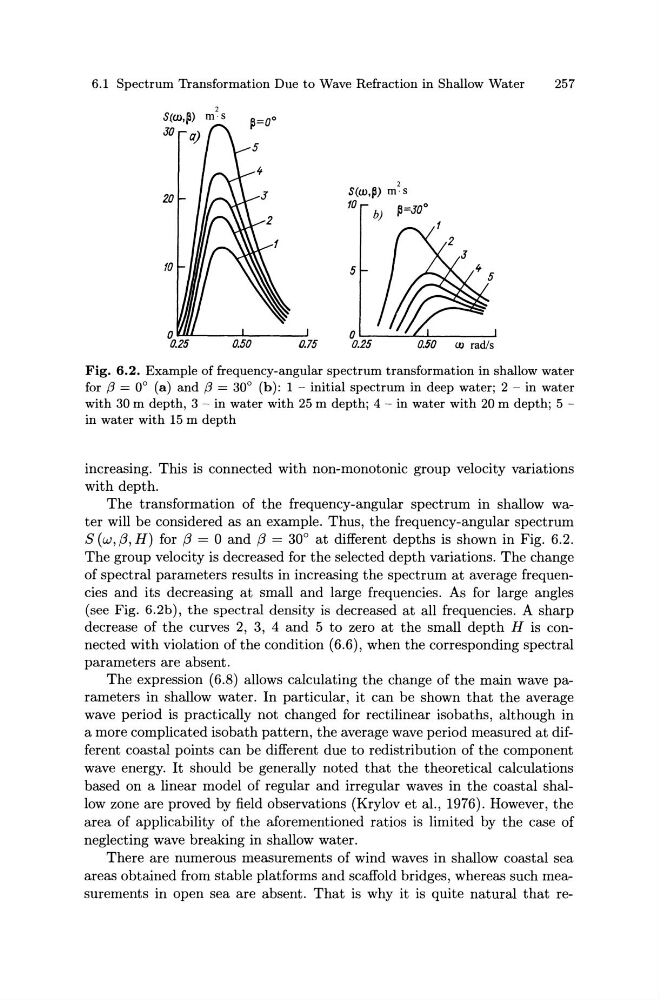
Fig. 6.2. Example of frequency-angular spectrum transformation in shallow water
for fJ = 0° (a) and fJ = 30° (b): 1 -initial spectrum in deep water; 2- in water
with 30 m depth, 3 - in water with 25 m depth; 4 - in water with 20 m depth; 5 -
in water with 15 m depth
increasing. This is connected with non-monotonic group velocity variations
with depth.
The transformation of the frequency-angular spectrum in shallow water will be considered as an example. Thus, the frequency-angular spectrum
S (w, {3, H) for {3 = 0 and {3 = 30° at different depths is shown in Fig. 6.2.
The group velocity is decreased for the selected depth variations. The change
of spectral parameters results in increasing the spectrum at average frequencies and its decreasing at small and large frequencies. As for large angles
(see Fig. 6.2b), the spectral density is decreased at all frequencies. A sharp
decrease of the curves 2, 3, 4 and 5 to zero at the small depth H is connected with violation of the condition (6.6), when the corresponding spectral
parameters are absent.
The expression (6.8) allows calculating the change of the main wave parameters in shallow water. In particular, it can be shown that the average
wave period is practically not changed for rectilinear isobaths, although in
a more complicated isobath pattern, the average wave period measured at different coastal points can be different due to redistribution of the component
wave energy. It should be generally noted that the theoretical calculations
based on a linear model of regular and irregular waves in the coastal shallow zone are proved by field observations (Krylov et al., 1976). However, the
area of applicability of the aforementioned ratios is limited by the case of
neglecting wave breaking in shallow water.
There are numerous measurements of wind waves in shallow coastal sea
areas obtained from stable platforms and scaffold bridges, whereas such measurements in open sea are absent. That is why it is quite natural that re-
257
2
S(w,p) m·s
10 b) p=JOo
5
Fig. 6.2. Example of frequency-angular spectrum transformation in shallow water
for fJ = 0° (a) and fJ = 30° (b): 1 -initial spectrum in deep water; 2- in water
with 30 m depth, 3 - in water with 25 m depth; 4 - in water with 20 m depth; 5 -
in water with 15 m depth
increasing. This is connected with non-monotonic group velocity variations
with depth.
The transformation of the frequency-angular spectrum in shallow water will be considered as an example. Thus, the frequency-angular spectrum
S (w, {3, H) for {3 = 0 and {3 = 30° at different depths is shown in Fig. 6.2.
The group velocity is decreased for the selected depth variations. The change
of spectral parameters results in increasing the spectrum at average frequencies and its decreasing at small and large frequencies. As for large angles
(see Fig. 6.2b), the spectral density is decreased at all frequencies. A sharp
decrease of the curves 2, 3, 4 and 5 to zero at the small depth H is connected with violation of the condition (6.6), when the corresponding spectral
parameters are absent.
The expression (6.8) allows calculating the change of the main wave parameters in shallow water. In particular, it can be shown that the average
wave period is practically not changed for rectilinear isobaths, although in
a more complicated isobath pattern, the average wave period measured at different coastal points can be different due to redistribution of the component
wave energy. It should be generally noted that the theoretical calculations
based on a linear model of regular and irregular waves in the coastal shallow zone are proved by field observations (Krylov et al., 1976). However, the
area of applicability of the aforementioned ratios is limited by the case of
neglecting wave breaking in shallow water.
There are numerous measurements of wind waves in shallow coastal sea
areas obtained from stable platforms and scaffold bridges, whereas such measurements in open sea are absent. That is why it is quite natural that re-