

232
5 Wave Evolution in Non-uniform Currents in Deep Water
w, rads-'
2.00
1.50
1.00
0.50
M1
0.50
=-- =o. :..Vm.=- Jms-'
"""':-..
- - 1 Vm.=-1,54ms-'
----2
- · - J
-·
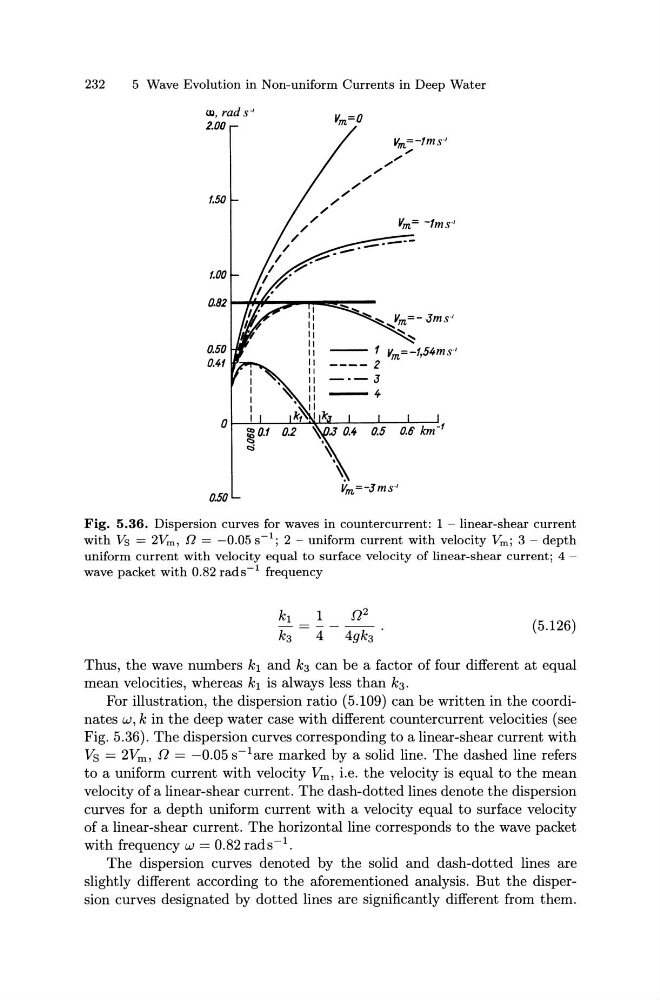
Fig. 5.36. Dispersion curves for waves in countercurrent: 1 -linear-shear current
with Vs = 2Vm, n = -0.05 s-\ 2 - uniform current with velocity Vm; 3 - depth
uniform current with velocity equal to surface velocity of linear-shear current; 4 -
wave packet with 0.82 rads- 1 frequency
1
JJ2
- - - -
4
4gk3 °
(5.126)
Thus, the wave numbers k1 and k3 can be a factor of four different at equal
mean velocities, whereas k1 is always less than k3 •
For illustration, the dispersion ratio (5.109) can be written in the coordinates w, kin the deep water case with different countercurrent velocities (see
Fig. 5.36). The dispersion curves corresponding to a linear-shear current with
Vs = 2Vm, n = -0.05 s- 1 are marked by a solid line. The dashed line refers
to a uniform current with velocity Vm, i.e. the velocity is equal to the mean
velocity of a linear-shear current. The dash-dotted lines denote the dispersion
curves for a depth uniform current with a velocity equal to surface velocity
of a linear-shear current. The horizontal line corresponds to the wave packet
with frequency w = 0.82 rads- 1 .
The dispersion curves denoted by the solid and dash-dotted lines are
slightly different according to the aforementioned analysis. But the dispersion curves designated by dotted lines are significantly different from them.
5 Wave Evolution in Non-uniform Currents in Deep Water
w, rads-'
2.00
1.50
1.00
0.50
M1
0.50
=-- =o. :..Vm.=- Jms-'
"""':-..
- - 1 Vm.=-1,54ms-'
----2
- · - J
-·
Fig. 5.36. Dispersion curves for waves in countercurrent: 1 -linear-shear current
with Vs = 2Vm, n = -0.05 s-\ 2 - uniform current with velocity Vm; 3 - depth
uniform current with velocity equal to surface velocity of linear-shear current; 4 -
wave packet with 0.82 rads- 1 frequency
1
JJ2
- - - -
4
4gk3 °
(5.126)
Thus, the wave numbers k1 and k3 can be a factor of four different at equal
mean velocities, whereas k1 is always less than k3 •
For illustration, the dispersion ratio (5.109) can be written in the coordinates w, kin the deep water case with different countercurrent velocities (see
Fig. 5.36). The dispersion curves corresponding to a linear-shear current with
Vs = 2Vm, n = -0.05 s- 1 are marked by a solid line. The dashed line refers
to a uniform current with velocity Vm, i.e. the velocity is equal to the mean
velocity of a linear-shear current. The dash-dotted lines denote the dispersion
curves for a depth uniform current with a velocity equal to surface velocity
of a linear-shear current. The horizontal line corresponds to the wave packet
with frequency w = 0.82 rads- 1 .
The dispersion curves denoted by the solid and dash-dotted lines are
slightly different according to the aforementioned analysis. But the dispersion curves designated by dotted lines are significantly different from them.