

5.9 Vertical Non-Uniform Current Effect
231
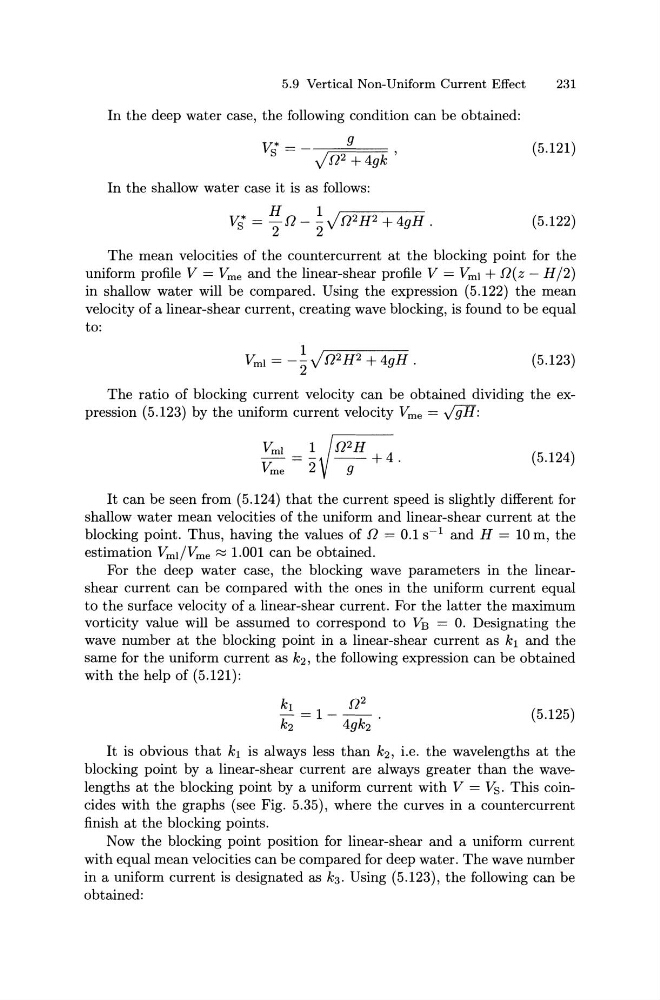
In the deep water case, the following condition can be obtained:
V;*-g
s- Jn2 +4gk'
(5.121)
In the shallow water case it is as follows:
H
1
V 8 * = -n- -Jn2H2 + 4gH.
2
2
(5.122)
The mean velocities of the countercurrent at the blocking point for the
uniform profile V = Vme and the linear-shear profile V = Vmi + il(z- H/2)
in shallow water will be compared. Using the expression (5.122) the mean
velocity of a linear-shear current, creating wave blocking, is found to be equal
to:
(5.123)
The ratio of blocking current velocity can be obtained dividing the expression (5.123) by the uniform current velocity Vme = y'gH:
Vmi = !jil
2
H + 4 .
Vme
2
g
(5.124)
It can be seen from (5.124) that the current speed is slightly different for
shallow water mean velocities of the uniform and linear-shear current at the
blocking point. Thus, having the values of il = 0.1 s- 1 and H = 10m, the
estimation VmJ/Vme ~ 1.001 can be obtained.
For the deep water case, the blocking wave parameters in the linearshear current can be compared with the ones in the uniform current equal
to the surface velocity of a linear-shear current. For the latter the maximum
vorticity value will be assumed to correspond to VB = 0. Designating the
wave number at the blocking point in a linear-shear current as k1 and the
same for the uniform current as k2, the following expression can be obtained
with the help of (5.121):
kl
il 2
- = 1 - - .
k2
4gk2
(5.125)
It is obvious that k1 is always less than k2, i.e. the wavelengths at the
blocking point by a linear-shear current are always greater than the wavelengths at the blocking point by a uniform current with V = Vs. This coincides with the graphs (see Fig. 5.35), where the curves in a countercurrent
finish at the blocking points.
Now the blocking point position for linear-shear and a uniform current
with equal mean velocities can be compared for deep water. The wave number
in a uniform current is designated as k3 . Using (5.123), the following can be
obtained:
231
In the deep water case, the following condition can be obtained:
V;*-g
s- Jn2 +4gk'
(5.121)
In the shallow water case it is as follows:
H
1
V 8 * = -n- -Jn2H2 + 4gH.
2
2
(5.122)
The mean velocities of the countercurrent at the blocking point for the
uniform profile V = Vme and the linear-shear profile V = Vmi + il(z- H/2)
in shallow water will be compared. Using the expression (5.122) the mean
velocity of a linear-shear current, creating wave blocking, is found to be equal
to:
(5.123)
The ratio of blocking current velocity can be obtained dividing the expression (5.123) by the uniform current velocity Vme = y'gH:
Vmi = !jil
2
H + 4 .
Vme
2
g
(5.124)
It can be seen from (5.124) that the current speed is slightly different for
shallow water mean velocities of the uniform and linear-shear current at the
blocking point. Thus, having the values of il = 0.1 s- 1 and H = 10m, the
estimation VmJ/Vme ~ 1.001 can be obtained.
For the deep water case, the blocking wave parameters in the linearshear current can be compared with the ones in the uniform current equal
to the surface velocity of a linear-shear current. For the latter the maximum
vorticity value will be assumed to correspond to VB = 0. Designating the
wave number at the blocking point in a linear-shear current as k1 and the
same for the uniform current as k2, the following expression can be obtained
with the help of (5.121):
kl
il 2
- = 1 - - .
k2
4gk2
(5.125)
It is obvious that k1 is always less than k2, i.e. the wavelengths at the
blocking point by a linear-shear current are always greater than the wavelengths at the blocking point by a uniform current with V = Vs. This coincides with the graphs (see Fig. 5.35), where the curves in a countercurrent
finish at the blocking points.
Now the blocking point position for linear-shear and a uniform current
with equal mean velocities can be compared for deep water. The wave number
in a uniform current is designated as k3 . Using (5.123), the following can be
obtained: