

5.9 Vertical Non-Uniform Current Effect
233
The blocking of waves with frequency w = 0.82 rads- 1 takes place for
a linear-shear current at Vm ~ -1.5 ms- 1 , and for a uniform current at
Vm ~ -3 ms- 1 , i.e. twice as great as the absolute value. But the wave numbers at the blocking point are approximately equal. The linear-shear current
with mean velocity Vm ~ -3 ms- 1 blocks a wave with half the frequency,
whereas the wave number at the blocking point is approximately a third of
its value in a uniform current.
As shown, the current velocity depth shear significantly affects the wave
transformation in deep water. It is not enough to characterize the current
only by the surface velocity in solving problems of wave-current interaction
in deep water. It is also necessary to estimate the velocity depth shear. In
shallow water, the effect of velocity shear can be neglected in comparison
with the current effect. That is why it is admissible in this case to describe
the current using only the surface velocity or the average depth velocity.
Approximate wave dispersion ratio for an arbitrary vertical current velocity profile.
The simplest case of a vertical current profile is
considered above. But, in most cases, it is rather difficult to find an exact
solution.
That is why it is interesting to discuss a method for obtaining approximated dispersion formulas for arbitrary vertical current velocity profiles. It
was proposed by Stewart and Joy (1974) and elaborated by Skop (1987) and
Kirby and Chen (1989). The value Vjc :s; 0(1) is taken as a small parameter for solving the initial problem (5.105)-(5.107) using the perturbation
method.
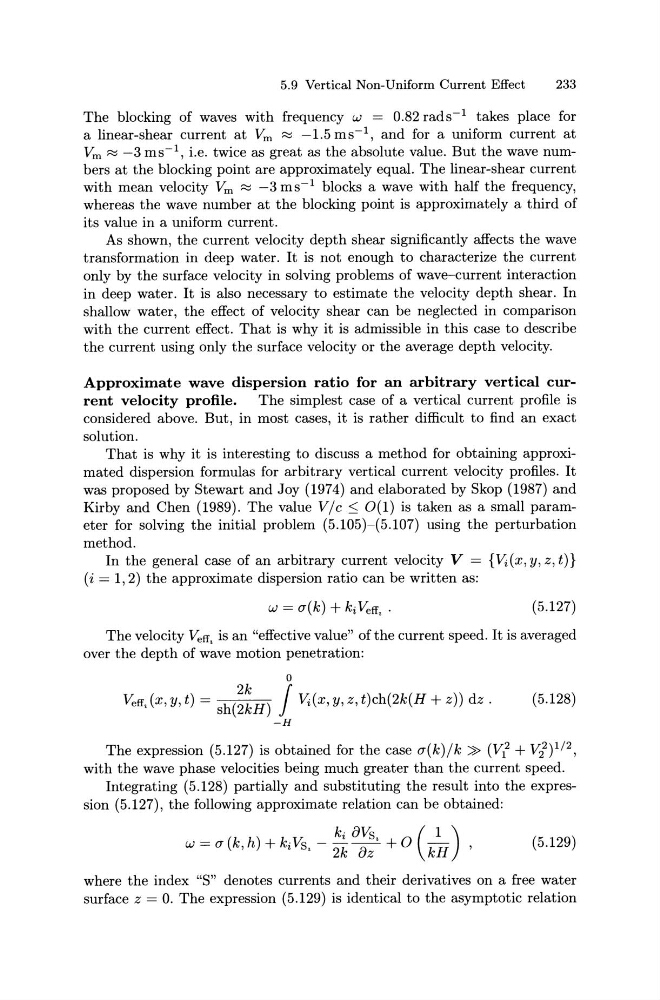
In the general case of an arbitrary current velocity V = {Vi(x, y, z, t)}
(i = 1, 2) the approximate dispersion ratio can be written as:
(5.127)
The velocity Veff, is an "effective value" of the current speed. It is averaged
over the depth of wave motion penetration:
0
2k
J
Veff, (x, y, t) = sh( 2 kH)
Vi(x, y, z, t)ch(2k(H + z)) dz.
(5.128)
-H
The expression (5.127) is obtained for the case O'(k)/k » (Vl + V 2 2 ) 1 1 2 ,
with the wave phase velocities being much greater than the current speed.
Integrating (5.128) partially and substituting the result into the expression (5.127), the following approximate relation can be obtained:
ki aVs,
( 1 )
w = (J' (k, h)+ ki Vs,- 2 k 8z + 0 kH ,
(5.129)
where the index "S" denotes currents and their derivatives on a free water
surface z = 0. The expression (5.129) is identical to the asymptotic relation
233
The blocking of waves with frequency w = 0.82 rads- 1 takes place for
a linear-shear current at Vm ~ -1.5 ms- 1 , and for a uniform current at
Vm ~ -3 ms- 1 , i.e. twice as great as the absolute value. But the wave numbers at the blocking point are approximately equal. The linear-shear current
with mean velocity Vm ~ -3 ms- 1 blocks a wave with half the frequency,
whereas the wave number at the blocking point is approximately a third of
its value in a uniform current.
As shown, the current velocity depth shear significantly affects the wave
transformation in deep water. It is not enough to characterize the current
only by the surface velocity in solving problems of wave-current interaction
in deep water. It is also necessary to estimate the velocity depth shear. In
shallow water, the effect of velocity shear can be neglected in comparison
with the current effect. That is why it is admissible in this case to describe
the current using only the surface velocity or the average depth velocity.
Approximate wave dispersion ratio for an arbitrary vertical current velocity profile.
The simplest case of a vertical current profile is
considered above. But, in most cases, it is rather difficult to find an exact
solution.
That is why it is interesting to discuss a method for obtaining approximated dispersion formulas for arbitrary vertical current velocity profiles. It
was proposed by Stewart and Joy (1974) and elaborated by Skop (1987) and
Kirby and Chen (1989). The value Vjc :s; 0(1) is taken as a small parameter for solving the initial problem (5.105)-(5.107) using the perturbation
method.
In the general case of an arbitrary current velocity V = {Vi(x, y, z, t)}
(i = 1, 2) the approximate dispersion ratio can be written as:
(5.127)
The velocity Veff, is an "effective value" of the current speed. It is averaged
over the depth of wave motion penetration:
0
2k
J
Veff, (x, y, t) = sh( 2 kH)
Vi(x, y, z, t)ch(2k(H + z)) dz.
(5.128)
-H
The expression (5.127) is obtained for the case O'(k)/k » (Vl + V 2 2 ) 1 1 2 ,
with the wave phase velocities being much greater than the current speed.
Integrating (5.128) partially and substituting the result into the expression (5.127), the following approximate relation can be obtained:
ki aVs,
( 1 )
w = (J' (k, h)+ ki Vs,- 2 k 8z + 0 kH ,
(5.129)
where the index "S" denotes currents and their derivatives on a free water
surface z = 0. The expression (5.129) is identical to the asymptotic relation