

216
5 Wave Evolution in Non-uniform Currents in Deep Water
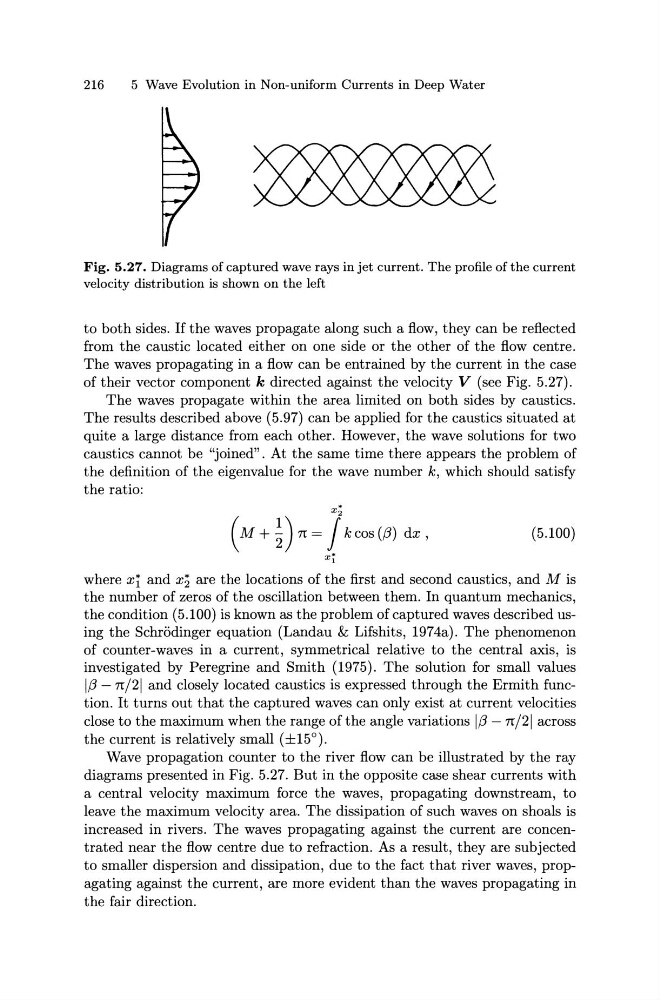
Fig. 5.27. Diagrams of captured wave rays in jet current. The profile of the current
velocity distribution is shown on the left
to both sides. If the waves propagate along such a flow, they can be reflected
from the caustic located either on one side or the other of the flow centre.
The waves propagating in a flow can be entrained by the current in the case
of their vector component k directed against the velocity V (see Fig. 5.27).
The waves propagate within the area limited on both sides by caustics.
The results described above (5.97) can be applied for the caustics situated at
quite a large distance from each other. However, the wave solutions for two
caustics cannot be "joined". At the same time there appears the problem of
the definition of the eigenvalue for the wave number k, which should satisfy
the ratio:
x;
( M + ~) 7t = J k cos (!3) dx ,
(5.100)
xr
where xi and x2 are the locations of the first and second caustics, and M is
the number of zeros of the oscillation between them. In quantum mechanics,
the condition (5.100) is known as the problem of captured waves described using the Schrodinger equation (Landau & Lifshits, 1974a). The phenomenon
of counter-waves in a current, symmetrical relative to the central axis, is
investigated by Peregrine and Smith (1975). The solution for small values
1!3- n/21 and closely located caustics is expressed through the Ermith function. It turns out that the captured waves can only exist at current velocities
close to the maximum when the range of the angle variations 1!3- n/21 across
the current is relatively small (±15°).
Wave propagation counter to the river flow can be illustrated by the ray
diagrams presented in Fig. 5.27. But in the opposite case shear currents with
a central velocity maximum force the waves, propagating downstream, to
leave the maximum velocity area. The dissipation of such waves on shoals is
increased in rivers. The waves propagating against the current are concentrated near the flow centre due to refraction. As a result, they are subjected
to smaller dispersion and dissipation, due to the fact that river waves, propagating against the current, are more evident than the waves propagating in
the fair direction.
5 Wave Evolution in Non-uniform Currents in Deep Water
Fig. 5.27. Diagrams of captured wave rays in jet current. The profile of the current
velocity distribution is shown on the left
to both sides. If the waves propagate along such a flow, they can be reflected
from the caustic located either on one side or the other of the flow centre.
The waves propagating in a flow can be entrained by the current in the case
of their vector component k directed against the velocity V (see Fig. 5.27).
The waves propagate within the area limited on both sides by caustics.
The results described above (5.97) can be applied for the caustics situated at
quite a large distance from each other. However, the wave solutions for two
caustics cannot be "joined". At the same time there appears the problem of
the definition of the eigenvalue for the wave number k, which should satisfy
the ratio:
x;
( M + ~) 7t = J k cos (!3) dx ,
(5.100)
xr
where xi and x2 are the locations of the first and second caustics, and M is
the number of zeros of the oscillation between them. In quantum mechanics,
the condition (5.100) is known as the problem of captured waves described using the Schrodinger equation (Landau & Lifshits, 1974a). The phenomenon
of counter-waves in a current, symmetrical relative to the central axis, is
investigated by Peregrine and Smith (1975). The solution for small values
1!3- n/21 and closely located caustics is expressed through the Ermith function. It turns out that the captured waves can only exist at current velocities
close to the maximum when the range of the angle variations 1!3- n/21 across
the current is relatively small (±15°).
Wave propagation counter to the river flow can be illustrated by the ray
diagrams presented in Fig. 5.27. But in the opposite case shear currents with
a central velocity maximum force the waves, propagating downstream, to
leave the maximum velocity area. The dissipation of such waves on shoals is
increased in rivers. The waves propagating against the current are concentrated near the flow centre due to refraction. As a result, they are subjected
to smaller dispersion and dissipation, due to the fact that river waves, propagating against the current, are more evident than the waves propagating in
the fair direction.