

5.7 Wind Wave Transformation in Cross-Velocity Shear Current
215
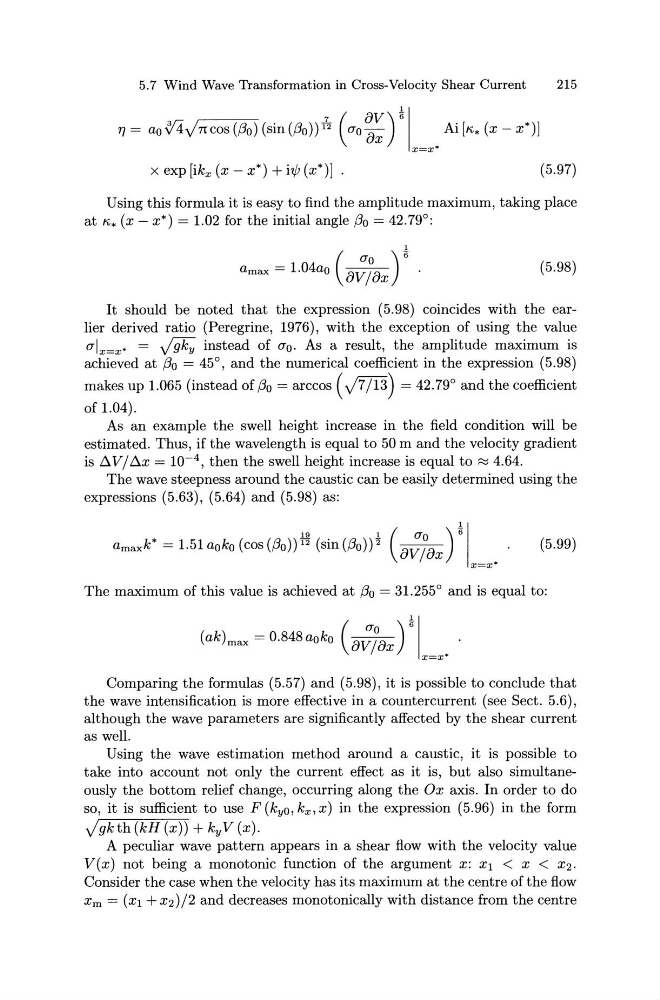
' TJ = a0V'4Jncos (;Jo)(sin (;Jo))'; (O'o ~~Yl=x* Ai [K. (x- x*)]
x exp [ikx (x- x*) + i'lj; (x*)] .
(5.97)
Using this formula it is easy to find the amplitude maximum, taking place
at "• (x- x*) = 1.02 for the initial angle ;Jo = 42.79°:
(
O"o ) i
amax = 1.04ao BV/Bx
.
(5.98)
It should be noted that the expression (5.98) coincides with the earlier derived ratio (Peregrine, 1976), with the exception of using the value
O'lx=x* = J[}k; instead of O'o. As a result, the amplitude maximum is
achieved at ;30 = 45°, and the numerical coefficient in the expression (5.98)
makes up 1.065 (instead of ;30 = arccos ( J7713) = 42.79° and the coefficient
ofl.04).
As an example the swell height increase in the field condition will be
estimated. Thus, if the wavelength is equal to 50 m and the velocity gradient
is .6..V/ .6..x = 10-4, then the swell height increase is equal to""' 4.64.
The wave steepness around the caustic can be easily determined using the
expressions (5.63), (5.64) and (5.98) as:
19
1
O'Q
6
' I
amaxk* = 1.51aoko(cos(;3o)) 12 (sin(;3o)) 2 (av;ax) x=x* (5.99)
The maximum of this value is achieved at ;30 = 31.255° and is equal to:
Comparing the formulas (5.57) and (5.98), it is possible to conclude that
the wave intensification is more effective in a countercurrent (see Sect. 5.6),
although the wave parameters are significantly affected by the shear current
as well.
Using the wave estimation method around a caustic, it is possible to
take into account not only the current effect as it is, but also simultaneously the bottom relief change, occurring along the Ox axis. In order to do
so, it is sufficient to use F (kyo, kx, x) in the expression (5.96) in the form
Jgkth (kH (x)) + ky V (x).
A peculiar wave pattern appears in a shear flow with the velocity value
V(x) not being a monotonic function of the argument x: XI < x < x2•
Consider the case when the velocity has its maximum at the centre of the flow
Xm = (XI + x2) /2 and decreases monotonically with distance from the centre
215
' TJ = a0V'4Jncos (;Jo)(sin (;Jo))'; (O'o ~~Yl=x* Ai [K. (x- x*)]
x exp [ikx (x- x*) + i'lj; (x*)] .
(5.97)
Using this formula it is easy to find the amplitude maximum, taking place
at "• (x- x*) = 1.02 for the initial angle ;Jo = 42.79°:
(
O"o ) i
amax = 1.04ao BV/Bx
.
(5.98)
It should be noted that the expression (5.98) coincides with the earlier derived ratio (Peregrine, 1976), with the exception of using the value
O'lx=x* = J[}k; instead of O'o. As a result, the amplitude maximum is
achieved at ;30 = 45°, and the numerical coefficient in the expression (5.98)
makes up 1.065 (instead of ;30 = arccos ( J7713) = 42.79° and the coefficient
ofl.04).
As an example the swell height increase in the field condition will be
estimated. Thus, if the wavelength is equal to 50 m and the velocity gradient
is .6..V/ .6..x = 10-4, then the swell height increase is equal to""' 4.64.
The wave steepness around the caustic can be easily determined using the
expressions (5.63), (5.64) and (5.98) as:
19
1
O'Q
6
' I
amaxk* = 1.51aoko(cos(;3o)) 12 (sin(;3o)) 2 (av;ax) x=x* (5.99)
The maximum of this value is achieved at ;30 = 31.255° and is equal to:
Comparing the formulas (5.57) and (5.98), it is possible to conclude that
the wave intensification is more effective in a countercurrent (see Sect. 5.6),
although the wave parameters are significantly affected by the shear current
as well.
Using the wave estimation method around a caustic, it is possible to
take into account not only the current effect as it is, but also simultaneously the bottom relief change, occurring along the Ox axis. In order to do
so, it is sufficient to use F (kyo, kx, x) in the expression (5.96) in the form
Jgkth (kH (x)) + ky V (x).
A peculiar wave pattern appears in a shear flow with the velocity value
V(x) not being a monotonic function of the argument x: XI < x < x2•
Consider the case when the velocity has its maximum at the centre of the flow
Xm = (XI + x2) /2 and decreases monotonically with distance from the centre