

5.8 Freak Wave Problem
217
5.8 Freak Wave Problem
Phenomenological review. The size, power and technical equipment on
modern ships would allow one to think that there is no danger for a ship
sailing everywhere on the ocean. Actually this is not quite so. On June 13,
1968 the Word Glory tanker (built in the USA in 1954) under the Liberian
flag, while travelling along the South African coast, encountered a freak wave,
which broke the tanker into two pieces and led to the death of 22 crew members. A number of similar cases are well known (Mallory, 1974; Sanderson,
1974; Sturm, 1974; Davidan & Lopatukhin, 1982; Lavrenov, 1985a; 1998b).
The term "freak waves" (or abnormal waves, exceptional waves, killer
waves, cape rollers and rogue waves) pertains to individual asymmetric waves
with a crest of an extremely high slope, in front of which appears a longer
and deeper trough than compared with ordinary wind waves. The height of
such waves can reach 15-20 m and more, sometimes in a relatively calm sea.
The wave often appears suddenly. That is why it is practically impossible for
a ship's crew to take any precautionary measures.
Abnormal waves are often observed frequently in different regions of the
World's oceans, with strong currents: for example, the Gulf Stream, the
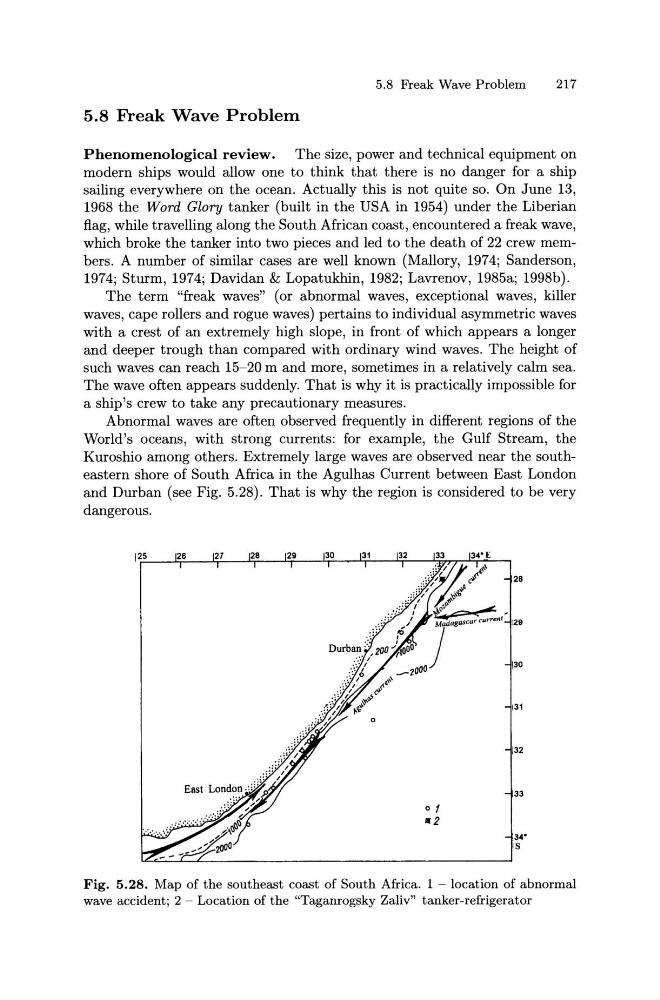
Kuroshio among others. Extremely large waves are observed near the southeastern shore of South Africa in the Agulhas Current between East London
and Durban (see Fig. 5.28). That is why the region is considered to be very
dangerous.
Fig. 5.28. Map of the southeast coast of South Africa. 1 - location of abnormal
wave accident; 2 - Location of the "Taganrogsky Zaliv" tanker-refrigerator
217
5.8 Freak Wave Problem
Phenomenological review. The size, power and technical equipment on
modern ships would allow one to think that there is no danger for a ship
sailing everywhere on the ocean. Actually this is not quite so. On June 13,
1968 the Word Glory tanker (built in the USA in 1954) under the Liberian
flag, while travelling along the South African coast, encountered a freak wave,
which broke the tanker into two pieces and led to the death of 22 crew members. A number of similar cases are well known (Mallory, 1974; Sanderson,
1974; Sturm, 1974; Davidan & Lopatukhin, 1982; Lavrenov, 1985a; 1998b).
The term "freak waves" (or abnormal waves, exceptional waves, killer
waves, cape rollers and rogue waves) pertains to individual asymmetric waves
with a crest of an extremely high slope, in front of which appears a longer
and deeper trough than compared with ordinary wind waves. The height of
such waves can reach 15-20 m and more, sometimes in a relatively calm sea.
The wave often appears suddenly. That is why it is practically impossible for
a ship's crew to take any precautionary measures.
Abnormal waves are often observed frequently in different regions of the
World's oceans, with strong currents: for example, the Gulf Stream, the
Kuroshio among others. Extremely large waves are observed near the southeastern shore of South Africa in the Agulhas Current between East London
and Durban (see Fig. 5.28). That is why the region is considered to be very
dangerous.
Fig. 5.28. Map of the southeast coast of South Africa. 1 - location of abnormal
wave accident; 2 - Location of the "Taganrogsky Zaliv" tanker-refrigerator