

12
1 General Problem Formulation
where 8ij is a single tensor (8ij = 1 for i = j, otherwise 8ij = 0); J.L is the
viscous fluid coefficient, and
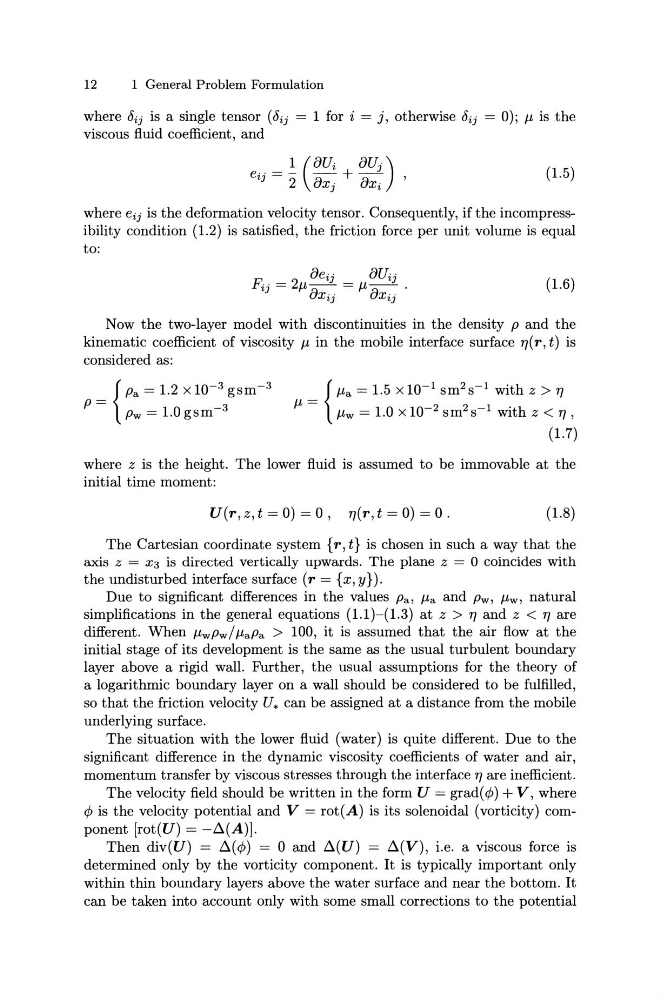
1 (aui auj)
eij = 2 8xj + 8xi '
(1.5)
where eij is the deformation velocity tensor. Consequently, if the incompressibility condition (1.2) is satisfied, the friction force per unit volume is equal
to:
(1.6)
Now the two-layer model with discontinuities in the density p and the
kinematic coefficient of viscosity J.L in the mobile interface surface ry(r, t) is
considered as:
{
Pa = 1.2 X w- 3 gsm- 3
p= Pw = 1.0 gsm- 3
_ { J.La = 1.5 X 10-l sm 2 s-l with Z > rJ
J.L- J.Lw = 1.0 X 10- 2 sm 2 s-l with Z < rJ,
(1.7)
where z is the height. The lower fluid is assumed to be immovable at the
initial time moment:
U(r,z,t=O)=O, ry(r,t=O)=O.
(1.8)
The Cartesian coordinate system { r, t} is chosen in such a way that the
axis z = x3 is directed vertically upwards. The plane z = 0 coincides with
the undisturbed interface surface ( r = { x, y}).
Due to significant differences in the values Pa, J.La and Pw, J.Lw, natural
simplifications in the general equations (1.1)-(1.3) at z > rJ and z < rJ are
different. When J.LwPw/ J.LaPa > 100, it is assumed that the air flow at the
initial stage of its development is the same as the usual turbulent boundary
layer above a rigid wall. Further, the usual assumptions for the theory of
a logarithmic boundary layer on a wall should be considered to be fulfilled,
so that the friction velocity U* can be assigned at a distance from the mobile
underlying surface.
The situation with the lower fluid (water) is quite different. Due to the
significant difference in the dynamic viscosity coefficients of water and air,
momentum transfer by viscous stresses through the interface rJ are inefficient.
The velocity field should be written in the form U = grad(¢) + V, where
¢ is the velocity potential and V = rot(A) is its solenoidal (vorticity) component [rot(U) = -~(A)].
Then div(U) = ~(¢) = 0 and ~(U) = ~(V), i.e. a viscous force is
determined only by the vorticity component. It is typically important only
within thin boundary layers above the water surface and near the bottom. It
can be taken into account only with some small corrections to the potential
1 General Problem Formulation
where 8ij is a single tensor (8ij = 1 for i = j, otherwise 8ij = 0); J.L is the
viscous fluid coefficient, and
1 (aui auj)
eij = 2 8xj + 8xi '
(1.5)
where eij is the deformation velocity tensor. Consequently, if the incompressibility condition (1.2) is satisfied, the friction force per unit volume is equal
to:
(1.6)
Now the two-layer model with discontinuities in the density p and the
kinematic coefficient of viscosity J.L in the mobile interface surface ry(r, t) is
considered as:
{
Pa = 1.2 X w- 3 gsm- 3
p= Pw = 1.0 gsm- 3
_ { J.La = 1.5 X 10-l sm 2 s-l with Z > rJ
J.L- J.Lw = 1.0 X 10- 2 sm 2 s-l with Z < rJ,
(1.7)
where z is the height. The lower fluid is assumed to be immovable at the
initial time moment:
U(r,z,t=O)=O, ry(r,t=O)=O.
(1.8)
The Cartesian coordinate system { r, t} is chosen in such a way that the
axis z = x3 is directed vertically upwards. The plane z = 0 coincides with
the undisturbed interface surface ( r = { x, y}).
Due to significant differences in the values Pa, J.La and Pw, J.Lw, natural
simplifications in the general equations (1.1)-(1.3) at z > rJ and z < rJ are
different. When J.LwPw/ J.LaPa > 100, it is assumed that the air flow at the
initial stage of its development is the same as the usual turbulent boundary
layer above a rigid wall. Further, the usual assumptions for the theory of
a logarithmic boundary layer on a wall should be considered to be fulfilled,
so that the friction velocity U* can be assigned at a distance from the mobile
underlying surface.
The situation with the lower fluid (water) is quite different. Due to the
significant difference in the dynamic viscosity coefficients of water and air,
momentum transfer by viscous stresses through the interface rJ are inefficient.
The velocity field should be written in the form U = grad(¢) + V, where
¢ is the velocity potential and V = rot(A) is its solenoidal (vorticity) component [rot(U) = -~(A)].
Then div(U) = ~(¢) = 0 and ~(U) = ~(V), i.e. a viscous force is
determined only by the vorticity component. It is typically important only
within thin boundary layers above the water surface and near the bottom. It
can be taken into account only with some small corrections to the potential