

1 General Problem Formulation of Wind Wave
Modelling in a Non-Uniform Ocean
1.1 Hydrodynamic Problem
of Surface Wave Generation by Air Flow
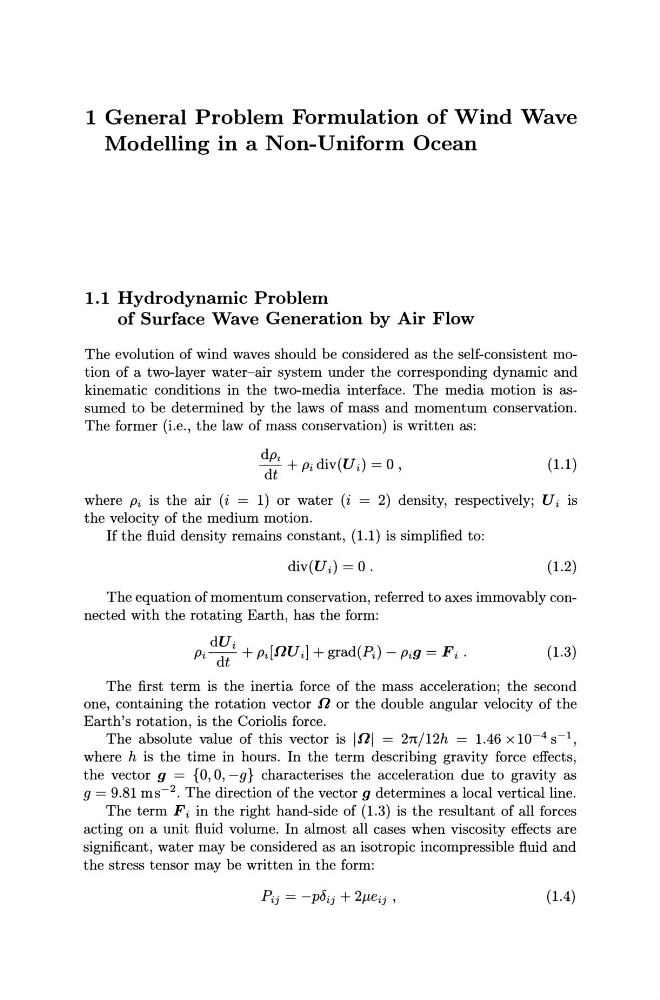
The evolution of wind waves should be considered as the self-consistent motion of a two-layer water-air system under the corresponding dynamic and
kinematic conditions in the two-media interface. The media motion is assumed to be determined by the laws of mass and momentum conservation.
The former (i.e., the law of mass conservation) is written as:
~·+Pi div(Ui) = 0,
(1.1)
where Pi is the air (i = 1) or water (i = 2) density, respectively; Ui is
the velocity of the medium motion.
If the fluid density remains constant, (1.1) is simplified to:
div(Ui) = 0.
(1.2)
The equation of momentum conservation, referred to axes immovably connected with the rotating Earth, has the form:
dU·
Pi dt' + p;[!1Ui] + grad(Pi)- PiY = Fi .
(1.3)
The first term is the inertia force of the mass acceleration; the second
one, containing the rotation vector .n or the double angular velocity of the
Earth's rotation, is the Coriolis force.
The absolute value of this vector is 1!11 = 2n/12h = 1.46 X w- 4 s- 1 '
where h is the time in hours. In the term describing gravity force effects,
the vector g = {0, 0, -g} characterises the acceleration due to gravity as
g = 9.81 ms- 2 . The direction of the vector g determines a local vertical line.
The term Fi in the right hand-side of (1.3) is the resultant of all forces
acting on a unit fluid volume. In almost all cases when viscosity effects are
significant, water may be considered as an isotropic incompressible fluid and
the stress tensor may be written in the form:
(1.4)
Modelling in a Non-Uniform Ocean
1.1 Hydrodynamic Problem
of Surface Wave Generation by Air Flow
The evolution of wind waves should be considered as the self-consistent motion of a two-layer water-air system under the corresponding dynamic and
kinematic conditions in the two-media interface. The media motion is assumed to be determined by the laws of mass and momentum conservation.
The former (i.e., the law of mass conservation) is written as:
~·+Pi div(Ui) = 0,
(1.1)
where Pi is the air (i = 1) or water (i = 2) density, respectively; Ui is
the velocity of the medium motion.
If the fluid density remains constant, (1.1) is simplified to:
div(Ui) = 0.
(1.2)
The equation of momentum conservation, referred to axes immovably connected with the rotating Earth, has the form:
dU·
Pi dt' + p;[!1Ui] + grad(Pi)- PiY = Fi .
(1.3)
The first term is the inertia force of the mass acceleration; the second
one, containing the rotation vector .n or the double angular velocity of the
Earth's rotation, is the Coriolis force.
The absolute value of this vector is 1!11 = 2n/12h = 1.46 X w- 4 s- 1 '
where h is the time in hours. In the term describing gravity force effects,
the vector g = {0, 0, -g} characterises the acceleration due to gravity as
g = 9.81 ms- 2 . The direction of the vector g determines a local vertical line.
The term Fi in the right hand-side of (1.3) is the resultant of all forces
acting on a unit fluid volume. In almost all cases when viscosity effects are
significant, water may be considered as an isotropic incompressible fluid and
the stress tensor may be written in the form:
(1.4)