

200
5 Wave Evolution in Non-uniform Currents in Deep Water
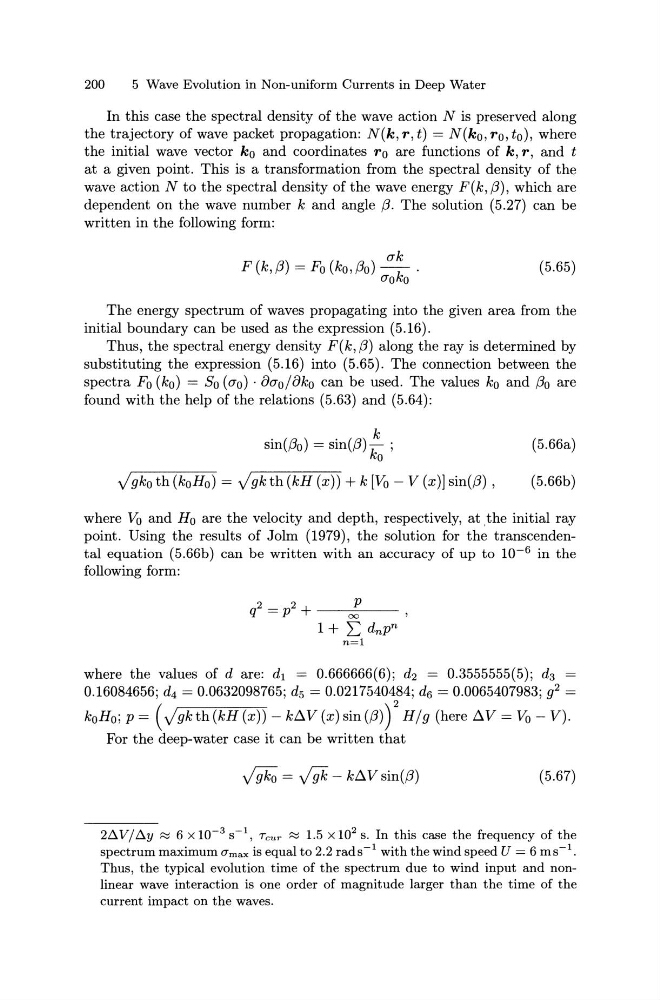
In this case the spectral density of the wave action N is preserved along
the trajectory of wave packet propagation: N(k, r, t) = N(k0 , r 0 , t 0 ), where
the initial wave vector k 0 and coordinates r 0 are functions of k, r, and t
at a given point. This is a transformation from the spectral density of the
wave action N to the spectral density of the wave energy F(k, (3), which are
dependent on the wave number k and angle (3. The solution (5.27) can be
written in the following form:
ak
F (k, (3) = Fo (ko,f3o) - k .
ao o
(5.65)
The energy spectrum of waves propagating into the given area from the
initial boundary can be used as the expression (5.16).
Thus, the spectral energy density F(k, (3) along the ray is determined by
substituting the expression (5.16) into (5.65). The connection between the
spectra Fo (ko) = So (ao) · 8aof8ko can be used. The values ko and f3o are
found with the help of the relations (5.63) and (5.64):
sin(f3o) = sin((J) ~ ;
(5.66a)
J gko th (koHo) = Jgkth (kH (x)) + k [Vo- V (x)] sin((J) ,
(5.66b)
where V0 and H 0 are the velocity and depth, respectively, at ,the initial ray
point. Using the results of Jolm (1979), the solution for the transcendental equation (5.66b) can be written with an accuracy of up to 10- 6 in the
following form:
q2=p2+
:!
1 + ~ dnpn
n=l
where the values of d are: d1 = 0.666666(6); d2 = 0.3555555(5); d3 =
0.16084656; d4 = 0.0632098765; d5 = 0.0217540484; d6 = 0.0065407983; g 2 =
koHo; p = ( Jgkth(kH (x))- k~V (x) sin ((J)r Hfg (here ~V = Vo- V).
For the deep-water case it can be written that
#a= yfgk- k~ V sin((J)
(5.67)
2/:l V/ fly ;::;! 6 X w- 3 s-I, Tcur ;::;! 1.5 X 10 2 s. In this case the frequency of the
spectrum maximum O"rnax is equal to 2.2 rads- 1 with the wind speed U = 6 ms- 1 .
Thus, the typical evolution time of the spectrum due to wind input and nonlinear wave interaction is one order of magnitude larger than the time of the
current impact on the waves.
5 Wave Evolution in Non-uniform Currents in Deep Water
In this case the spectral density of the wave action N is preserved along
the trajectory of wave packet propagation: N(k, r, t) = N(k0 , r 0 , t 0 ), where
the initial wave vector k 0 and coordinates r 0 are functions of k, r, and t
at a given point. This is a transformation from the spectral density of the
wave action N to the spectral density of the wave energy F(k, (3), which are
dependent on the wave number k and angle (3. The solution (5.27) can be
written in the following form:
ak
F (k, (3) = Fo (ko,f3o) - k .
ao o
(5.65)
The energy spectrum of waves propagating into the given area from the
initial boundary can be used as the expression (5.16).
Thus, the spectral energy density F(k, (3) along the ray is determined by
substituting the expression (5.16) into (5.65). The connection between the
spectra Fo (ko) = So (ao) · 8aof8ko can be used. The values ko and f3o are
found with the help of the relations (5.63) and (5.64):
sin(f3o) = sin((J) ~ ;
(5.66a)
J gko th (koHo) = Jgkth (kH (x)) + k [Vo- V (x)] sin((J) ,
(5.66b)
where V0 and H 0 are the velocity and depth, respectively, at ,the initial ray
point. Using the results of Jolm (1979), the solution for the transcendental equation (5.66b) can be written with an accuracy of up to 10- 6 in the
following form:
q2=p2+
:!
1 + ~ dnpn
n=l
where the values of d are: d1 = 0.666666(6); d2 = 0.3555555(5); d3 =
0.16084656; d4 = 0.0632098765; d5 = 0.0217540484; d6 = 0.0065407983; g 2 =
koHo; p = ( Jgkth(kH (x))- k~V (x) sin ((J)r Hfg (here ~V = Vo- V).
For the deep-water case it can be written that
#a= yfgk- k~ V sin((J)
(5.67)
2/:l V/ fly ;::;! 6 X w- 3 s-I, Tcur ;::;! 1.5 X 10 2 s. In this case the frequency of the
spectrum maximum O"rnax is equal to 2.2 rads- 1 with the wind speed U = 6 ms- 1 .
Thus, the typical evolution time of the spectrum due to wind input and nonlinear wave interaction is one order of magnitude larger than the time of the
current impact on the waves.