

5. 7 Wind Wave Transformation in Cross-Velocity Shear Current
199
X
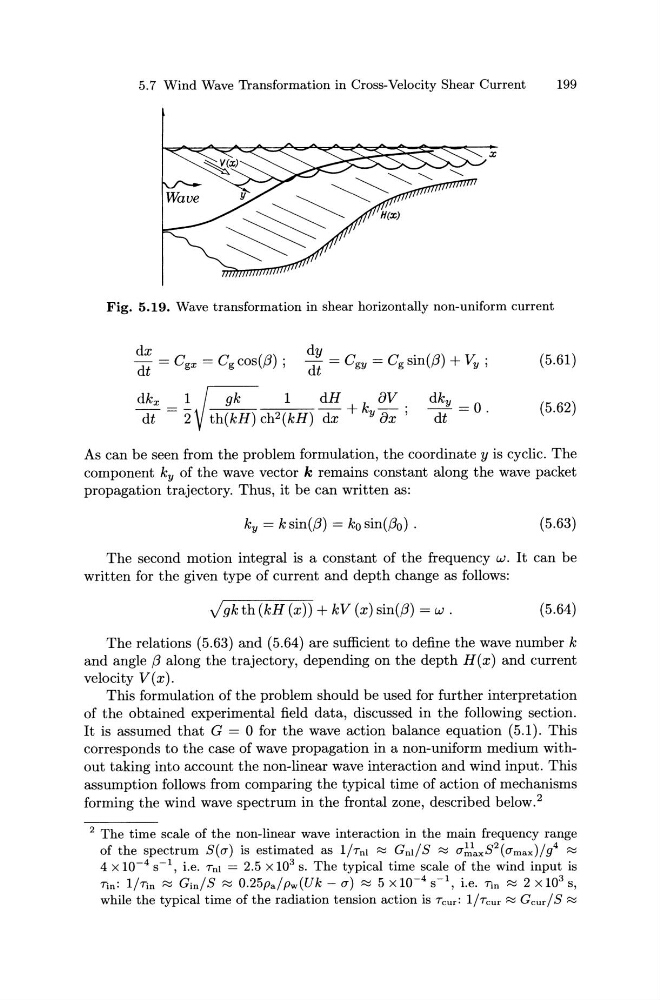
Fig. 5.19. Wave transformation in shear horizontally non-uniform current
dx
dy
.
dt = Cgx = Cg cos(/3) ; dt = Cgy = Cg sm(/3) + Vy ;
(5.61)
dkx _ ~ j9k 1 dH k 8V . dky
dt - 2 v th(/di) ch2 (kH) dx + Y ax ' dt = O .
(5.62)
As can be seen from the problem formulation, the coordinate y is cyclic. The
component ky of the wave vector k remains constant along the wave packet
propagation trajectory. Thus, it be can written as:
ky = k sin(/3) = ko sin(f3o) .
(5.63)
The second motion integral is a constant of the frequency w. It can be
written for the given type of current and depth change as follows:
Jgkth (kH (x)) + kV (x) sin(/3) = w.
(5.64)
The relations (5.63) and (5.64) are sufficient to define the wave number k
and angle (3 along the trajectory, depending on the depth H ( x) and current
velocity V ( x).
This formulation of the problem should be used for further interpretation
of the obtained experimental field data, discussed in the following section.
It is assumed that G = 0 for the wave action balance equation (5.1). This
corresponds to the case of wave propagation in a non-uniform medium without taking into account the non-linear wave interaction and wind input. This
assumption follows from comparing the typical time of action of mechanisms
forming the wind wave spectrum in the frontal zone, described below. 2
2 The time scale of the non-linear wave interaction in the main frequency range
of the spectrum S(lT) is estimated as 1/Tnl ~ GnJ/S ~ lT;, 1 axS 2 (lTmax)/g 4 ~
4 X 10- 4 s- 1 ' i.e. Tnl = 2.5 X 10 3 s. The typical time scale of the wind input is
Tin: 1/Tin ~ Gin/ s ~ 0.25pa/ Pw(Uk - lT) ~ 5 X 10- 4 s- 1 ' i.e. Tin ~ 2 X 10 3 s,
while the typical time of the radiation tension action is Tcur: 1/Tcur ~ Gcur/S ~
199
X
Fig. 5.19. Wave transformation in shear horizontally non-uniform current
dx
dy
.
dt = Cgx = Cg cos(/3) ; dt = Cgy = Cg sm(/3) + Vy ;
(5.61)
dkx _ ~ j9k 1 dH k 8V . dky
dt - 2 v th(/di) ch2 (kH) dx + Y ax ' dt = O .
(5.62)
As can be seen from the problem formulation, the coordinate y is cyclic. The
component ky of the wave vector k remains constant along the wave packet
propagation trajectory. Thus, it be can written as:
ky = k sin(/3) = ko sin(f3o) .
(5.63)
The second motion integral is a constant of the frequency w. It can be
written for the given type of current and depth change as follows:
Jgkth (kH (x)) + kV (x) sin(/3) = w.
(5.64)
The relations (5.63) and (5.64) are sufficient to define the wave number k
and angle (3 along the trajectory, depending on the depth H ( x) and current
velocity V ( x).
This formulation of the problem should be used for further interpretation
of the obtained experimental field data, discussed in the following section.
It is assumed that G = 0 for the wave action balance equation (5.1). This
corresponds to the case of wave propagation in a non-uniform medium without taking into account the non-linear wave interaction and wind input. This
assumption follows from comparing the typical time of action of mechanisms
forming the wind wave spectrum in the frontal zone, described below. 2
2 The time scale of the non-linear wave interaction in the main frequency range
of the spectrum S(lT) is estimated as 1/Tnl ~ GnJ/S ~ lT;, 1 axS 2 (lTmax)/g 4 ~
4 X 10- 4 s- 1 ' i.e. Tnl = 2.5 X 10 3 s. The typical time scale of the wind input is
Tin: 1/Tin ~ Gin/ s ~ 0.25pa/ Pw(Uk - lT) ~ 5 X 10- 4 s- 1 ' i.e. Tin ~ 2 X 10 3 s,
while the typical time of the radiation tension action is Tcur: 1/Tcur ~ Gcur/S ~