

5.7 Wind Wave Transformation in Cross-Velocity Shear Current
201
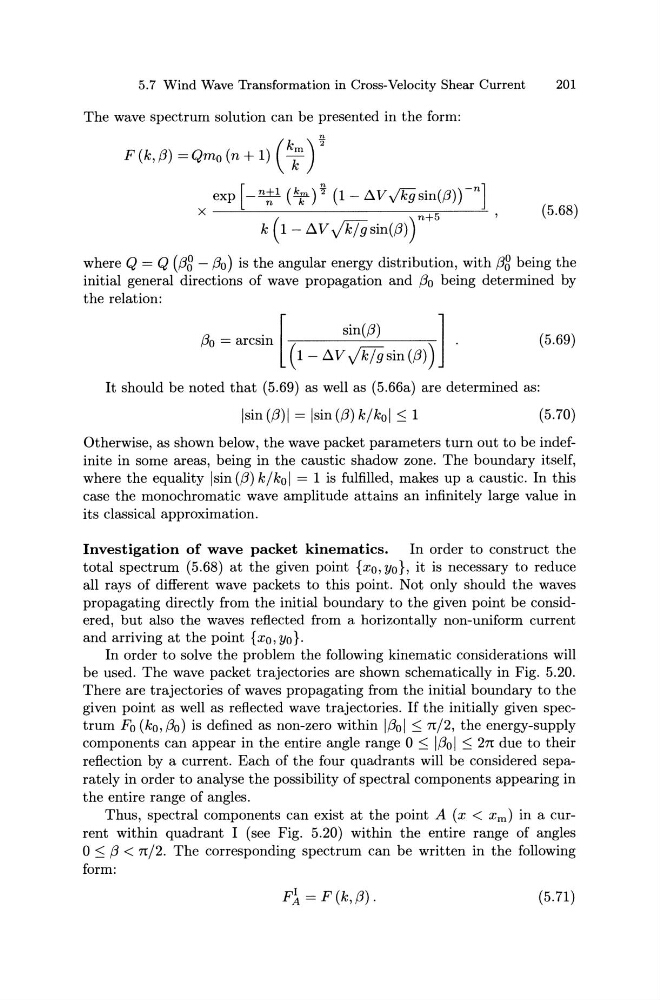
The wave spectrum solution can be presented in the form:
F(k,/3) =Qm 0 (n+1) (k;) ~
exp [-~ (~)~ (1- ~VVkgsin(/3))-n)
X
n+5
'
k ( 1 - ~ V Vk/9 sin(/3))
(5.68)
where Q = Q (/38- f30 ) is the angular energy distribution, with /38 being the
initial general directions of wave propagation and f3o being determined by
the relation:
fJo ~ "''"" [ ( 1 - l> : ; . sin (il)) ] .
(5.69)
It should be noted that (5.69) as well as (5.66a) are determined as:
I sin (/3)1 = lsin (/3) k/kol ~ 1
(5. 70)
Otherwise, as shown below, the wave packet parameters turn out to be indefinite in some areas, being in the caustic shadow zone. The boundary itself,
where the equality lsin (/3) k/kol = 1 is fulfilled, makes up a caustic. In this
case the monochromatic wave amplitude attains an infinitely large value in
its classical approximation.
Investigation of wave packet kinematics. In order to construct the
total spectrum (5.68) at the given point {x0 ,y0 }, it is necessary to reduce
all rays of different wave packets to this point. Not only should the waves
propagating directly from the initial boundary to the given point be considered, but also the waves reflected from a horizontally non-uniform current
and arriving at the point {xo,Yo}.
In order to solve the problem the following kinematic considerations will
be used. The wave packet trajectories are shown schematically in Fig. 5.20.
There are trajectories of waves propagating from the initial boundary to the
given point as well as reflected wave trajectories. If the initially given spectrum F0 ( k0 , f3o) is defined as non-zero within l/3o I ~ n/2, the energy-supply
components can appear in the entire angle range 0 ~ l/30 I ~ 2n due to their
reflection by a current. Each of the four quadrants will be considered separately in order to analyse the possibility of spectral components appearing in
the entire range of angles.
Thus, spectral components can exist at the point A (x < xm) in a current within quadrant I (see Fig. 5.20) within the entire range of angles
0 ~ f3 < n/2. The corresponding spectrum can be written in the following
form:
F1 = F (k,/3).
(5.71)
201
The wave spectrum solution can be presented in the form:
F(k,/3) =Qm 0 (n+1) (k;) ~
exp [-~ (~)~ (1- ~VVkgsin(/3))-n)
X
n+5
'
k ( 1 - ~ V Vk/9 sin(/3))
(5.68)
where Q = Q (/38- f30 ) is the angular energy distribution, with /38 being the
initial general directions of wave propagation and f3o being determined by
the relation:
fJo ~ "''"" [ ( 1 - l> : ; . sin (il)) ] .
(5.69)
It should be noted that (5.69) as well as (5.66a) are determined as:
I sin (/3)1 = lsin (/3) k/kol ~ 1
(5. 70)
Otherwise, as shown below, the wave packet parameters turn out to be indefinite in some areas, being in the caustic shadow zone. The boundary itself,
where the equality lsin (/3) k/kol = 1 is fulfilled, makes up a caustic. In this
case the monochromatic wave amplitude attains an infinitely large value in
its classical approximation.
Investigation of wave packet kinematics. In order to construct the
total spectrum (5.68) at the given point {x0 ,y0 }, it is necessary to reduce
all rays of different wave packets to this point. Not only should the waves
propagating directly from the initial boundary to the given point be considered, but also the waves reflected from a horizontally non-uniform current
and arriving at the point {xo,Yo}.
In order to solve the problem the following kinematic considerations will
be used. The wave packet trajectories are shown schematically in Fig. 5.20.
There are trajectories of waves propagating from the initial boundary to the
given point as well as reflected wave trajectories. If the initially given spectrum F0 ( k0 , f3o) is defined as non-zero within l/3o I ~ n/2, the energy-supply
components can appear in the entire angle range 0 ~ l/30 I ~ 2n due to their
reflection by a current. Each of the four quadrants will be considered separately in order to analyse the possibility of spectral components appearing in
the entire range of angles.
Thus, spectral components can exist at the point A (x < xm) in a current within quadrant I (see Fig. 5.20) within the entire range of angles
0 ~ f3 < n/2. The corresponding spectrum can be written in the following
form:
F1 = F (k,/3).
(5.71)