

196
5 Wave Evolution in Non-uniform Currents in Deep Water
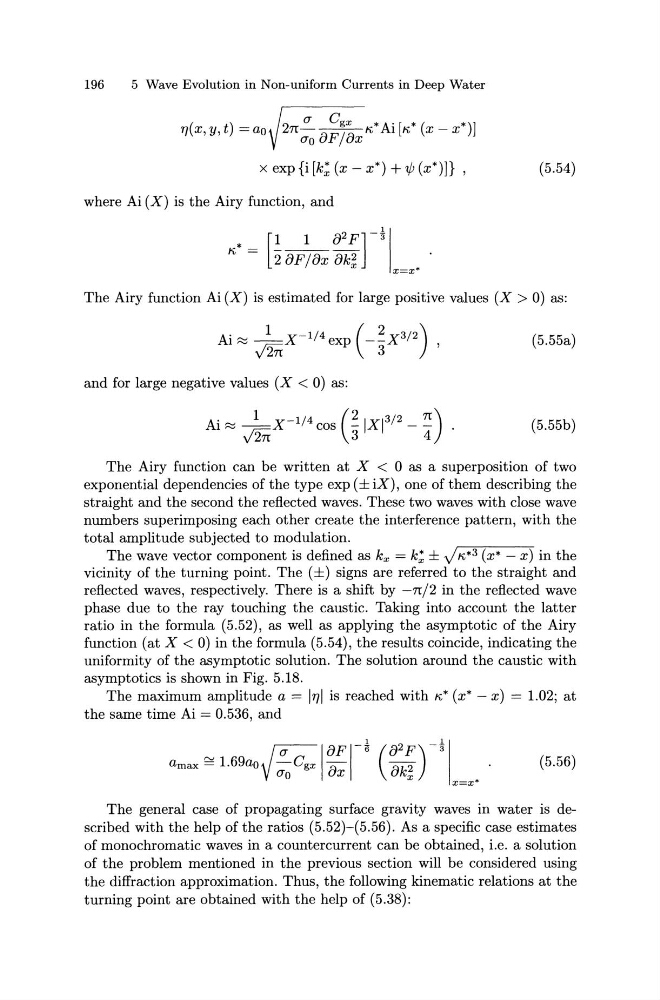
(
)
a Cgx
*A" [ * (
*)]
Tf x,y,t =ao 2nao{)Fj{)xK, 111, x-x
x exp {i [k; (x - x*) + 7/J (x*)]} ,
(5.54)
where Ai (X) is the Airy function, and
The Airy function Ai (X) is estimated for large positive values (X > 0) as:
Ai ~ - 1 -x- 1 1 4 exp (-~X 3 1 2 )
y'27r
3
'
(5.55a)
and for large negative values (X < 0) as:
A .~ 1 x-1/4 (2 IXI3/2 n)
COS- -
y'27[
3
4
(5.55b)
The Airy function can be written at X < 0 as a superposition of two
exponential dependencies of the type exp (± iX), one of them describing the
straight and the second the reflected waves. These two waves with close wave
numbers superimposing each other create the interference pattern, with the
total amplitude subjected to modulation.
The wave vector component is defined as kx = k; ± J11,* 3 (x*- x) in the
vicinity of the turning point. The (±) signs are referred to the straight and
reflected waves, respectively. There is a shift by -n/2 in the reflected wave
phase due to the ray touching the caustic. Taking into account the latter
ratio in the formula (5.52), as well as applying the asymptotic of the Airy
function (at X < 0) in the formula (5.54), the results coincide, indicating the
uniformity of the asymptotic solution. The solution around the caustic with
asymptotics is shown in Fig. 5.18.
The maximum amplitude a = ITfl is reached with 11,* (x*- x) = 1.02; at
the same time Ai = 0.536, and
(5.56)
The general case of propagating surface gravity waves in water is described with the help of the ratios (5.52)-(5.56). As a specific case estimates
of monochromatic waves in a countercurrent can be obtained, i.e. a solution
of the problem mentioned in the previous section will be considered using
the diffraction approximation. Thus, the following kinematic relations at the
turning point are obtained with the help of (5.38):
5 Wave Evolution in Non-uniform Currents in Deep Water
(
)
a Cgx
*A" [ * (
*)]
Tf x,y,t =ao 2nao{)Fj{)xK, 111, x-x
x exp {i [k; (x - x*) + 7/J (x*)]} ,
(5.54)
where Ai (X) is the Airy function, and
The Airy function Ai (X) is estimated for large positive values (X > 0) as:
Ai ~ - 1 -x- 1 1 4 exp (-~X 3 1 2 )
y'27r
3
'
(5.55a)
and for large negative values (X < 0) as:
A .~ 1 x-1/4 (2 IXI3/2 n)
COS- -
y'27[
3
4
(5.55b)
The Airy function can be written at X < 0 as a superposition of two
exponential dependencies of the type exp (± iX), one of them describing the
straight and the second the reflected waves. These two waves with close wave
numbers superimposing each other create the interference pattern, with the
total amplitude subjected to modulation.
The wave vector component is defined as kx = k; ± J11,* 3 (x*- x) in the
vicinity of the turning point. The (±) signs are referred to the straight and
reflected waves, respectively. There is a shift by -n/2 in the reflected wave
phase due to the ray touching the caustic. Taking into account the latter
ratio in the formula (5.52), as well as applying the asymptotic of the Airy
function (at X < 0) in the formula (5.54), the results coincide, indicating the
uniformity of the asymptotic solution. The solution around the caustic with
asymptotics is shown in Fig. 5.18.
The maximum amplitude a = ITfl is reached with 11,* (x*- x) = 1.02; at
the same time Ai = 0.536, and
(5.56)
The general case of propagating surface gravity waves in water is described with the help of the ratios (5.52)-(5.56). As a specific case estimates
of monochromatic waves in a countercurrent can be obtained, i.e. a solution
of the problem mentioned in the previous section will be considered using
the diffraction approximation. Thus, the following kinematic relations at the
turning point are obtained with the help of (5.38):