

5.6 Wave Diffraction Around a Caustic
195
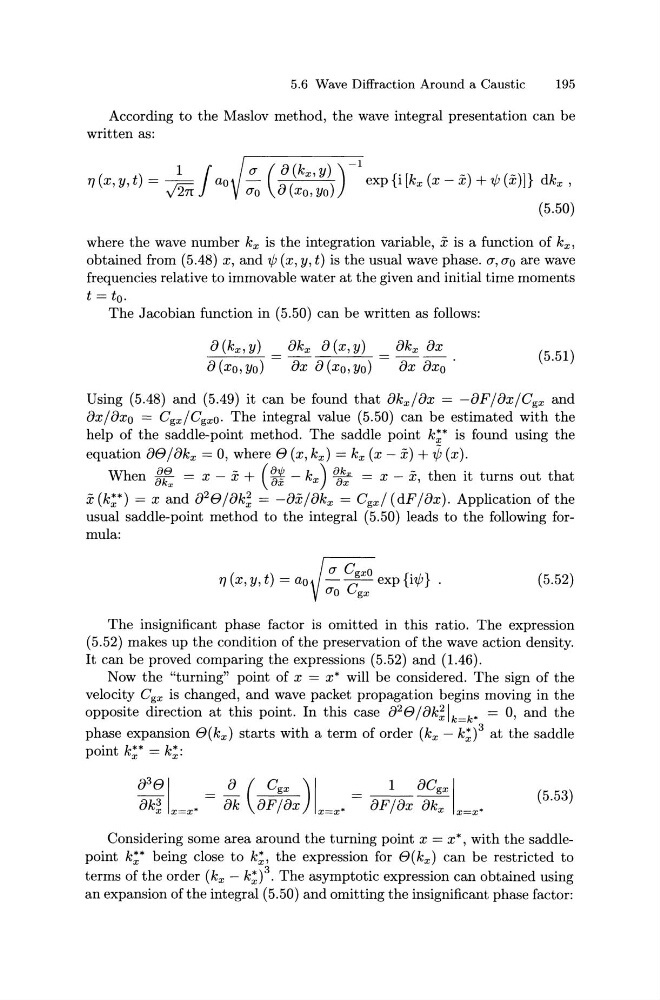
According to the Maslov method, the wave integral presentation can be
written as:
ry(x,y,t) = vk j ao ~ (:?x' Y\) -I exp {i [kx (x- x) + ' ljJ (x)]} dkx ,
ao
xo,Yo
(5.50)
where the wave number kx is the integration variable, x is a function of kx,
obtained from (5.48) x, and 'ljJ (x, y, t) is the usual wave phase. a, a0 are wave
frequencies relative to immovable water at the given and initial time moments
t = t0 .
The Jacobian function in (5.50) can be written as follows:
a (kx, y)
a (xo, Yo)
akx a(x,y)
ax a(xo,Yo)
akx ax
ax axo .
(5.51)
Using (5.48) and (5.49) it can be found that akxfax = -aFjaxjCgx and
axjaxo = Cgx/CgxO· The integral value (5.50) can be estimated with the
help of the saddle-point method. The saddle point k~* is found using the
equation aejakx = 0, where e (x, kx) = kx (x- x) + ,([; (x).
Wh
ae
- (1!3E. k ) ak
- h ·
h
en akx = x - x + ax - x 7f: = x - x, t en It turns out t at
x (k~*) = x and a 2 ejak';, = -axjakx = Cgx/ ( dF jax). Application of the
usual saddle-point method to the integral (5.50) leads to the following formula:
' TJ (x, y, t) = ao a CgxO
{" }
---exp 1' 1jJ •
ao Cgx
(5.52)
The insignificant phase factor is omitted in this ratio. The expression
(5.52) makes up the condition of the preservation of the wave action density.
It can be proved comparing the expressions (5.52) and (1.46).
Now the "turning" point of x = x* will be considered. The sign of the
velocity Cgx is changed, and wave packet propagation begins moving in the
opposite direction at this point. In this case a 2 e I ak; I k=k· = 0, and the
phase expansion B(kx) starts with a term of order (kx- k~) 3 at the saddle
point k~* = k~:
(5.53)
Considering some area around the turning point x = x*, with the saddlepoint k~* being close to k~, the expression for B(kx) can be restricted to
terms of the order (kx - k~) 3 • The asymptotic expression can obtained using
an expansion of the integral (5.50) and omitting the insignificant phase factor:
195
According to the Maslov method, the wave integral presentation can be
written as:
ry(x,y,t) = vk j ao ~ (:?x' Y\) -I exp {i [kx (x- x) + ' ljJ (x)]} dkx ,
ao
xo,Yo
(5.50)
where the wave number kx is the integration variable, x is a function of kx,
obtained from (5.48) x, and 'ljJ (x, y, t) is the usual wave phase. a, a0 are wave
frequencies relative to immovable water at the given and initial time moments
t = t0 .
The Jacobian function in (5.50) can be written as follows:
a (kx, y)
a (xo, Yo)
akx a(x,y)
ax a(xo,Yo)
akx ax
ax axo .
(5.51)
Using (5.48) and (5.49) it can be found that akxfax = -aFjaxjCgx and
axjaxo = Cgx/CgxO· The integral value (5.50) can be estimated with the
help of the saddle-point method. The saddle point k~* is found using the
equation aejakx = 0, where e (x, kx) = kx (x- x) + ,([; (x).
Wh
ae
- (1!3E. k ) ak
- h ·
h
en akx = x - x + ax - x 7f: = x - x, t en It turns out t at
x (k~*) = x and a 2 ejak';, = -axjakx = Cgx/ ( dF jax). Application of the
usual saddle-point method to the integral (5.50) leads to the following formula:
' TJ (x, y, t) = ao a CgxO
{" }
---exp 1' 1jJ •
ao Cgx
(5.52)
The insignificant phase factor is omitted in this ratio. The expression
(5.52) makes up the condition of the preservation of the wave action density.
It can be proved comparing the expressions (5.52) and (1.46).
Now the "turning" point of x = x* will be considered. The sign of the
velocity Cgx is changed, and wave packet propagation begins moving in the
opposite direction at this point. In this case a 2 e I ak; I k=k· = 0, and the
phase expansion B(kx) starts with a term of order (kx- k~) 3 at the saddle
point k~* = k~:
(5.53)
Considering some area around the turning point x = x*, with the saddlepoint k~* being close to k~, the expression for B(kx) can be restricted to
terms of the order (kx - k~) 3 • The asymptotic expression can obtained using
an expansion of the integral (5.50) and omitting the insignificant phase factor: