

5.6 Wave Diffraction Around a Caustic
197
Ai(X)
0.7
¥
6x
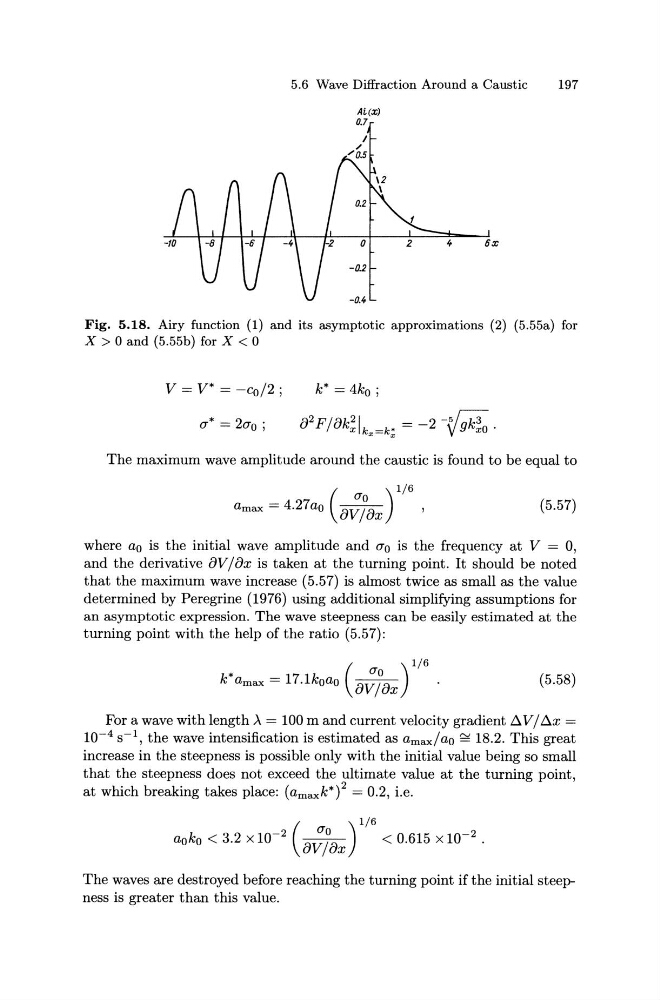
Fig. 5.18. Airy function (1) and its asymptotic approximations (2) (5.55a) for
X> 0 and (5.55b) for X< 0
V = V* = -c0 /2 ;
k* = 4k0 ;
a*= 2a0 ;
8 2 F/ok;lkx=k; = -2 -~ ·
The maximum wave amplitude around the caustic is found to be equal to
(
)
1/6
ama.x = 4.27ao a:/ax
'
(5.57)
where a0 is the initial wave amplitude and a0 is the frequency at V = 0,
and the derivative av;ax is taken at the turning point. It should be noted
that the maximum wave increase (5.57) is almost twice as small as the value
determined by Peregrine (1976) using additional simplifying assumptions for
an asymptotic expression. The wave steepness can be easily estimated at the
turning point with the help of the ratio (5.57):
*
ao
(
)
1/6
k amax = 17.1koao av;ax
(5.58)
For a wave with length A = 100m and current velocity gradient D. V / D.x =
10- 4 s- 1 , the wave intensification is estimated as amax/a0 ~ 18.2. This great
increase in the steepness is possible only with the initial value being so small
that the steepness does not exceed the ultimate value at the turning point,
at which breaking takes place: (amaxk*) 2 = 0.2, i.e.
(
)
1/6
aoko < 3.2 X 10- 2 o;fox < 0.615 X 10- 2 .
The waves are destroyed before reaching the turning point if the initial steepness is greater than this value.
197
Ai(X)
0.7
¥
6x
Fig. 5.18. Airy function (1) and its asymptotic approximations (2) (5.55a) for
X> 0 and (5.55b) for X< 0
V = V* = -c0 /2 ;
k* = 4k0 ;
a*= 2a0 ;
8 2 F/ok;lkx=k; = -2 -~ ·
The maximum wave amplitude around the caustic is found to be equal to
(
)
1/6
ama.x = 4.27ao a:/ax
'
(5.57)
where a0 is the initial wave amplitude and a0 is the frequency at V = 0,
and the derivative av;ax is taken at the turning point. It should be noted
that the maximum wave increase (5.57) is almost twice as small as the value
determined by Peregrine (1976) using additional simplifying assumptions for
an asymptotic expression. The wave steepness can be easily estimated at the
turning point with the help of the ratio (5.57):
*
ao
(
)
1/6
k amax = 17.1koao av;ax
(5.58)
For a wave with length A = 100m and current velocity gradient D. V / D.x =
10- 4 s- 1 , the wave intensification is estimated as amax/a0 ~ 18.2. This great
increase in the steepness is possible only with the initial value being so small
that the steepness does not exceed the ultimate value at the turning point,
at which breaking takes place: (amaxk*) 2 = 0.2, i.e.
(
)
1/6
aoko < 3.2 X 10- 2 o;fox < 0.615 X 10- 2 .
The waves are destroyed before reaching the turning point if the initial steepness is greater than this value.