

4.3 Wave Energy Dissipation in Deep Water
133
Davidan et al., 1985; Theoretical bases and methods for wind sea calculation,
1988). It should be noted that Komen, Hasselmann and Hasselmann (1984)
came to the same conclusion, estimating the wave energy dissipation as the
difference between the empirical source function obtained by spectral density
variations and the sum of the functions of the non-linear transfer and wind
energy input. The dissipation values were estimated with sign opposite to the
physical meaning of the mechanism.
As it has been noted, the results of Zakharov & Zaslavskii ( 1982, 1983a, b)
were obtained in the form of the approximation of weak turbulence and within
the transparency interval with the wave energy input and dissipation being
inessential. This statement seems to be rather doubtful in actual situations.
Probably it explains the difference between theoretical estimations and field
spectra data. At the same time these solutions may be useful for qualitative
research of wind wave dynamics, when they allow extracting the most significant physical mechanisms forming the wave spectrum in this frequency
band.
It is interesting to note that Tolman and Chalikov (1996) came to the
same conclusions as Davidan. They investigated the source function in the
third-generation wind wave models and found principal difference of the physical mechanism effect in various bands of the frequency spectrum. The whole
frequency range is divided into three sections: low, transitional and highfrequency parts, the dissipative mechanism being determined separately for
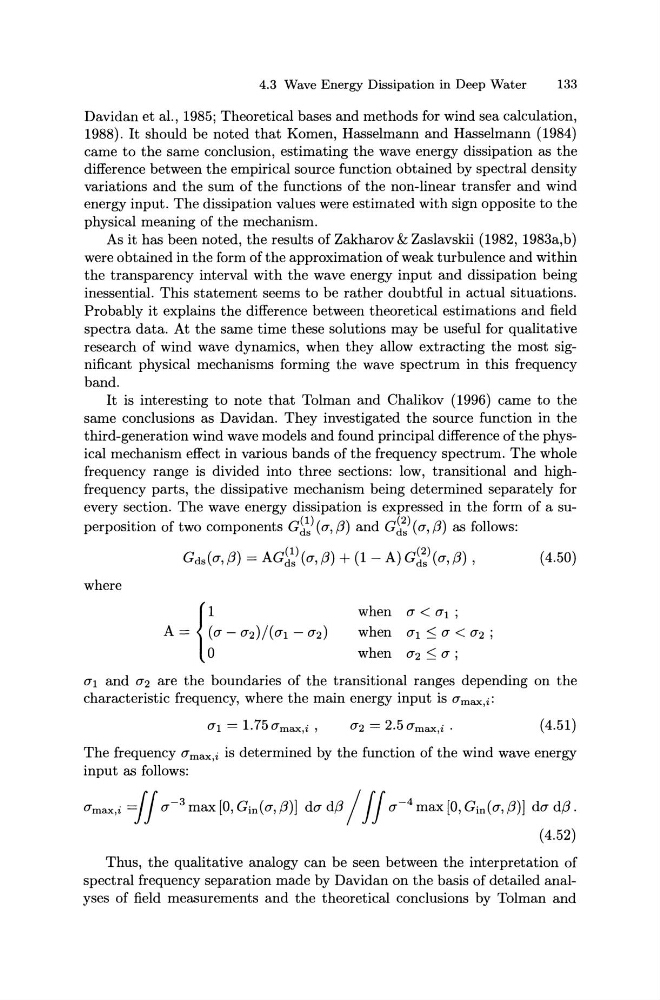
every section. The wave energy dissipation is expressed in the form of a superposition of two components G~~\ (1, (3) and G~!) ( (1, (3) as follows:
where
Gds((1, (3) = AG~~) ((1, (3) + (1- A) G~) ((1, (3) ,
when (1 < (11 ;
when (11 ~ (1 < (12 ;
when (12 ~ (1 ;
(4.50)
(11 and (12 are the boundaries of the transitional ranges depending on the
characteristic frequency, where the main energy input is (1max,i:
(4.51)
The frequency (1max,i is determined by the function of the wind wave energy
input as follows:
(1max,i =!! (1- 3 max[O,Gin((1,(3)] d(1d(3 I JJ (1- 4 max[O,Gin((1,(3)] dad(3.
(4.52)
Thus, the qualitative analogy can be seen between the interpretation of
spectral frequency separation made by Davidan on the basis of detailed analyses of field measurements and the theoretical conclusions by Tolman and
133
Davidan et al., 1985; Theoretical bases and methods for wind sea calculation,
1988). It should be noted that Komen, Hasselmann and Hasselmann (1984)
came to the same conclusion, estimating the wave energy dissipation as the
difference between the empirical source function obtained by spectral density
variations and the sum of the functions of the non-linear transfer and wind
energy input. The dissipation values were estimated with sign opposite to the
physical meaning of the mechanism.
As it has been noted, the results of Zakharov & Zaslavskii ( 1982, 1983a, b)
were obtained in the form of the approximation of weak turbulence and within
the transparency interval with the wave energy input and dissipation being
inessential. This statement seems to be rather doubtful in actual situations.
Probably it explains the difference between theoretical estimations and field
spectra data. At the same time these solutions may be useful for qualitative
research of wind wave dynamics, when they allow extracting the most significant physical mechanisms forming the wave spectrum in this frequency
band.
It is interesting to note that Tolman and Chalikov (1996) came to the
same conclusions as Davidan. They investigated the source function in the
third-generation wind wave models and found principal difference of the physical mechanism effect in various bands of the frequency spectrum. The whole
frequency range is divided into three sections: low, transitional and highfrequency parts, the dissipative mechanism being determined separately for
every section. The wave energy dissipation is expressed in the form of a superposition of two components G~~\ (1, (3) and G~!) ( (1, (3) as follows:
where
Gds((1, (3) = AG~~) ((1, (3) + (1- A) G~) ((1, (3) ,
when (1 < (11 ;
when (11 ~ (1 < (12 ;
when (12 ~ (1 ;
(4.50)
(11 and (12 are the boundaries of the transitional ranges depending on the
characteristic frequency, where the main energy input is (1max,i:
(4.51)
The frequency (1max,i is determined by the function of the wind wave energy
input as follows:
(1max,i =!! (1- 3 max[O,Gin((1,(3)] d(1d(3 I JJ (1- 4 max[O,Gin((1,(3)] dad(3.
(4.52)
Thus, the qualitative analogy can be seen between the interpretation of
spectral frequency separation made by Davidan on the basis of detailed analyses of field measurements and the theoretical conclusions by Tolman and