

132
4 Physical Mechanisms Forming the Wave Spectrum in Deep Water
the different physical mechanisms that form the spectral structure in various
frequency bands.
As concluded by Davidan et al. (1978), if the Miles model is accepted,
the wind wave frequency spectrum can be divided into three ranges. These
are determined by the different physical mechanisms on wind wave spectrum formation. That is why the total frequency range can be separated in
those determined mainly by non-linear energy transfer Gn1; the range of wind
energy input, with the source function determined by the sum of three components: Gin, Gnh Gds and the equilibrium range, with the source function
determined by the sum of two components Gin and Gds· It is also found that
the peculiarities of the energy dissipation in the spectrum equilibrium range
differ essentially from the those in other spectrum frequency ranges.
As for the first frequency range with the source function determined
mainly by non-linear energy transfer, the papers by Zakharov & Zaslavskii
(1982, 1983a,b) should be mentioned. In their opinion the spectral evolution
of developed waves within the spectral maximum range could be described
within the supposition of a "transparency window". This is a frequency spectrum area without any wind energy input, and dissipation can be neglected.
The ideas of the Kolmogorov weak turbulence theory are used in this case.
The turbulence is known to appear as a result of laminar current instability. This is characterized by the large number of degrees of freedom. In
media with dispersion, such as the sea surface, separate wave packages overlap during a short period, and their interaction is weak enough (this state
is called the weak turbulent state). The smallest interaction energy between
wave packages in comparison with the total wave energy allows the use of disturbance theory. The turbulence is described by a closed equation set, which
yields analytical results in some cases.
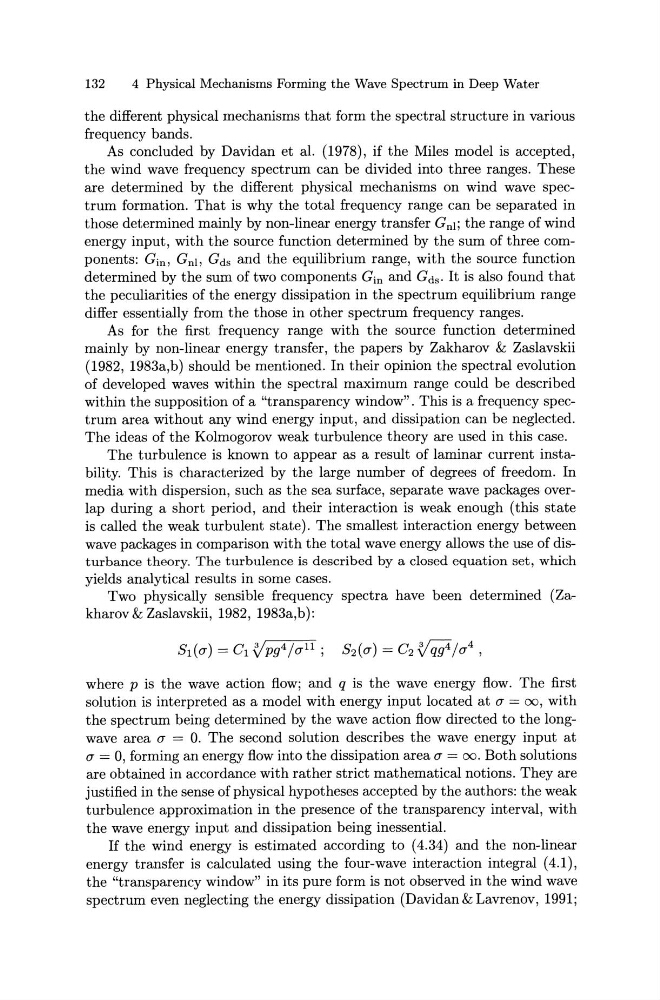
Two physically sensible frequency spectra have been determined (Zakharov& Zaslavskii, 1982, 1983a,b):
where p is the wave action flow; and q is the wave energy flow. The first
solution is interpreted as a model with energy input located at Ci = oo, with
the spectrum being determined by the wave action flow directed to the longwave area Ci = 0. The second solution describes the wave energy input at
Ci = 0, forming an energy flow into the dissipation area Ci = oo. Both solutions
are obtained in accordance with rather strict mathematical notions. They are
justified in the sense of physical hypotheses accepted by the authors: the weak
turbulence approximation in the presence of the transparency interval, with
the wave energy input and dissipation being inessential.
If the wind energy is estimated according to (4.34) and the non-linear
energy transfer is calculated using the four-wave interaction integral ( 4.1),
the "transparency window" in its pure form is not observed in the wind wave
spectrum even neglecting the energy dissipation (Davidan & Lavrenov, 1991;
4 Physical Mechanisms Forming the Wave Spectrum in Deep Water
the different physical mechanisms that form the spectral structure in various
frequency bands.
As concluded by Davidan et al. (1978), if the Miles model is accepted,
the wind wave frequency spectrum can be divided into three ranges. These
are determined by the different physical mechanisms on wind wave spectrum formation. That is why the total frequency range can be separated in
those determined mainly by non-linear energy transfer Gn1; the range of wind
energy input, with the source function determined by the sum of three components: Gin, Gnh Gds and the equilibrium range, with the source function
determined by the sum of two components Gin and Gds· It is also found that
the peculiarities of the energy dissipation in the spectrum equilibrium range
differ essentially from the those in other spectrum frequency ranges.
As for the first frequency range with the source function determined
mainly by non-linear energy transfer, the papers by Zakharov & Zaslavskii
(1982, 1983a,b) should be mentioned. In their opinion the spectral evolution
of developed waves within the spectral maximum range could be described
within the supposition of a "transparency window". This is a frequency spectrum area without any wind energy input, and dissipation can be neglected.
The ideas of the Kolmogorov weak turbulence theory are used in this case.
The turbulence is known to appear as a result of laminar current instability. This is characterized by the large number of degrees of freedom. In
media with dispersion, such as the sea surface, separate wave packages overlap during a short period, and their interaction is weak enough (this state
is called the weak turbulent state). The smallest interaction energy between
wave packages in comparison with the total wave energy allows the use of disturbance theory. The turbulence is described by a closed equation set, which
yields analytical results in some cases.
Two physically sensible frequency spectra have been determined (Zakharov& Zaslavskii, 1982, 1983a,b):
where p is the wave action flow; and q is the wave energy flow. The first
solution is interpreted as a model with energy input located at Ci = oo, with
the spectrum being determined by the wave action flow directed to the longwave area Ci = 0. The second solution describes the wave energy input at
Ci = 0, forming an energy flow into the dissipation area Ci = oo. Both solutions
are obtained in accordance with rather strict mathematical notions. They are
justified in the sense of physical hypotheses accepted by the authors: the weak
turbulence approximation in the presence of the transparency interval, with
the wave energy input and dissipation being inessential.
If the wind energy is estimated according to (4.34) and the non-linear
energy transfer is calculated using the four-wave interaction integral ( 4.1),
the "transparency window" in its pure form is not observed in the wind wave
spectrum even neglecting the energy dissipation (Davidan & Lavrenov, 1991;