

128
4 Physical Mechanisms Forming the Wave Spectrum in Deep Water
the form of linear dependence on the spectrum. It is multiplied by the value
depending on the integral spectrum parameters of the whole spectrum. The
wave dissipation used in the WAM model (The WAM model, 1988; Komen
et al., 1994) connected with wave breaking is accepted in the form of the
quasi-linear approximation, as suggested by Komen et al. (1984) on the basis
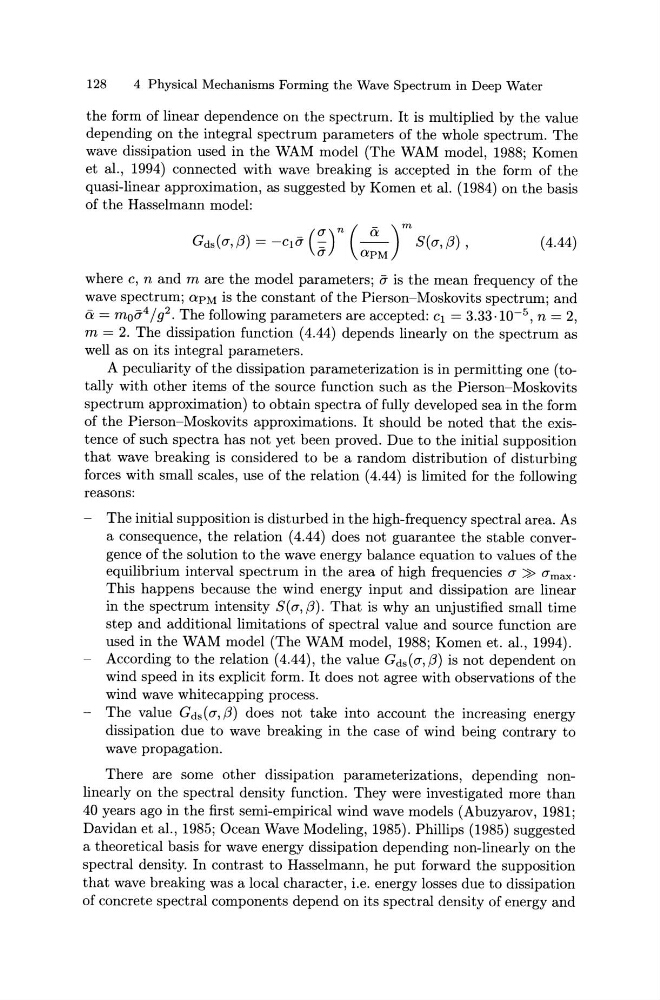
of the Hasselmann model:
( 4.44)
where c, n and m are the model parameters; a- is the mean frequency of the
wave spectrum; apM is the constant of the Pierson-Moskovits spectrum; and
a = m 0 a- 4 / g 2 . The following parameters are accepted: c1 = 3.33-10- 5 , n = 2,
m = 2. The dissipation function (4.44) depends linearly on the spectrum as
well as on its integral parameters.
A peculiarity of the dissipation parameterization is in permitting one (totally with other items of the source function such as the Pierson-Moskovits
spectrum approximation) to obtain spectra of fully developed sea in the form
of the Pierson-Moskovits approximations. It should be noted that the existence of such spectra has not yet been proved. Due to the initial supposition
that wave breaking is considered to be a random distribution of disturbing
forces with small scales, use of the relation ( 4.44) is limited for the following
reasons:
- The initial supposition is disturbed in the high-frequency spectral area. As
a consequence, the relation ( 4.44) does not guarantee the stable convergence of the solution to the wave energy balance equation to values of the
equilibrium interval spectrum in the area of high frequencies u » Umax·
This happens because the wind energy input and dissipation are linear
in the spectrum intensity S( u, /3). That is why an unjustified small time
step and additional limitations of spectral value and source function are
used in the WAM model (The WAM model, 1988; Komen et. al., 1994).
- According to the relation (4.44), the value Gct8 (u,f3) is not dependent on
wind speed in its explicit form. It does not agree with observations of the
wind wave whitecapping process.
- The value Gct8 (u, /3) does not take into account the increasing energy
dissipation due to wave breaking in the case of wind being contrary to
wave propagation.
There are some other dissipation parameterizations, depending nonlinearly on the spectral density function. They were investigated more than
40 years ago in the first semi-empirical wind wave models (Abuzyarov, 1981;
Davidan et al., 1985; Ocean Wave Modeling, 1985). Phillips (1985) suggested
a theoretical basis for wave energy dissipation depending non-linearly on the
spectral density. In contrast to Hasselmann, he put forward the supposition
that wave breaking was a local character, i.e. energy losses due to dissipation
of concrete spectral components depend on its spectral density of energy and
4 Physical Mechanisms Forming the Wave Spectrum in Deep Water
the form of linear dependence on the spectrum. It is multiplied by the value
depending on the integral spectrum parameters of the whole spectrum. The
wave dissipation used in the WAM model (The WAM model, 1988; Komen
et al., 1994) connected with wave breaking is accepted in the form of the
quasi-linear approximation, as suggested by Komen et al. (1984) on the basis
of the Hasselmann model:
( 4.44)
where c, n and m are the model parameters; a- is the mean frequency of the
wave spectrum; apM is the constant of the Pierson-Moskovits spectrum; and
a = m 0 a- 4 / g 2 . The following parameters are accepted: c1 = 3.33-10- 5 , n = 2,
m = 2. The dissipation function (4.44) depends linearly on the spectrum as
well as on its integral parameters.
A peculiarity of the dissipation parameterization is in permitting one (totally with other items of the source function such as the Pierson-Moskovits
spectrum approximation) to obtain spectra of fully developed sea in the form
of the Pierson-Moskovits approximations. It should be noted that the existence of such spectra has not yet been proved. Due to the initial supposition
that wave breaking is considered to be a random distribution of disturbing
forces with small scales, use of the relation ( 4.44) is limited for the following
reasons:
- The initial supposition is disturbed in the high-frequency spectral area. As
a consequence, the relation ( 4.44) does not guarantee the stable convergence of the solution to the wave energy balance equation to values of the
equilibrium interval spectrum in the area of high frequencies u » Umax·
This happens because the wind energy input and dissipation are linear
in the spectrum intensity S( u, /3). That is why an unjustified small time
step and additional limitations of spectral value and source function are
used in the WAM model (The WAM model, 1988; Komen et. al., 1994).
- According to the relation (4.44), the value Gct8 (u,f3) is not dependent on
wind speed in its explicit form. It does not agree with observations of the
wind wave whitecapping process.
- The value Gct8 (u, /3) does not take into account the increasing energy
dissipation due to wave breaking in the case of wind being contrary to
wave propagation.
There are some other dissipation parameterizations, depending nonlinearly on the spectral density function. They were investigated more than
40 years ago in the first semi-empirical wind wave models (Abuzyarov, 1981;
Davidan et al., 1985; Ocean Wave Modeling, 1985). Phillips (1985) suggested
a theoretical basis for wave energy dissipation depending non-linearly on the
spectral density. In contrast to Hasselmann, he put forward the supposition
that wave breaking was a local character, i.e. energy losses due to dissipation
of concrete spectral components depend on its spectral density of energy and