

4.3 Wave Energy Dissipation in Deep Water
127
In order to implement the aforementioned scheme in spectral calculations
of the energy and momentum fluxes to waves in the first approximation,
it can be suggested that the wind profile is described with the help of the
logarithmic law using the known roughness parameter ( 4.37).
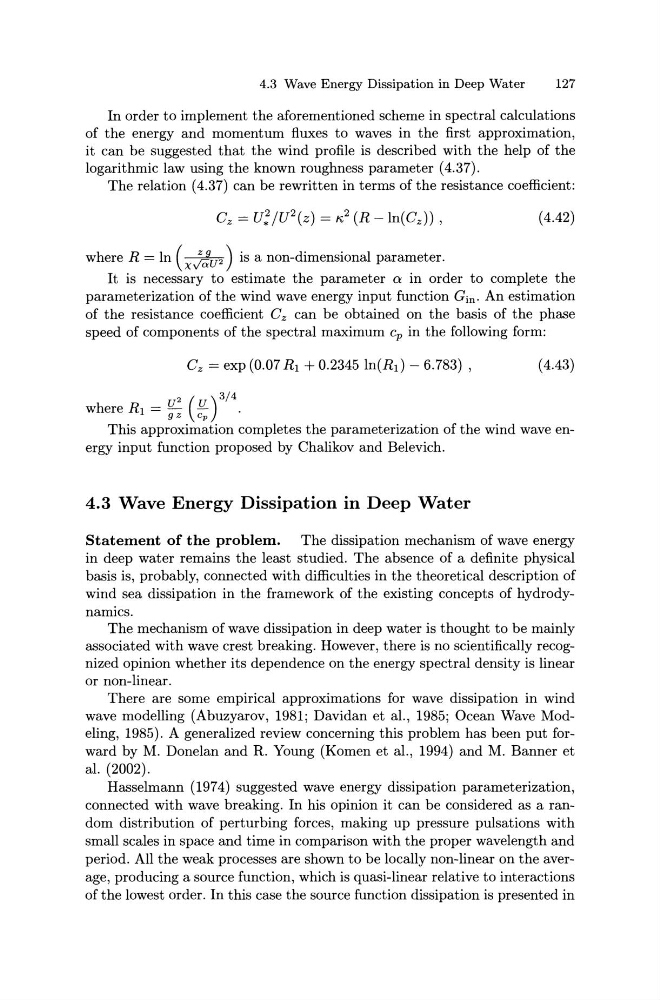
The relation ( 4.37) can be rewritten in terms of the resistance coefficient:
( 4.42)
where R = ln (xJ!u2 ) is a non-dimensional parameter.
It is necessary to estimate the parameter a in order to complete the
parameterization of the wind wave energy input function Gin. An estimation
of the resistance coefficient Cz can be obtained on the basis of the phase
speed of components of the spectral maximum cp in the following form:
Cz = exp (0.07 R1 + 0.2345 ln(R1) - 6.783) ,
( 4.43)
2 (
)3/4
where R 1 = !L !l..
.
g Z
Cp
This approximation completes the parameterization of the wind wave energy input function proposed by Chalikov and Belevich.
4.3 Wave Energy Dissipation in Deep Water
Statement of the problem. The dissipation mechanism of wave energy
in deep water remains the least studied. The absence of a definite physical
basis is, probably, connected with difficulties in the theoretical description of
wind sea dissipation in the framework of the existing concepts of hydrodynanncs.
The mechanism of wave dissipation in deep water is thought to be mainly
associated with wave crest breaking. However, there is no scientifically recognized opinion whether its dependence on the energy spectral density is linear
or non-linear.
There are some empirical approximations for wave dissipation in wind
wave modelling (Abuzyarov, 1981; Davidan et al., 1985; Ocean Wave Modeling, 1985). A generalized review concerning this problem has been put forward by M. Donelan and R. Young (Komen et al., 1994) and M. Banner et
al. (2002).
Hasselmann (1974) suggested wave energy dissipation parameterization,
connected with wave breaking. In his opinion it can be considered as a random distribution of perturbing forces, making up pressure pulsations with
small scales in space and time in comparison with the proper wavelength and
period. All the weak processes are shown to be locally non-linear on the average, producing a source function, which is quasi-linear relative to interactions
of the lowest order. In this case the source function dissipation is presented in
127
In order to implement the aforementioned scheme in spectral calculations
of the energy and momentum fluxes to waves in the first approximation,
it can be suggested that the wind profile is described with the help of the
logarithmic law using the known roughness parameter ( 4.37).
The relation ( 4.37) can be rewritten in terms of the resistance coefficient:
( 4.42)
where R = ln (xJ!u2 ) is a non-dimensional parameter.
It is necessary to estimate the parameter a in order to complete the
parameterization of the wind wave energy input function Gin. An estimation
of the resistance coefficient Cz can be obtained on the basis of the phase
speed of components of the spectral maximum cp in the following form:
Cz = exp (0.07 R1 + 0.2345 ln(R1) - 6.783) ,
( 4.43)
2 (
)3/4
where R 1 = !L !l..
.
g Z
Cp
This approximation completes the parameterization of the wind wave energy input function proposed by Chalikov and Belevich.
4.3 Wave Energy Dissipation in Deep Water
Statement of the problem. The dissipation mechanism of wave energy
in deep water remains the least studied. The absence of a definite physical
basis is, probably, connected with difficulties in the theoretical description of
wind sea dissipation in the framework of the existing concepts of hydrodynanncs.
The mechanism of wave dissipation in deep water is thought to be mainly
associated with wave crest breaking. However, there is no scientifically recognized opinion whether its dependence on the energy spectral density is linear
or non-linear.
There are some empirical approximations for wave dissipation in wind
wave modelling (Abuzyarov, 1981; Davidan et al., 1985; Ocean Wave Modeling, 1985). A generalized review concerning this problem has been put forward by M. Donelan and R. Young (Komen et al., 1994) and M. Banner et
al. (2002).
Hasselmann (1974) suggested wave energy dissipation parameterization,
connected with wave breaking. In his opinion it can be considered as a random distribution of perturbing forces, making up pressure pulsations with
small scales in space and time in comparison with the proper wavelength and
period. All the weak processes are shown to be locally non-linear on the average, producing a source function, which is quasi-linear relative to interactions
of the lowest order. In this case the source function dissipation is presented in