

4.1 Non-Linear Energy Transfer in Wind Wave Spectrum
121
S = S(a, ap, a"', t, E, A)
(4.27)
where a"' is the frequency of transition from the main frequency domain to
the high-frequency range.
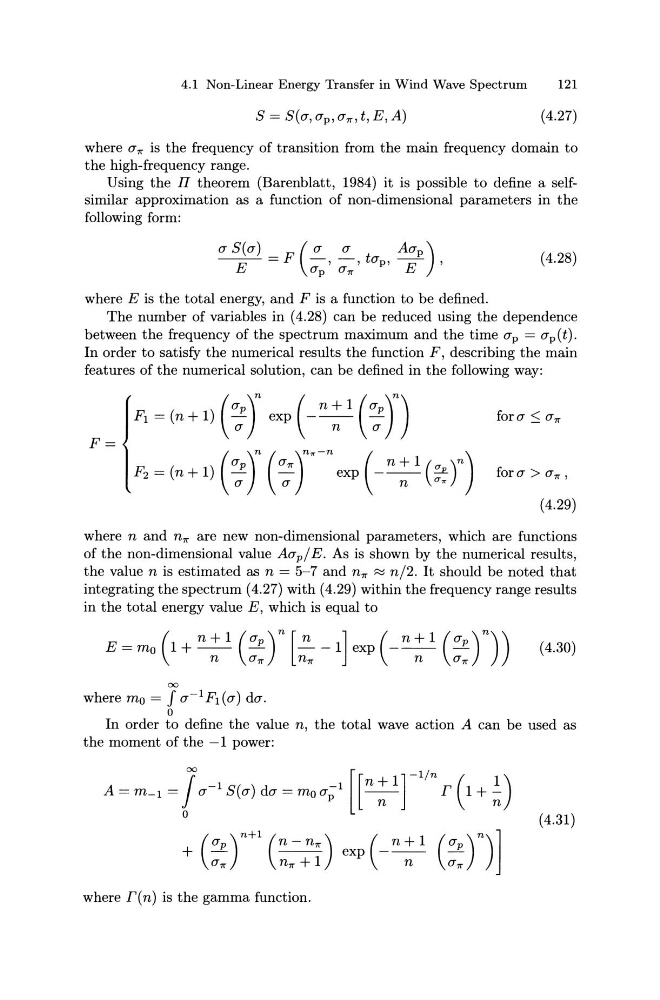
Using the II theorem (Barenblatt, 1984) it is possible to define a selfsimilar approximation as a function of non-dimensional parameters in the
following form:
(4.28)
where E is the total energy, and F is a function to be defined.
The number of variables in (4.28) can be reduced using the dependence
between the frequency of the spectrum maximum and the time ap = ap(t).
In order to satisfy the numerical results the function F, describing the main
features of the numerical solution, can be defined in the following way:
F=
( ) n (
( )n)
ap
n + 1 ap
F1 = (n + 1) --; exp --n- --;
ap
a"'
n + 1 u n
( ) n ( )n,-n
(
)
F2 = ( n + 1) --;
-;;
exp - -n- ( ~)
fora> a"',
(4.29)
where n and n"' are new non-dimensional parameters, which are functions
of the non-dimensional value Aap/ E. As is shown by the numerical results,
the value n is estimated as n = 5-7 and n"' ~ n/2. It should be noted that
integrating the spectrum ( 4.27) with ( 4.29) within the frequency range results
in the total energy value E, which is equal to
(
n+1(ap)n[n
]
( n+1(ap)n))
E = mo 1 + -n- a"'
n"' -1 exp --n- a"'
00
where mo = J a- 1 F1(a) da.
0
(4.30)
In order to define the value n, the total wave action A can be used as
the moment of the -1 power:
/
00
[[n+1]1 /n (
1)
A= m-1 =
0
a- 1 S(a) da = mo a; 1 -nr 1 + ~
(4.31)
ap
n- n"'
(
)
n+1 (
)
+ a"'
n"' + 1
( n + 1 (ap)n)]
exp --n- a"'
where r(n) is the gamma function.
121
S = S(a, ap, a"', t, E, A)
(4.27)
where a"' is the frequency of transition from the main frequency domain to
the high-frequency range.
Using the II theorem (Barenblatt, 1984) it is possible to define a selfsimilar approximation as a function of non-dimensional parameters in the
following form:
(4.28)
where E is the total energy, and F is a function to be defined.
The number of variables in (4.28) can be reduced using the dependence
between the frequency of the spectrum maximum and the time ap = ap(t).
In order to satisfy the numerical results the function F, describing the main
features of the numerical solution, can be defined in the following way:
F=
( ) n (
( )n)
ap
n + 1 ap
F1 = (n + 1) --; exp --n- --;
ap
a"'
n + 1 u n
( ) n ( )n,-n
(
)
F2 = ( n + 1) --;
-;;
exp - -n- ( ~)
fora> a"',
(4.29)
where n and n"' are new non-dimensional parameters, which are functions
of the non-dimensional value Aap/ E. As is shown by the numerical results,
the value n is estimated as n = 5-7 and n"' ~ n/2. It should be noted that
integrating the spectrum ( 4.27) with ( 4.29) within the frequency range results
in the total energy value E, which is equal to
(
n+1(ap)n[n
]
( n+1(ap)n))
E = mo 1 + -n- a"'
n"' -1 exp --n- a"'
00
where mo = J a- 1 F1(a) da.
0
(4.30)
In order to define the value n, the total wave action A can be used as
the moment of the -1 power:
/
00
[[n+1]1 /n (
1)
A= m-1 =
0
a- 1 S(a) da = mo a; 1 -nr 1 + ~
(4.31)
ap
n- n"'
(
)
n+1 (
)
+ a"'
n"' + 1
( n + 1 (ap)n)]
exp --n- a"'
where r(n) is the gamma function.