

120
4 Physical Mechanisms Forming the Wave Spectrum in Deep Water
B{t)
0.7
- + - - 1
- 2
- a - . 3
0.6
-----e-- ·4
-. 5
- 6
______..___ • 7
-8
-9
0.5
0.4
0.3
time
10
100
1000
1e+004 1e+005 1e+006 1e+007 1e+008
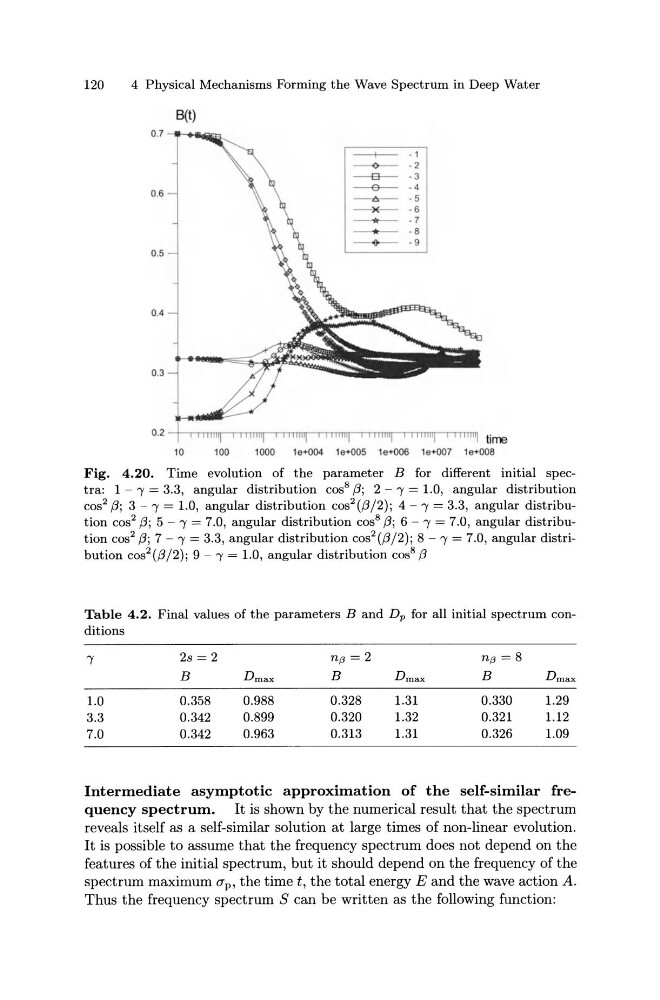
Fig. 4.20. Time evolution of the parameter B for different initial spectra: 1 - 1 = 3.3, angular distribution cos 8 (3; 2 - 1 = 1.0, angular distribution
cos 2 (3; 3 - 1 = 1.0, angular distribution cos 2 ((J/2); 4- 1 = 3.3, angular distribution cos 2 (3; 5 - 1 = 7.0, angular distribution cos 8 (3; 6 - 1 = 7.0, angular distribution cos 2 (3; 7 - 1 = 3.3, angular distribution cos 2 ((J/ 2); 8 - 1 = 7.0, angular distribution cos 2 ((J/2); 9- 1 = 1.0, angular distribution cos 8 (3
Table 4.2. Final values of the parameters B and D p for all initial spectrum conditions
'
2s = 2
n13 = 2
n 13 = 8
B
Dmax
B
Dmax
B
Dmax
1.0
0.358
0.988
0.328
1.31
0.330
1.29
3.3
0.342
0.899
0.320
1.32
0.321
1.12
7.0
0.342
0.963
0.313
1.31
0.326
1.09
Intermediate asymptotic approximation of the self-similar frequency spectrum. It is shown by the numerical result that the spectrum
reveals itself as a self-similar solution at large times of non-linear evolut ion.
It is possible to assume that the frequency spectrum does not depend on the
features of the initial spectrum, but it should depend on the frequency of the
spectrum maximum ap , the timet, the total energy E and the wave action A .
Thus the frequency spectrum S can be written as the following funct ion:
4 Physical Mechanisms Forming the Wave Spectrum in Deep Water
B{t)
0.7
- + - - 1
- 2
- a - . 3
0.6
-----e-- ·4
-. 5
- 6
______..___ • 7
-8
-9
0.5
0.4
0.3
time
10
100
1000
1e+004 1e+005 1e+006 1e+007 1e+008
Fig. 4.20. Time evolution of the parameter B for different initial spectra: 1 - 1 = 3.3, angular distribution cos 8 (3; 2 - 1 = 1.0, angular distribution
cos 2 (3; 3 - 1 = 1.0, angular distribution cos 2 ((J/2); 4- 1 = 3.3, angular distribution cos 2 (3; 5 - 1 = 7.0, angular distribution cos 8 (3; 6 - 1 = 7.0, angular distribution cos 2 (3; 7 - 1 = 3.3, angular distribution cos 2 ((J/ 2); 8 - 1 = 7.0, angular distribution cos 2 ((J/2); 9- 1 = 1.0, angular distribution cos 8 (3
Table 4.2. Final values of the parameters B and D p for all initial spectrum conditions
'
2s = 2
n13 = 2
n 13 = 8
B
Dmax
B
Dmax
B
Dmax
1.0
0.358
0.988
0.328
1.31
0.330
1.29
3.3
0.342
0.899
0.320
1.32
0.321
1.12
7.0
0.342
0.963
0.313
1.31
0.326
1.09
Intermediate asymptotic approximation of the self-similar frequency spectrum. It is shown by the numerical result that the spectrum
reveals itself as a self-similar solution at large times of non-linear evolut ion.
It is possible to assume that the frequency spectrum does not depend on the
features of the initial spectrum, but it should depend on the frequency of the
spectrum maximum ap , the timet, the total energy E and the wave action A .
Thus the frequency spectrum S can be written as the following funct ion: