

122
4 Physical Mechanisms Forming the Wave Spectrum in Deep Water
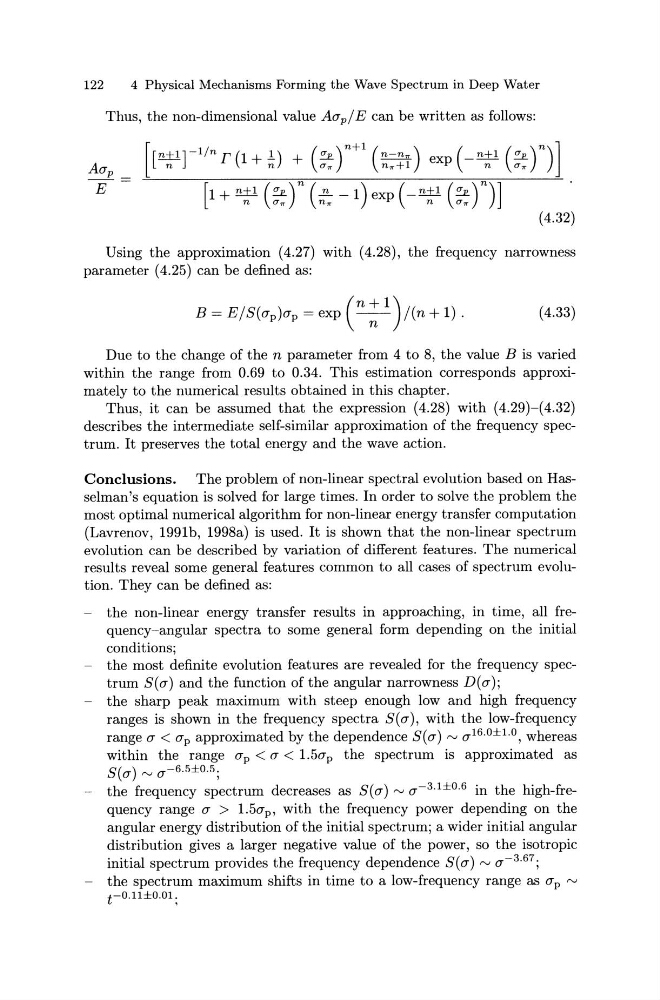
Thus, the non-dimensional value Aapj E can be written as follows:
[[~rl/n r(1+ !J + (~r+l (~) exp(-~ (~r)]
[1+n~l (~r(nn~ -1)exp(-~(~r)J
(4.32)
Using the approximation (4.27) with (4.28), the frequency narrowness
parameter ( 4.25) can be defined as:
( n+ 1)
B = E/S(ap)ap = exp -n- /(n + 1).
( 4.33)
Due to the change of the n parameter from 4 to 8, the value B is varied
within the range from 0.69 to 0.34. This estimation corresponds approximately to the numerical results obtained in this chapter.
Thus, it can be assumed that the expression ( 4.28) with ( 4.29)-( 4.32)
describes the intermediate self-similar approximation of the frequency spectrum. It preserves the total energy and the wave action.
Conclusions. The problem of non-linear spectral evolution based on Hasselman's equation is solved for large times. In order to solve the problem the
most optimal numerical algorithm for non-linear energy transfer computation
(Lavrenov, 1991b, 1998a) is used. It is shown that the non-linear spectrum
evolution can be described by variation of different features. The numerical
results reveal some general features common to all cases of spectrum evolution. They can be defined as:
- the non-linear energy transfer results in approaching, in time, all frequency-angular spectra to some general form depending on the initial
conditions;
- the most definite evolution features are revealed for the frequency spectrum S(a) and the function of the angular narrowness D(a);
- the sharp peak maximum with steep enough low and high frequency
ranges is shown in the frequency spectra S(a), with the low-frequency
range a< ap approximated by the dependence S(a) rv a 16 · 0 ±Lo, whereas
within the range ap
- the frequency spectrum decreases as S(a) "'a- 3 .1± 0 · 6 in the high-frequency range a > 1.5ap, with the frequency power depending on the
angular energy distribution of the initial spectrum; a wider initial angular
distribution gives a larger negative value of the power, so the isotropic
initial spectrum provides the frequency dependence S(a) "'a- 3 · 67 ;
- the spectrum maximum shifts in time to a low-frequency range asaP rv
cO.ll±O.Ol;
4 Physical Mechanisms Forming the Wave Spectrum in Deep Water
Thus, the non-dimensional value Aapj E can be written as follows:
[[~rl/n r(1+ !J + (~r+l (~) exp(-~ (~r)]
[1+n~l (~r(nn~ -1)exp(-~(~r)J
(4.32)
Using the approximation (4.27) with (4.28), the frequency narrowness
parameter ( 4.25) can be defined as:
( n+ 1)
B = E/S(ap)ap = exp -n- /(n + 1).
( 4.33)
Due to the change of the n parameter from 4 to 8, the value B is varied
within the range from 0.69 to 0.34. This estimation corresponds approximately to the numerical results obtained in this chapter.
Thus, it can be assumed that the expression ( 4.28) with ( 4.29)-( 4.32)
describes the intermediate self-similar approximation of the frequency spectrum. It preserves the total energy and the wave action.
Conclusions. The problem of non-linear spectral evolution based on Hasselman's equation is solved for large times. In order to solve the problem the
most optimal numerical algorithm for non-linear energy transfer computation
(Lavrenov, 1991b, 1998a) is used. It is shown that the non-linear spectrum
evolution can be described by variation of different features. The numerical
results reveal some general features common to all cases of spectrum evolution. They can be defined as:
- the non-linear energy transfer results in approaching, in time, all frequency-angular spectra to some general form depending on the initial
conditions;
- the most definite evolution features are revealed for the frequency spectrum S(a) and the function of the angular narrowness D(a);
- the sharp peak maximum with steep enough low and high frequency
ranges is shown in the frequency spectra S(a), with the low-frequency
range a< ap approximated by the dependence S(a) rv a 16 · 0 ±Lo, whereas
within the range ap
- the frequency spectrum decreases as S(a) "'a- 3 .1± 0 · 6 in the high-frequency range a > 1.5ap, with the frequency power depending on the
angular energy distribution of the initial spectrum; a wider initial angular
distribution gives a larger negative value of the power, so the isotropic
initial spectrum provides the frequency dependence S(a) "'a- 3 · 67 ;
- the spectrum maximum shifts in time to a low-frequency range asaP rv
cO.ll±O.Ol;