

dead-reckoning
86
ing populations of insects carrying diseases such as malaria. Persistence of
DDT and its adverse effects on wildlife led DDT to be restricted severely as
from the start of 1970. The technical mixture dichlorodiphenyltrichloroethane
contains three isomers, of which p,p'-DDT is the principal component; the others are the o,p'-DDT and p,p'-DDE, the minor constituent to the technical mixture. In the environment DDT is rapidly converted to p,p'-DDE (in biota) and
to p,p'-DDD in the abiotic compartments (sediment and water).
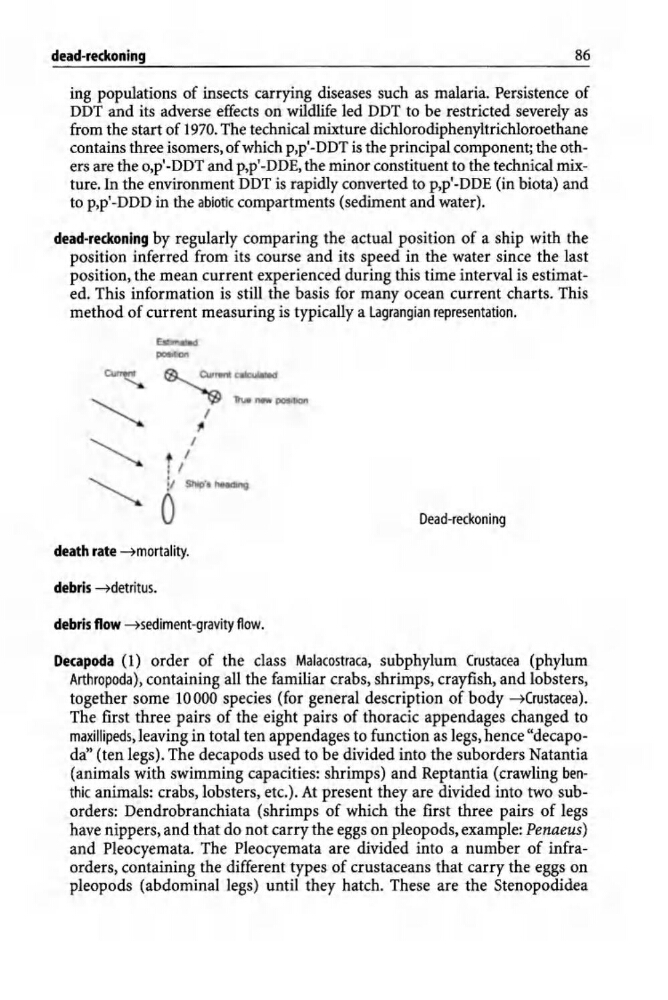
dead-reckoning by regularly comparing the actual position of a ship with the
position inferred from its course and its speed in the water since the last
position, the mean current experienced during this time interval is estimated. This information is still the basis for many ocean current charts. This
method of current measuring is typically a lagrangian representation.
~ cu......caICu_
~ 1h.- ' - _lion
I
I
+ I
: I
~
V SNp'.-.g
o
death rate --7mortality.
debris --7detritus.
debris flow --7sediment-gravity flow.
Dead-reckoning
Decapoda (1) order of the class Malacostraca, subphylum Crustacea (phylum
Arthropoda), containing all the familiar crabs, shrimps, crayfish, and lobsters,
together some 10000 species (for general description of body --7Crustacea).
The first three pairs of the eight pairs of thoracic appendages changed to
maxillipeds, leaving in total ten appendages to function as legs, hence "decapoda" (ten legs). The decapods used to be divided into the suborders Natantia
(animals with swimming capacities: shrimps) and Reptantia (crawling benthic animals: crabs, lobsters, etc.). At present they are divided into two suborders: Dendrobranchiata (shrimps of which the first three pairs of legs
have nippers, and that do not carry the eggs on pleopods, example: Penaeus)
and Pleocyemata. The Pleocyemata are divided into a number of infraorders, containing the different types of crustaceans that carry the eggs on
pleopods (abdominal legs) until they hatch. These are the Stenopodidea
86
ing populations of insects carrying diseases such as malaria. Persistence of
DDT and its adverse effects on wildlife led DDT to be restricted severely as
from the start of 1970. The technical mixture dichlorodiphenyltrichloroethane
contains three isomers, of which p,p'-DDT is the principal component; the others are the o,p'-DDT and p,p'-DDE, the minor constituent to the technical mixture. In the environment DDT is rapidly converted to p,p'-DDE (in biota) and
to p,p'-DDD in the abiotic compartments (sediment and water).
dead-reckoning by regularly comparing the actual position of a ship with the
position inferred from its course and its speed in the water since the last
position, the mean current experienced during this time interval is estimated. This information is still the basis for many ocean current charts. This
method of current measuring is typically a lagrangian representation.
~ cu......caICu_
~ 1h.- ' - _lion
I
I
+ I
: I
~
V SNp'.-.g
o
death rate --7mortality.
debris --7detritus.
debris flow --7sediment-gravity flow.
Dead-reckoning
Decapoda (1) order of the class Malacostraca, subphylum Crustacea (phylum
Arthropoda), containing all the familiar crabs, shrimps, crayfish, and lobsters,
together some 10000 species (for general description of body --7Crustacea).
The first three pairs of the eight pairs of thoracic appendages changed to
maxillipeds, leaving in total ten appendages to function as legs, hence "decapoda" (ten legs). The decapods used to be divided into the suborders Natantia
(animals with swimming capacities: shrimps) and Reptantia (crawling benthic animals: crabs, lobsters, etc.). At present they are divided into two suborders: Dendrobranchiata (shrimps of which the first three pairs of legs
have nippers, and that do not carry the eggs on pleopods, example: Penaeus)
and Pleocyemata. The Pleocyemata are divided into a number of infraorders, containing the different types of crustaceans that carry the eggs on
pleopods (abdominal legs) until they hatch. These are the Stenopodidea