
 French
Permalien :
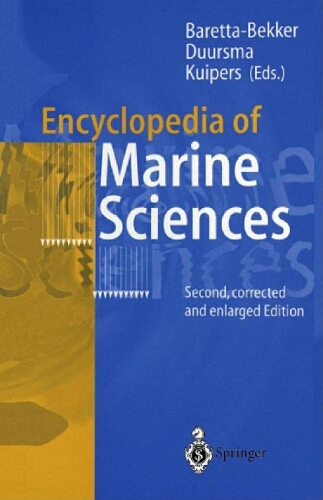
Encyclopedia of marine sciences
- Date_TXT
- Berlin : Springer , 1998
- Cote
- 551.460 3 HAN
- Auteur
- Hanneke, J. G., Baretta-Bekker, Egbert K. Duursma
- Type de document
- Livre
Description :
Marine science today is an area of rapid expansion. Scientific activity is increasing, and a growing number of scientists are involved in one or more of its disciplines. For a thorough understanding of the marine environment, for its exploration, exploitation, and management, background knowledge of more than one discipline is required. A clear need therefore exists for a concise multidisciplinary oceanographic encyclopedia.
The initiative for this book was taken by the Netherlands Institute of Sea Research, NIOZ, texel, a multidisciplinary institute, founded in 1876.
The second edition of this encyclopedia contains some 1980 entries, 210 of which in (bio) chemistry, 330 in (bio) physics, 350 in geology, and 970 in biology, while the remaining 120 are general terms, with 60 on oceanographic expeditions. Concepts, terminology, and methods of the various disciplines are briefly explained and, especially in the description of marine processes, the book tries to be more than a glossary or a dictionary. It attempts to provide a succinct overview of the major topics in marine science. Students, teachers and scientists as well as interested laymen may use it to find an explanation of oceanographic terms outside their own fields. The manuscript of the first edition was read by a variety of potential users, whose comments have been used to improve and clarify the descriptions.
The second edition has benefited from the comments by several reviewers. Based on their comments, omissions and errors have been corrected and the encyclopedia has been extended with entries on fishery biology and oceanographic expeditions. The taxonomy of organisms and the description of taxonomical groups has been revised and updated. The five kingdoms classification (Margulies and Schwartz 1987) is used throughout this edition. For one of these kingdoms, the Protoctista, the system of Margulies et al. (1990) is followed. However, taxonomy is a living science, and different views about the major classifications of organisms do exist and are used in textbooks. Our approach induced some major changes in comparison with the first edition, especially within the unicellular groups. Some major group names of older or other classification systems are still preserved in the list. The descriptions of the different taxonomical groups had to be kept general and short, and could not include exceptions to the general pattern.