

87
Deep-Sea Drilling Project
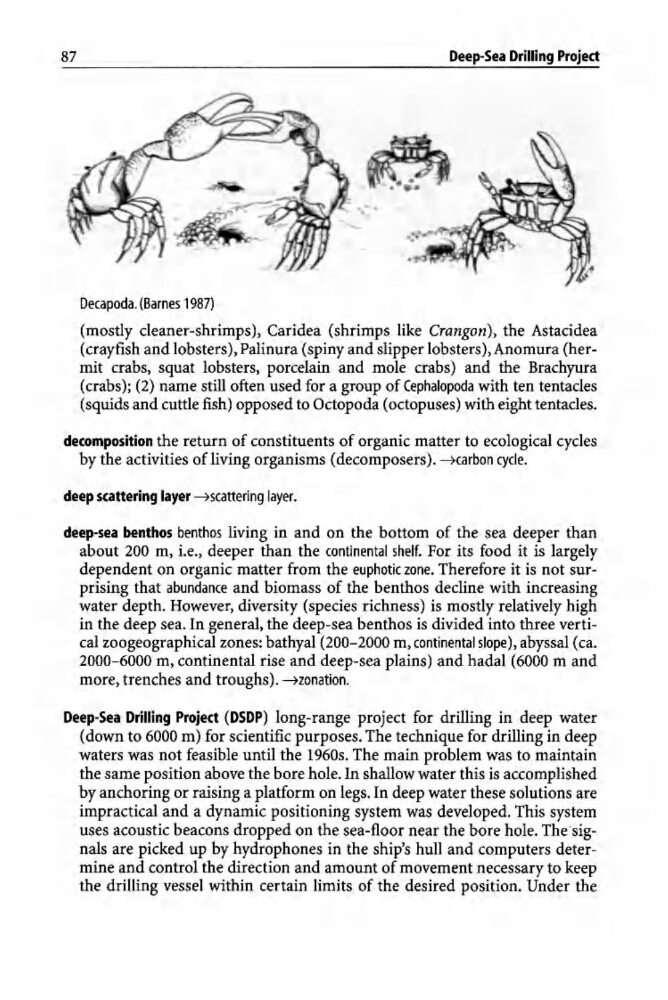
,-Decapoda. (Barnes 1987)
(mostly cleaner-shrimps), Caridea (shrimps like Crangon), the Astacidea
(crayfish and lobsters), Palinura (spiny and slipper lobsters), Anomura (hermit crabs, squat lobsters, porcelain and mole crabs) and the Brachyura
(crabs); (2) name still often used for a group of Cephalopoda with ten tentacles
(squids and cuttle fish) opposed to Octopoda (octopuses) with eight tentacles.
decomposition the return of constituents of organic matter to ecological cycles
by the activities of living organisms (decomposers). ~carbon cycle.
deep scattering layer ~scattering layer.
deep-sea benthos benthos living in and on the bottom of the sea deeper than
about 200 m, i.e., deeper than the continental shelf. For its food it is largely
dependent on organic matter from the euphotic zone. Therefore it is not surprising that abundance and biomass of the benthos decline with increasing
water depth. However, diversity (species richness) is mostly relatively high
in the deep sea. In general, the deep-sea benthos is divided into three vertical zoogeographical zones: bathyal (200-2000 m, continental slope), abyssal (ca.
2000-6000 m, continental rise and deep-sea plains) and hadal (6000 m and
more, trenches and troughs). ~zonation.
Deep-Sea Drilling Project (DSDP) long-range project for drilling in deep water
(down to 6000 m) for scientific purposes. The technique for drilling in deep
waters was not feasible until the 1960s. The main problem was to maintain
the same position above the bore hole. In shallow water this is accomplished
by anchoring or raising a platform on legs. In deep water these solutions are
impractical and a dynamic positioning system was developed. This system
uses acoustic beacons dropped on the sea-floor near the bore hole. Thesignals are picked up by hydrophones in the ship's hull and computers determine and control the direction and amount of movement necessary to keep
the drilling vessel within certain limits of the desired position. Under the
Deep-Sea Drilling Project
,-Decapoda. (Barnes 1987)
(mostly cleaner-shrimps), Caridea (shrimps like Crangon), the Astacidea
(crayfish and lobsters), Palinura (spiny and slipper lobsters), Anomura (hermit crabs, squat lobsters, porcelain and mole crabs) and the Brachyura
(crabs); (2) name still often used for a group of Cephalopoda with ten tentacles
(squids and cuttle fish) opposed to Octopoda (octopuses) with eight tentacles.
decomposition the return of constituents of organic matter to ecological cycles
by the activities of living organisms (decomposers). ~carbon cycle.
deep scattering layer ~scattering layer.
deep-sea benthos benthos living in and on the bottom of the sea deeper than
about 200 m, i.e., deeper than the continental shelf. For its food it is largely
dependent on organic matter from the euphotic zone. Therefore it is not surprising that abundance and biomass of the benthos decline with increasing
water depth. However, diversity (species richness) is mostly relatively high
in the deep sea. In general, the deep-sea benthos is divided into three vertical zoogeographical zones: bathyal (200-2000 m, continental slope), abyssal (ca.
2000-6000 m, continental rise and deep-sea plains) and hadal (6000 m and
more, trenches and troughs). ~zonation.
Deep-Sea Drilling Project (DSDP) long-range project for drilling in deep water
(down to 6000 m) for scientific purposes. The technique for drilling in deep
waters was not feasible until the 1960s. The main problem was to maintain
the same position above the bore hole. In shallow water this is accomplished
by anchoring or raising a platform on legs. In deep water these solutions are
impractical and a dynamic positioning system was developed. This system
uses acoustic beacons dropped on the sea-floor near the bore hole. Thesignals are picked up by hydrophones in the ship's hull and computers determine and control the direction and amount of movement necessary to keep
the drilling vessel within certain limits of the desired position. Under the