

crust
78
bedding is caused by the migration of megaripples, longshore bars, and others;
units may reach thicknesses of 1 to 2 m. ~sedimentary structures.
Cross-bedding. (Reineck and Singh, 973)
crust outermost shell of the earth, overlying the mantle above the MohoroviCiC discontinuity. The definition includes the overlying sediments. The crust can be
divided into the part constituting the continents (continental crust) and the part
forming the floor of the ocean's basins (oceanic crust). Continental crust is composed of granitic rocks and denser (probably gabbroic) rocks at depth. It is
generally 30 km thick, but may be over 60 km thick under mountain regions.
Oceanic crust is only 5-10 km thick and is composed of a layer of basaltic rocks
(underlain by more peridotitic rocks at depth). ~earth's internal structure.
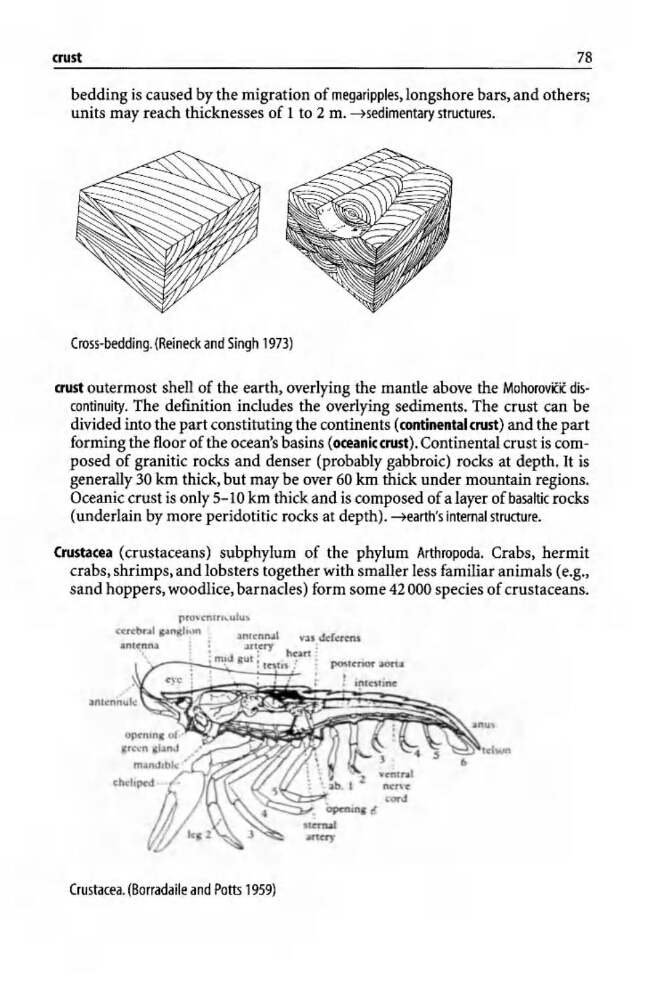
Crustacea (crustaceans) subphylum of the phylum Arthropoda. Crabs, hermit
crabs, shrimps, and lobsters together with smaller less familiar animals (e.g.,
sand hoppers, woodlice, barnacles) form some 42000 species of crustaceans.
pr cnlth,:ulu~
ccfcbf .. ll.ln h",,, .
.lnlC~ nn.l1
V;lS ddC'rcn5
;anlC'.~fU
:
;&tIer")'
;
"'-_ _ "'- : m,d BUI ; InUJ h : ut ~ poll eCtor ;aorta
;
f
I
! ._ ~'Unllne
,",1
ncr\'c
cord
78
bedding is caused by the migration of megaripples, longshore bars, and others;
units may reach thicknesses of 1 to 2 m. ~sedimentary structures.
Cross-bedding. (Reineck and Singh, 973)
crust outermost shell of the earth, overlying the mantle above the MohoroviCiC discontinuity. The definition includes the overlying sediments. The crust can be
divided into the part constituting the continents (continental crust) and the part
forming the floor of the ocean's basins (oceanic crust). Continental crust is composed of granitic rocks and denser (probably gabbroic) rocks at depth. It is
generally 30 km thick, but may be over 60 km thick under mountain regions.
Oceanic crust is only 5-10 km thick and is composed of a layer of basaltic rocks
(underlain by more peridotitic rocks at depth). ~earth's internal structure.
Crustacea (crustaceans) subphylum of the phylum Arthropoda. Crabs, hermit
crabs, shrimps, and lobsters together with smaller less familiar animals (e.g.,
sand hoppers, woodlice, barnacles) form some 42000 species of crustaceans.
pr cnlth,:ulu~
ccfcbf .. ll.ln h",,, .
.lnlC~ nn.l1
V;lS ddC'rcn5
;anlC'.~fU
:
;&tIer")'
;
"'-_ _ "'- : m,d BUI ; InUJ h : ut ~ poll eCtor ;aorta
;
f
I
! ._ ~'Unllne
,",1
ncr\'c
cord