

77
cross-bedding
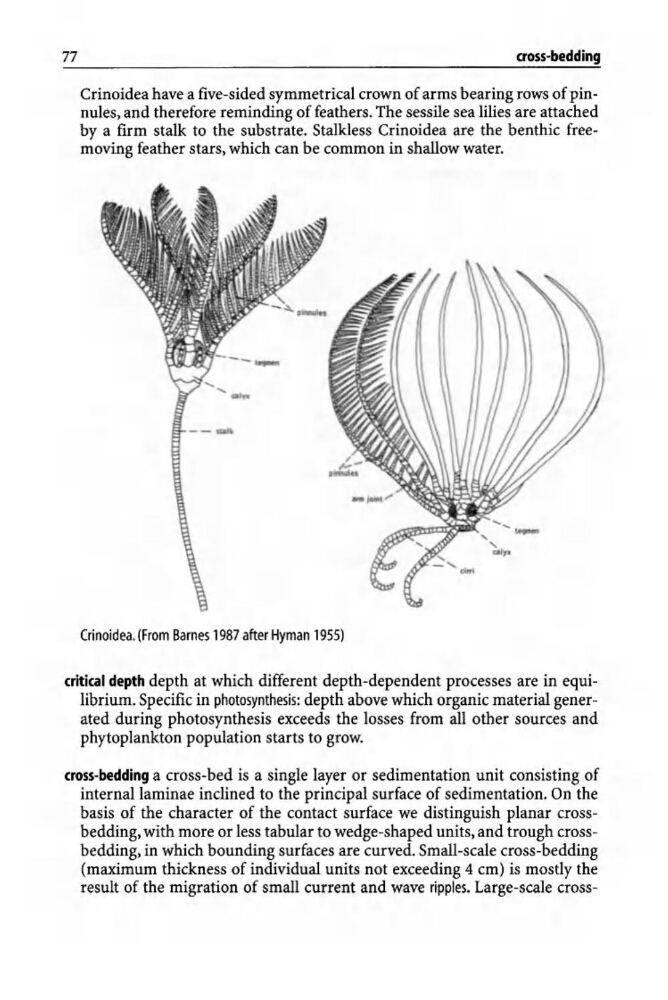
Crinoidea have a five-sided symmetrical crown of arms bearing rows of pinnules, and therefore reminding of feathers. The sessile sea lilies are attached
by a firm stalk to the substrate. Stalkless Crinoidea are the benthic freemoving feather stars, which can be common in shallow water.
- - 1U1\
Crinoidea. (From Barnes 1987 after Hyman 1955)
critical depth depth at which different depth-dependent processes are in equilibrium. Specific in photosynthesis: depth above which organic material generated during photosynthesis exceeds the losses from all other sources and
phytoplankton population starts to grow.
cross-bedding a cross-bed is a single layer or sedimentation unit consisting of
internal laminae inclined to the principal surface of sedimentation. On the
basis of the character of the contact surface we distinguish planar crossbedding, with more or less tabular to wedge-shaped units, and trough crossbedding, in which bounding surfaces are curved. Small-scale cross-bedding
(maximum thickness of individual units not exceeding 4 cm) is mostly the
result of the migration of small current and wave ripples. Large-scale cross-
cross-bedding
Crinoidea have a five-sided symmetrical crown of arms bearing rows of pinnules, and therefore reminding of feathers. The sessile sea lilies are attached
by a firm stalk to the substrate. Stalkless Crinoidea are the benthic freemoving feather stars, which can be common in shallow water.
- - 1U1\
Crinoidea. (From Barnes 1987 after Hyman 1955)
critical depth depth at which different depth-dependent processes are in equilibrium. Specific in photosynthesis: depth above which organic material generated during photosynthesis exceeds the losses from all other sources and
phytoplankton population starts to grow.
cross-bedding a cross-bed is a single layer or sedimentation unit consisting of
internal laminae inclined to the principal surface of sedimentation. On the
basis of the character of the contact surface we distinguish planar crossbedding, with more or less tabular to wedge-shaped units, and trough crossbedding, in which bounding surfaces are curved. Small-scale cross-bedding
(maximum thickness of individual units not exceeding 4 cm) is mostly the
result of the migration of small current and wave ripples. Large-scale cross-