

co-tidal lines
76
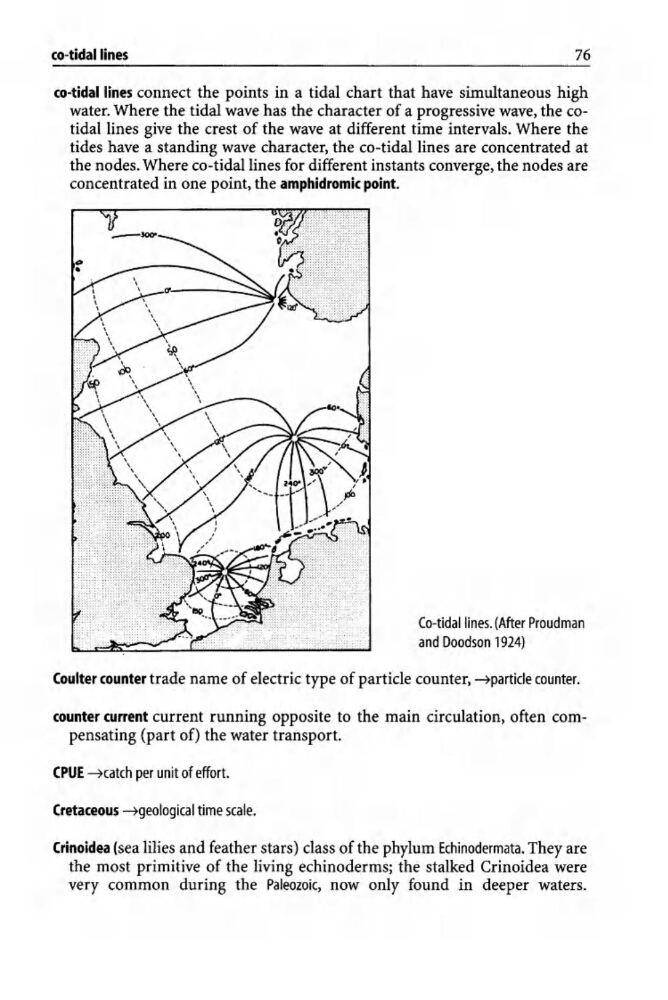
co-tidal lines connect the points in a tidal chart that have simultaneous high
water. Where the tidal wave has the character of a progressive wave, the cotidal lines give the crest of the wave at different time intervals. Where the
tides have a standing wave character, the co-tidal lines are concentrated at
the nodes. Where co-tidal lines for different instants converge, the nodes are
concentrated in one point, the amphidromic point.
Co-tidal lines. (After Proudman
and Doodson 1924)
Coulter counter trade name of electric type of particle counter, ~particle counter.
counter current current running opposite to the main circulation, often compensating (part of) the water transport.
CPUE ~catch per unit of effort.
Cretaceous ~geological time scale.
Crinoidea (sea lilies and feather stars) class of the phylum Echinodermata. They are
the most primitive of the living echinoderms; the stalked Crinoidea were
very common during the Paleozoic, now only found in deeper waters.
76
co-tidal lines connect the points in a tidal chart that have simultaneous high
water. Where the tidal wave has the character of a progressive wave, the cotidal lines give the crest of the wave at different time intervals. Where the
tides have a standing wave character, the co-tidal lines are concentrated at
the nodes. Where co-tidal lines for different instants converge, the nodes are
concentrated in one point, the amphidromic point.
Co-tidal lines. (After Proudman
and Doodson 1924)
Coulter counter trade name of electric type of particle counter, ~particle counter.
counter current current running opposite to the main circulation, often compensating (part of) the water transport.
CPUE ~catch per unit of effort.
Cretaceous ~geological time scale.
Crinoidea (sea lilies and feather stars) class of the phylum Echinodermata. They are
the most primitive of the living echinoderms; the stalked Crinoidea were
very common during the Paleozoic, now only found in deeper waters.