

Copepoda
72
free-living or parasitic, small (only few species are larger than 1 mm) but
extremely numerous, often dominate the zooplankton and are next to the
Nematoda the most common meiofaunal (~meiobenthos) animals. The body
consists of six thoracic segments, of which one or two are fused with the
head, forming the cephalothorax. The thoracic segments bear six pair of
appendages (maxilliped and five pair of limbs); the abdomen has five segments without limbs. The feeding can be raptorial, or filtering of particles
(mainly algae) from a water current effectuated by the anterior appendages.
The eggs (in the order of 100 jlIl1) are sometimes carried in egg sacs attached
to the first abdominal segment, but generally released in the water, where
they hatch in about a day. The larvae develop by successive molting through six
naupliar (~nauplius) and five copepodite stages (CI to CV) to the sixth or adult
stage. The generation time varies, depending on species, temperature and
food supply, from 2-3 weeks to 2-3 years. Sexes are separate; after fertilization the female stores the sperm and produces fertilized eggs over extended
periods. For overwintering in temperate and arctic regions, special resting
stages (copepodite CV) or winter eggs may be produced in late summer. The
free-living, nonparasitic copepods are divided into three orders: the
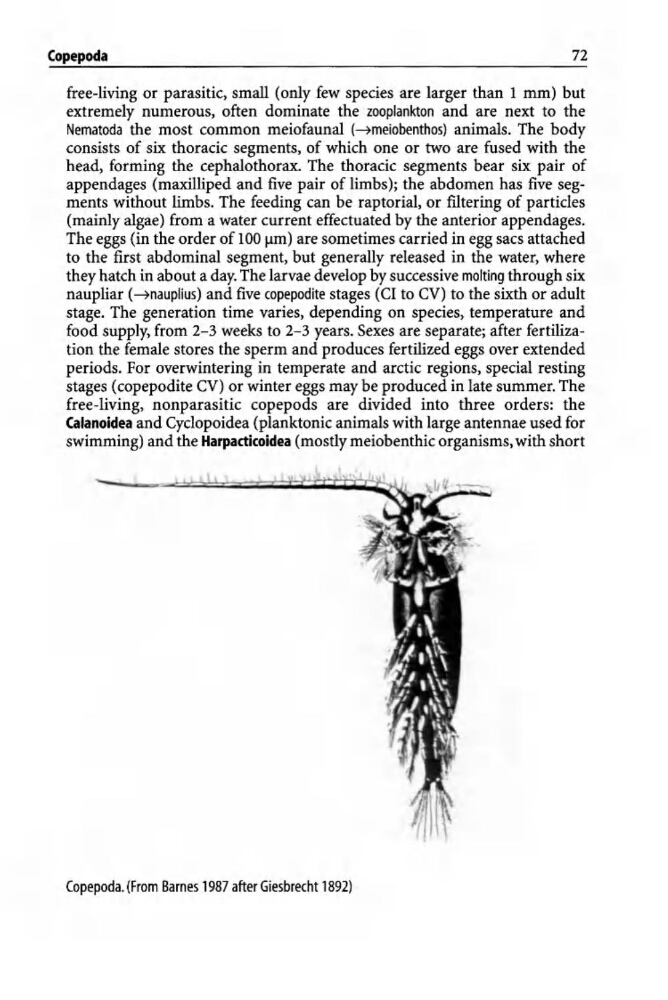
Calanoidea and Cyclopoidea (planktonic animals with large antennae used for
swimming) and the Harpacticoidea (mostly meiobenthic organisms, with short
Copepoda. (From Barnes 1987 after Giesbrecht 1892)
72
free-living or parasitic, small (only few species are larger than 1 mm) but
extremely numerous, often dominate the zooplankton and are next to the
Nematoda the most common meiofaunal (~meiobenthos) animals. The body
consists of six thoracic segments, of which one or two are fused with the
head, forming the cephalothorax. The thoracic segments bear six pair of
appendages (maxilliped and five pair of limbs); the abdomen has five segments without limbs. The feeding can be raptorial, or filtering of particles
(mainly algae) from a water current effectuated by the anterior appendages.
The eggs (in the order of 100 jlIl1) are sometimes carried in egg sacs attached
to the first abdominal segment, but generally released in the water, where
they hatch in about a day. The larvae develop by successive molting through six
naupliar (~nauplius) and five copepodite stages (CI to CV) to the sixth or adult
stage. The generation time varies, depending on species, temperature and
food supply, from 2-3 weeks to 2-3 years. Sexes are separate; after fertilization the female stores the sperm and produces fertilized eggs over extended
periods. For overwintering in temperate and arctic regions, special resting
stages (copepodite CV) or winter eggs may be produced in late summer. The
free-living, nonparasitic copepods are divided into three orders: the
Calanoidea and Cyclopoidea (planktonic animals with large antennae used for
swimming) and the Harpacticoidea (mostly meiobenthic organisms, with short
Copepoda. (From Barnes 1987 after Giesbrecht 1892)