

71
Copepoda
.-....
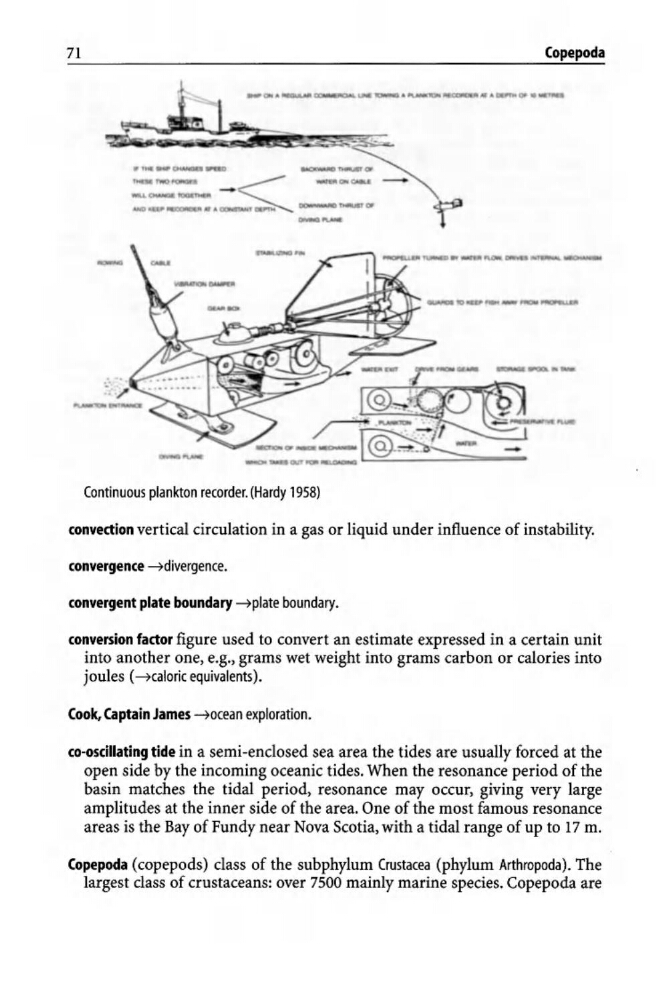
Continuous plankton recorder. (Hardy 1958)
convection vertical circulation in a gas or liquid under influence of instability.
convergence ~divergence.
convergent plate boundary ~plate boundary.
conversion factor figure used to convert an estimate expressed in a certain unit
into another one, e.g., grams wet weight into grams carbon or calories into
joules (~caloric equivalents).
Cook, Captain James ~ocean exploration.
co-oscillating tide in a semi-enclosed sea area the tides are usually forced at the
open side by the incoming oceanic tides. When the resonance period of the
basin matches the tidal period, resonance may occur, giving very large
amplitudes at the inner side of the area. One of the most famous resonance
areas is the Bay of Fundy near Nova Scotia, with a tidal range of up to 17 m.
Copepoda (copepods) class of the subphylum Crustacea (phylum Arthropoda). The
largest class of crustaceans: over 7500 mainly marine species. Copepoda are
Copepoda
.-....
Continuous plankton recorder. (Hardy 1958)
convection vertical circulation in a gas or liquid under influence of instability.
convergence ~divergence.
convergent plate boundary ~plate boundary.
conversion factor figure used to convert an estimate expressed in a certain unit
into another one, e.g., grams wet weight into grams carbon or calories into
joules (~caloric equivalents).
Cook, Captain James ~ocean exploration.
co-oscillating tide in a semi-enclosed sea area the tides are usually forced at the
open side by the incoming oceanic tides. When the resonance period of the
basin matches the tidal period, resonance may occur, giving very large
amplitudes at the inner side of the area. One of the most famous resonance
areas is the Bay of Fundy near Nova Scotia, with a tidal range of up to 17 m.
Copepoda (copepods) class of the subphylum Crustacea (phylum Arthropoda). The
largest class of crustaceans: over 7500 mainly marine species. Copepoda are