

73
corals
antennae and no such a clear division between thorax and abdomen as in the
other orders). Copepods (mainly Calanoidea) form a link in marine food
chains between the phytoplankton and pelagic planktivore fish like herring.
copepodite larval stage of Copepoda, with three pairs of functional swimming
legs. There are five copepodite stages (CI-CV). -7Copepoda.
coprophagy ingestion of feces. Especially the nonassimilated compounds in
feces of herbivores may have high nutritional value for omnivores and detritivores.
-7fecal pellets.
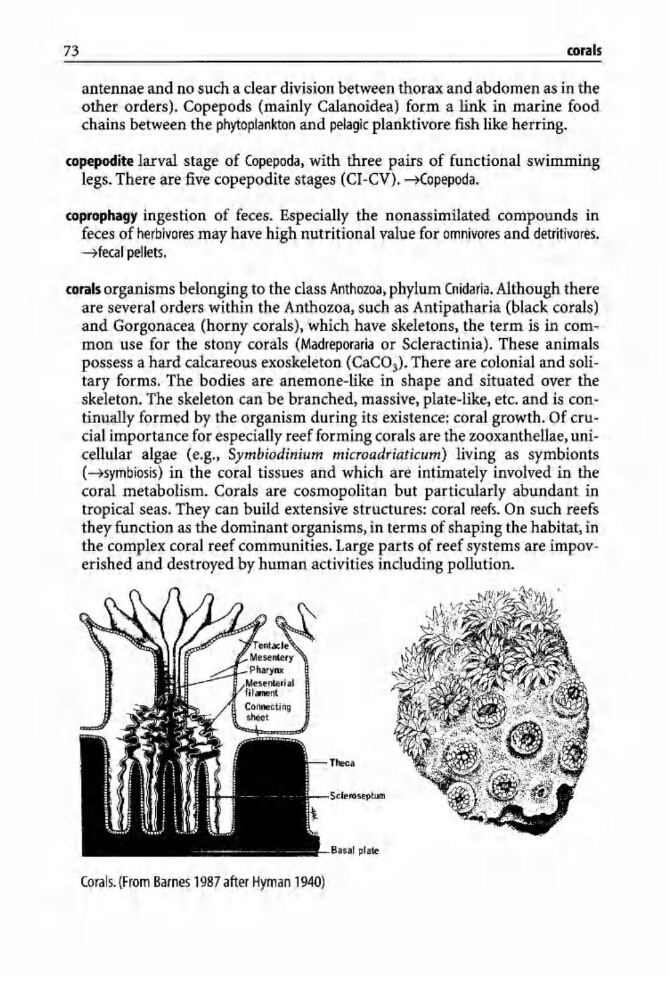
corals organisms belonging to the class Anthozoa, phylum Cnidaria. Although there
are several orders within the Anthozoa, such as Antipatharia (black corals)
and Gorgonacea (horny corals), which have skeletons, the term is in common use for the stony corals (Madreporaria or Scleractinia). These animals
possess a hard calcareous exoskeleton (CaC0 3 ). There are colonial and solitary forms. The bodies are anemone-like in shape and situated over the
skeleton. The skeleton can be branched, massive, plate-like, etc. and is continually formed by the organism during its existence: coral growth. Of crucial importance for especially reef forming corals are the zooxanthellae, unicellular algae (e.g., Symbiodinium microadriaticum) living as symbionts
(-7symbiosis) in the coral tissues and which are intimately involved in the
coral metabolism. Corals are cosmopolitan but particularly abundant in
tropical seas. They can build extensive structures: coral reefs. On such reefs
they function as the dominant organisms, in terms of shaping the habitat, in
the complex coral reef communities. Large parts of reef systems are impoverished and destroyed by human activities including pollution.
plate
Corals. (From Barnes 1987 after Hyman 1940)
corals
antennae and no such a clear division between thorax and abdomen as in the
other orders). Copepods (mainly Calanoidea) form a link in marine food
chains between the phytoplankton and pelagic planktivore fish like herring.
copepodite larval stage of Copepoda, with three pairs of functional swimming
legs. There are five copepodite stages (CI-CV). -7Copepoda.
coprophagy ingestion of feces. Especially the nonassimilated compounds in
feces of herbivores may have high nutritional value for omnivores and detritivores.
-7fecal pellets.
corals organisms belonging to the class Anthozoa, phylum Cnidaria. Although there
are several orders within the Anthozoa, such as Antipatharia (black corals)
and Gorgonacea (horny corals), which have skeletons, the term is in common use for the stony corals (Madreporaria or Scleractinia). These animals
possess a hard calcareous exoskeleton (CaC0 3 ). There are colonial and solitary forms. The bodies are anemone-like in shape and situated over the
skeleton. The skeleton can be branched, massive, plate-like, etc. and is continually formed by the organism during its existence: coral growth. Of crucial importance for especially reef forming corals are the zooxanthellae, unicellular algae (e.g., Symbiodinium microadriaticum) living as symbionts
(-7symbiosis) in the coral tissues and which are intimately involved in the
coral metabolism. Corals are cosmopolitan but particularly abundant in
tropical seas. They can build extensive structures: coral reefs. On such reefs
they function as the dominant organisms, in terms of shaping the habitat, in
the complex coral reef communities. Large parts of reef systems are impoverished and destroyed by human activities including pollution.
plate
Corals. (From Barnes 1987 after Hyman 1940)