

237
plate tectonics
types of plate boundaries: (a) the convergent plate boundary, where two plates
are moving towards each other. Motion is accommodated by one plate overriding the other. At the surface, converging plate boundaries are manifested
as deep oceanic trenches (resulting from the downward movement of overridden sea floor), or as mountain chains (in zones of continent-continent
collision); (b) the divergent plate boundary, where two plates are moving apart,
and new oceanic-type lithosphere is created. These spreading centers show as
mid-ocean ridges or partly as rifts; (c) the transform plate boundary, where relative
plate motion has no component perpendicular to the boundary and plates
are passively sliding against each other. Transform plate boundaries are
manifested as transform faults. ~plate tectonics.
plate tectonics a theory was developed in the early 1960s, renewing and founding the hypothesis of continental displacement. In this concept of plate tectonics,
the earth's lithosphere is divided into a small number of mobile rigid plates
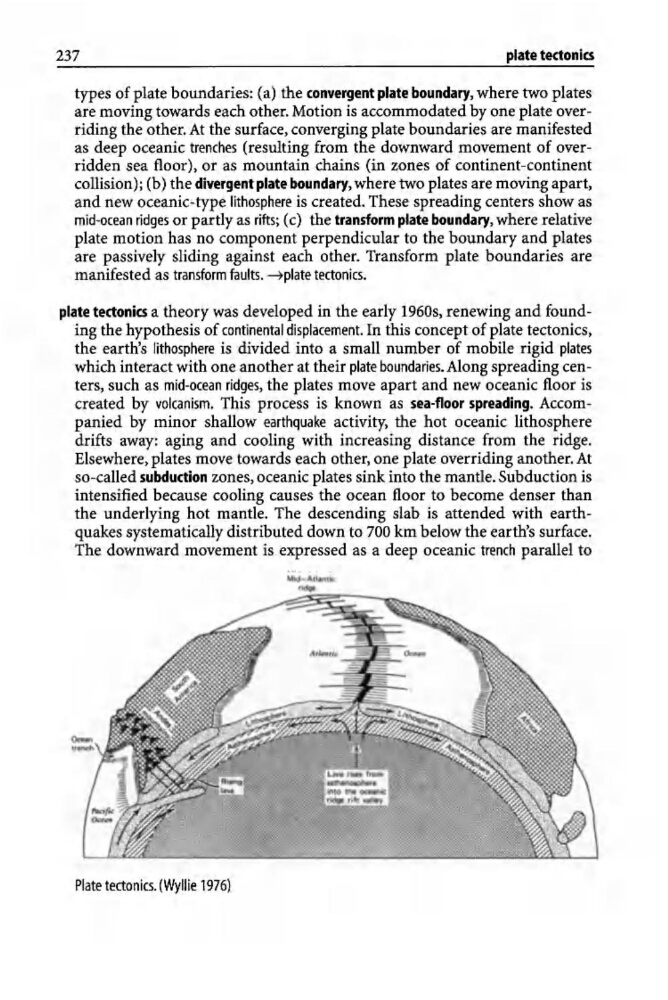
which interact with one another at their plate boundaries. Along spreading centers, such as mid-ocean ridges, the plates move apart and new oceanic floor is
created by volcanism. This process is known as sea-floor spreading. Accompanied by minor shallow earthquake activity, the hot oceanic lithosphere
drifts away: aging and cooling with increasing distance from the ridge.
Elsewhere, plates move towards each other, one plate overriding another. At
so-called subduction zones, oceanic plates sink into the mantle. Subduction is
intensified because cooling causes the ocean floor to become denser than
the underlying hot mantle. The descending slab is attended with earthquakes systematically distributed down to 700 km below the earth's surface.
The downward movement is expressed as a deep oceanic trench parallel to
Plate tectonics. (Wyllie 1976)
-....
plate tectonics
types of plate boundaries: (a) the convergent plate boundary, where two plates
are moving towards each other. Motion is accommodated by one plate overriding the other. At the surface, converging plate boundaries are manifested
as deep oceanic trenches (resulting from the downward movement of overridden sea floor), or as mountain chains (in zones of continent-continent
collision); (b) the divergent plate boundary, where two plates are moving apart,
and new oceanic-type lithosphere is created. These spreading centers show as
mid-ocean ridges or partly as rifts; (c) the transform plate boundary, where relative
plate motion has no component perpendicular to the boundary and plates
are passively sliding against each other. Transform plate boundaries are
manifested as transform faults. ~plate tectonics.
plate tectonics a theory was developed in the early 1960s, renewing and founding the hypothesis of continental displacement. In this concept of plate tectonics,
the earth's lithosphere is divided into a small number of mobile rigid plates
which interact with one another at their plate boundaries. Along spreading centers, such as mid-ocean ridges, the plates move apart and new oceanic floor is
created by volcanism. This process is known as sea-floor spreading. Accompanied by minor shallow earthquake activity, the hot oceanic lithosphere
drifts away: aging and cooling with increasing distance from the ridge.
Elsewhere, plates move towards each other, one plate overriding another. At
so-called subduction zones, oceanic plates sink into the mantle. Subduction is
intensified because cooling causes the ocean floor to become denser than
the underlying hot mantle. The descending slab is attended with earthquakes systematically distributed down to 700 km below the earth's surface.
The downward movement is expressed as a deep oceanic trench parallel to
Plate tectonics. (Wyllie 1976)
-....