

Plantae
236
Plantae (plants) one of the five kingdoms of living organisms. It includes the
mosses, ferns and flowerings plants. The only plants that can live permanently submerged in seawater are the sea grasses. In the littoral zone more
plants can survive, especially in salt marshes. Even some trees can survive a
partly submersion and can form mangroves.
plasmid is an extrachromosomal genetic element not essential to growth. Many
plasmids carry genes that control the bacterial production of toxins and
provide bacterial resistance to antibiotics and other drugs. The genetic
information of biodegradation of xenobiotic compounds such as herbicides or pesticides is often located on plasm ids which occur in bacteria, so that these
strains of bacteria can degrade such new very refractory molecules. Such
organisms able to metabolize xenobiotics are of considerable evolutionary
interest, since their existence has emerged only over the past 50 years. The
construction by bioengineering of plasmids with the genetic information
for enzymes to degrade a variety of pesticides or hydrocarbons may help
combat environmental pollution with toxic compounds.
plate (tectonic plate) one of the large, rigid or relatively rigid, segments of the lithosphere, able to move with respect to other plates, and with respect to the
underlying mantle. -tplate boundary, -tplate tectonics.
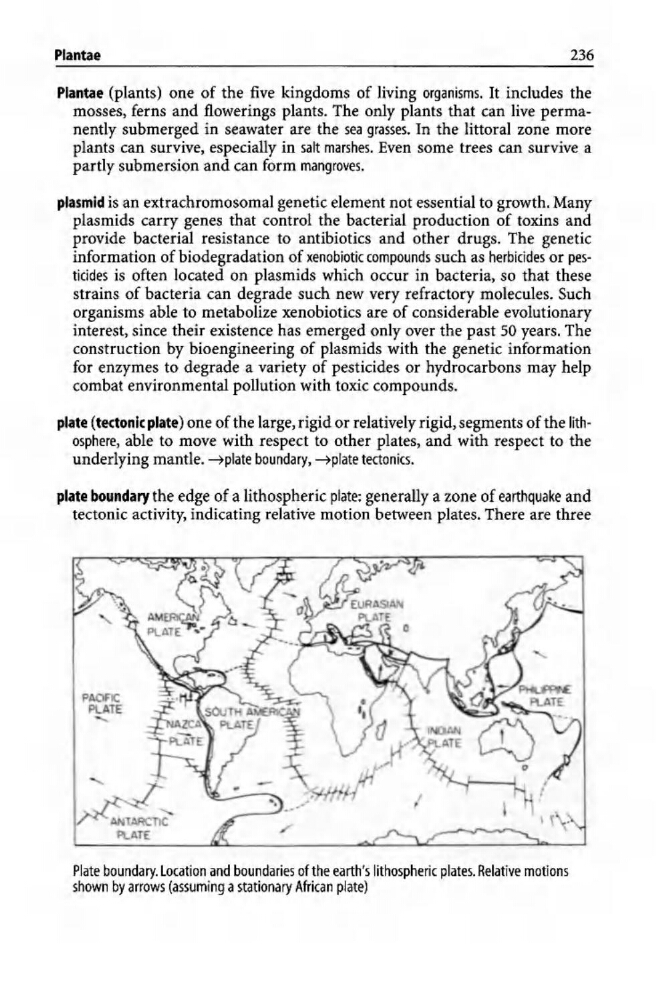
plate boundary the edge of a lithospheric plate: generally a zone of earthquake and
tectonic activity, indicating relative motion between plates. There are three
Plate boundary. Location and boundaries of the earth's lithospheric plates. Relative motions
shown by arrows (assuming a stationary African plate)
236
Plantae (plants) one of the five kingdoms of living organisms. It includes the
mosses, ferns and flowerings plants. The only plants that can live permanently submerged in seawater are the sea grasses. In the littoral zone more
plants can survive, especially in salt marshes. Even some trees can survive a
partly submersion and can form mangroves.
plasmid is an extrachromosomal genetic element not essential to growth. Many
plasmids carry genes that control the bacterial production of toxins and
provide bacterial resistance to antibiotics and other drugs. The genetic
information of biodegradation of xenobiotic compounds such as herbicides or pesticides is often located on plasm ids which occur in bacteria, so that these
strains of bacteria can degrade such new very refractory molecules. Such
organisms able to metabolize xenobiotics are of considerable evolutionary
interest, since their existence has emerged only over the past 50 years. The
construction by bioengineering of plasmids with the genetic information
for enzymes to degrade a variety of pesticides or hydrocarbons may help
combat environmental pollution with toxic compounds.
plate (tectonic plate) one of the large, rigid or relatively rigid, segments of the lithosphere, able to move with respect to other plates, and with respect to the
underlying mantle. -tplate boundary, -tplate tectonics.
plate boundary the edge of a lithospheric plate: generally a zone of earthquake and
tectonic activity, indicating relative motion between plates. There are three
Plate boundary. Location and boundaries of the earth's lithospheric plates. Relative motions
shown by arrows (assuming a stationary African plate)