

Platyhelminthes
238
the plate contact, whereas reabsorption of lithosphere induces volcanism on
the overriding plate (~island arc). Continents ride passively along on plates.
Where continents meet, subduction is converted into continent-continent
collision, crushing the lithosphere into mountain chains. Continents can be
split apart and rejoined in this way, but cannot be consumed in subduction
zones as in the case of the ocean floor. At transform plate boundaries, lithosphere is neither created nor destroyed; instead plates slide against each other
along transform faults (e.g., the San Andreas fault), giving rise to relatively shallow but sometimes severe earthquakes. ~Gondwana, ~Iapetus Ocean, ~Laurasia,
~Pangea, ~Panthalassa, ~Rheic Ocean, and ~Tethys.
Platyhelminthes (flatworms) phylum of two-sided symmetrical worms containing the parasitic class Trematoda (mostly endoparasites of vertebrates), the
Cestoda or tapeworms, and the class of the free-living Turbellaria. The body is
primitive, unsegmented, and flattened, elongated or oval; the head sometimes has tentacles. There is no coelom and a digestive tract is mostly absent
or incomplete.
Pleistocene ~geological time scale.
pleuston ~neuston.
Pliocene ~geological time scale.
plough mark furrow on the floor of a sea or lake caused by churning and scouring by icebergs.
POC ~particulate organic carbon.
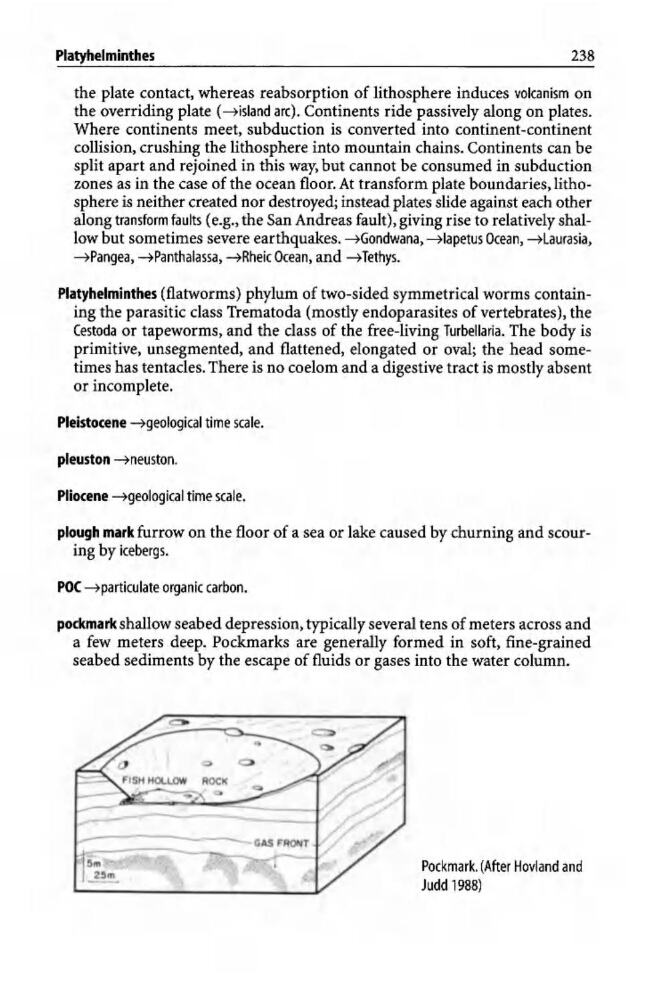
pockmark shallow seabed depression, typically several tens of meters across and
a few meters deep. Pockmarks are generally formed in soft, fine-grained
seabed sediments by the escape of fluids or gases into the water column.
Pockmark. (After Hovland and
Judd 1988)
238
the plate contact, whereas reabsorption of lithosphere induces volcanism on
the overriding plate (~island arc). Continents ride passively along on plates.
Where continents meet, subduction is converted into continent-continent
collision, crushing the lithosphere into mountain chains. Continents can be
split apart and rejoined in this way, but cannot be consumed in subduction
zones as in the case of the ocean floor. At transform plate boundaries, lithosphere is neither created nor destroyed; instead plates slide against each other
along transform faults (e.g., the San Andreas fault), giving rise to relatively shallow but sometimes severe earthquakes. ~Gondwana, ~Iapetus Ocean, ~Laurasia,
~Pangea, ~Panthalassa, ~Rheic Ocean, and ~Tethys.
Platyhelminthes (flatworms) phylum of two-sided symmetrical worms containing the parasitic class Trematoda (mostly endoparasites of vertebrates), the
Cestoda or tapeworms, and the class of the free-living Turbellaria. The body is
primitive, unsegmented, and flattened, elongated or oval; the head sometimes has tentacles. There is no coelom and a digestive tract is mostly absent
or incomplete.
Pleistocene ~geological time scale.
pleuston ~neuston.
Pliocene ~geological time scale.
plough mark furrow on the floor of a sea or lake caused by churning and scouring by icebergs.
POC ~particulate organic carbon.
pockmark shallow seabed depression, typically several tens of meters across and
a few meters deep. Pockmarks are generally formed in soft, fine-grained
seabed sediments by the escape of fluids or gases into the water column.
Pockmark. (After Hovland and
Judd 1988)