

219
orientation
,/ ::; .\ ,
, "tt~'\' . . . .
. " ".,-, . . . . . . . . . .
......."/1 'Ia'\' ........ -
/'1·"
----- /"11,\
I "II, "
II I, \
_
I
'II' \....
,'1, II '
' / " 1 \\ . . . _--; ,,·'1\ '" ;1' '/ / ,;1 \
1 , 1 \ '
,'1'.",
""1 " \
'---'
/,\
I
\
.....
I
I
\
__ ' /
' .... ____ ,,;'// I
-
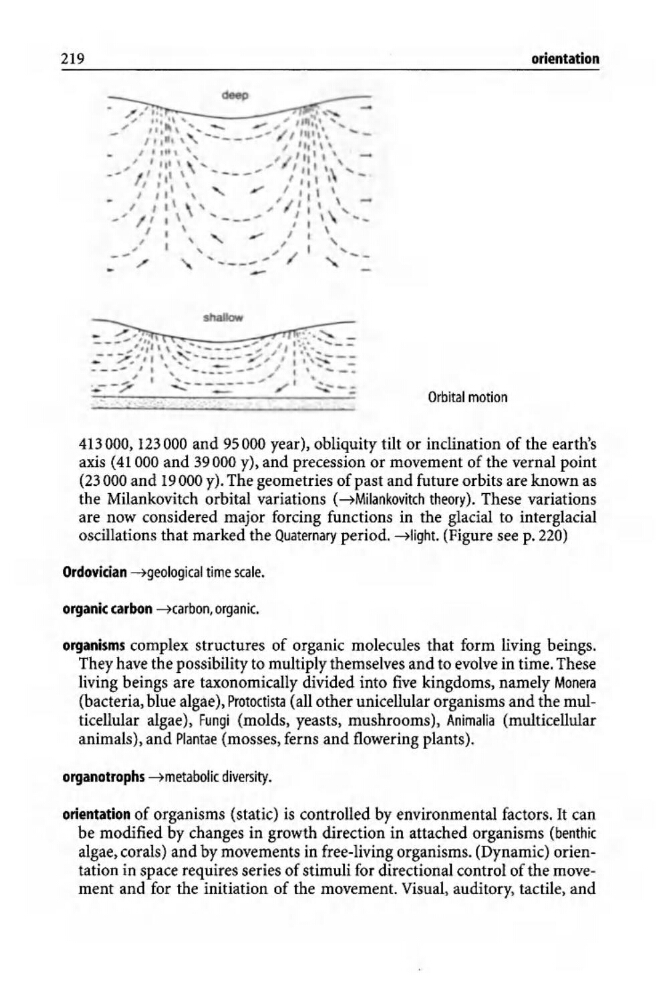
Orbital motion
413 000, 123000 and 95000 year), obliquity tilt or inclination of the earth's
axis (41000 and 39000 y), and precession or movement of the vernal point
(23000 and 19000 y). The geometries of past and future orbits are known as
the Milankovitch orbital variations (~Milankovitch theory). These variations
are now considered major forcing functions in the glacial to interglacial
oscillations that marked the Quaternary period. ~Iight. (Figure see p. 220)
Ordovician ~geological time scale.
organic carbon ~carbon. organic.
organisms complex structures of organic molecules that form living beings.
They have the possibility to multiply themselves and to evolve in time. These
living beings are taxonomically divided into five kingdoms, namely Monera
(bacteria, blue algae), Protoctista (all other unicellular organisms and the multicellular algae), Fungi (molds, yeasts, mushrooms), Animalia (multicellular
animals), and Plantae (mosses, ferns and flowering plants).
organotrophs ~metabolic diversity.
orientation of organisms (static) is controlled by environmental factors. It can
be modified by changes in growth direction in attached organisms (benthic
algae, corals) and by movements in free-living organisms. (Dynamic) orientation in space requires series of stimuli for directional control of the movement and for the initiation of the movement. Visual, auditory, tactile, and
orientation
,/ ::; .\ ,
, "tt~'\' . . . .
. " ".,-, . . . . . . . . . .
......."/1 'Ia'\' ........ -
/'1·"
----- /"11,\
I "II, "
II I, \
_
I
'II' \....
,'1, II '
' / " 1 \\ . . . _--; ,,·'1\ '" ;1' '/ / ,;1 \
1 , 1 \ '
,'1'.",
""1 " \
'---'
/,\
I
\
.....
I
I
\
__ ' /
' .... ____ ,,;'// I
-
Orbital motion
413 000, 123000 and 95000 year), obliquity tilt or inclination of the earth's
axis (41000 and 39000 y), and precession or movement of the vernal point
(23000 and 19000 y). The geometries of past and future orbits are known as
the Milankovitch orbital variations (~Milankovitch theory). These variations
are now considered major forcing functions in the glacial to interglacial
oscillations that marked the Quaternary period. ~Iight. (Figure see p. 220)
Ordovician ~geological time scale.
organic carbon ~carbon. organic.
organisms complex structures of organic molecules that form living beings.
They have the possibility to multiply themselves and to evolve in time. These
living beings are taxonomically divided into five kingdoms, namely Monera
(bacteria, blue algae), Protoctista (all other unicellular organisms and the multicellular algae), Fungi (molds, yeasts, mushrooms), Animalia (multicellular
animals), and Plantae (mosses, ferns and flowering plants).
organotrophs ~metabolic diversity.
orientation of organisms (static) is controlled by environmental factors. It can
be modified by changes in growth direction in attached organisms (benthic
algae, corals) and by movements in free-living organisms. (Dynamic) orientation in space requires series of stimuli for directional control of the movement and for the initiation of the movement. Visual, auditory, tactile, and