

orbital motion
.....
...
~
~
0)0 '2
r
.... ~
....
~
S
~ u z
ozo:
.oo
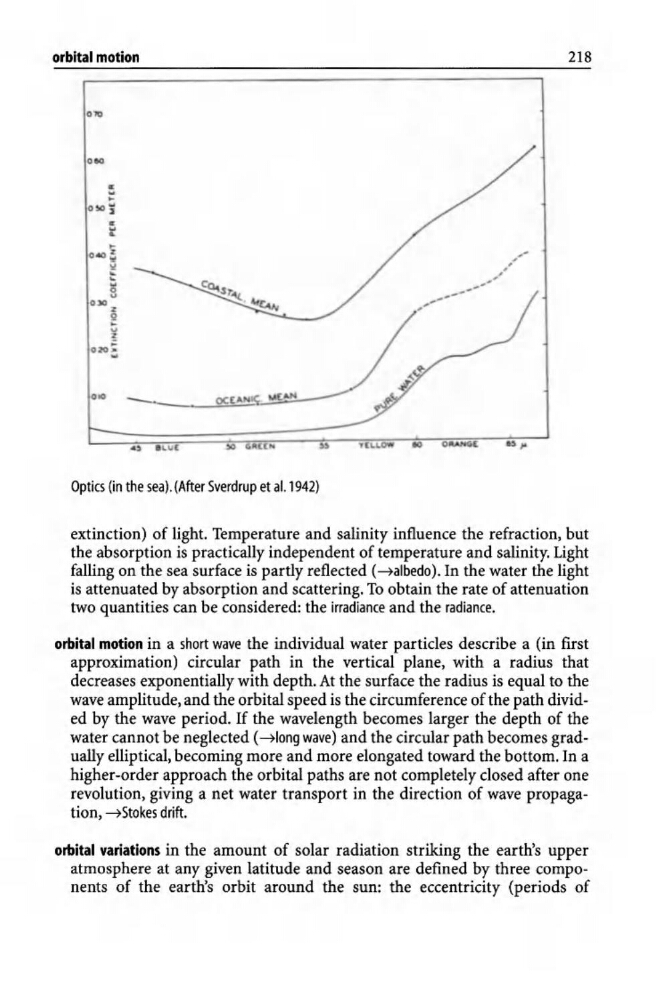
Optics (in the sea). (After Sverdrup et al. 1942)
218
. . lC:",J,.OW' 10 O~GC
extinction) of light. Temperature and salinity influence the refraction, but
the absorption is practically independent of temperature and salinity. Light
falling on the sea surface is partly reflected (~albedo). In the water the light
is attenuated by absorption and scattering. To obtain the rate of attenuation
two quantities can be considered: the irradiance and the radiance.
orbital motion in a short wave the individual water particles describe a (in first
approximation) circular path in the vertical plane, with a radius that
decreases exponentially with depth. At the surface the radius is equal to the
wave amplitude, and the orbital speed is the circumference of the path divided by the wave period. If the wavelength becomes larger the depth of the
water cannot be neglected (~Iong wave) and the circular path becomes gradually elliptical, becoming more and more elongated toward the bottom. In a
higher-order approach the orbital paths are not completely closed after one
revolution, giving a net water transport in the direction of wave propagation, ~Stokes drift.
orbital variations in the amount of solar radiation striking the earth's upper
atmosphere at any given latitude and season are defined by three components of the earth's orbit around the sun: the eccentricity (periods of
.....
...
~
~
0)0 '2
r
.... ~
....
~
S
~ u z
ozo:
.oo
Optics (in the sea). (After Sverdrup et al. 1942)
218
. . lC:",J,.OW' 10 O~GC
extinction) of light. Temperature and salinity influence the refraction, but
the absorption is practically independent of temperature and salinity. Light
falling on the sea surface is partly reflected (~albedo). In the water the light
is attenuated by absorption and scattering. To obtain the rate of attenuation
two quantities can be considered: the irradiance and the radiance.
orbital motion in a short wave the individual water particles describe a (in first
approximation) circular path in the vertical plane, with a radius that
decreases exponentially with depth. At the surface the radius is equal to the
wave amplitude, and the orbital speed is the circumference of the path divided by the wave period. If the wavelength becomes larger the depth of the
water cannot be neglected (~Iong wave) and the circular path becomes gradually elliptical, becoming more and more elongated toward the bottom. In a
higher-order approach the orbital paths are not completely closed after one
revolution, giving a net water transport in the direction of wave propagation, ~Stokes drift.
orbital variations in the amount of solar radiation striking the earth's upper
atmosphere at any given latitude and season are defined by three components of the earth's orbit around the sun: the eccentricity (periods of