

217
optics
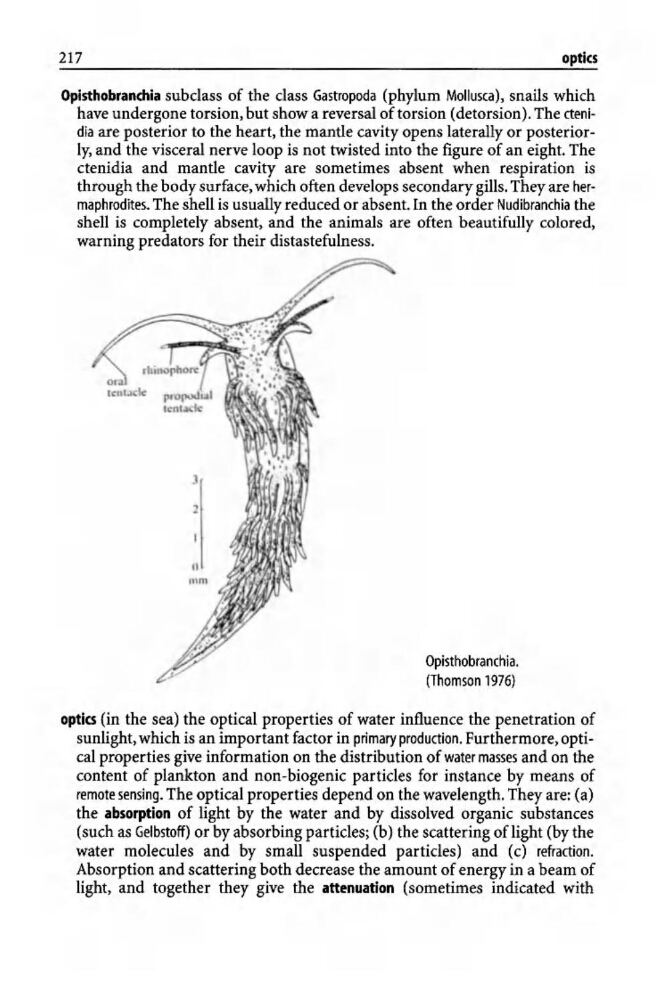
Opisthobranchia subclass of the class Gastropoda (phylum Mollusca), snails which
have undergone torsion, but show a reversal of torsion (detorsion). The ctenidia are posterior to the heart, the mantle cavity opens laterally or posteriorly, and the visceral nerve loop is not twisted into the figure of an eight. The
ctenidia and mantle cavity are sometimes absent when respiration is
through the body surface, which often develops secondary gills. They are hermaphrodites. The shell is usually reduced or absent. In the order Nudibranchia the
shell is completely absent, and the animals are often beautifully colored,
warning predators for their distastefulness.
Opisthobranchia.
(Thomson 1976)
optics (in the sea) the optical properties of water influence the penetration of
sunlight, which is an important factor in primary production. Furthermore, optical properties give information on the distribution of water masses and on the
content of plankton and non-biogenic particles for instance by means of
remote sensing. The optical properties depend on the wavelength. They are: (a)
the absorption of light by the water and by dissolved organic substances
(such as Gelbstoff) or by absorbing particles; (b) the scattering of light (by the
water molecules and by small suspended particles) and (c) refraction.
Absorption and scattering both decrease the amount of energy in a beam of
light, and together they give the attenuation (sometimes indicated with
optics
Opisthobranchia subclass of the class Gastropoda (phylum Mollusca), snails which
have undergone torsion, but show a reversal of torsion (detorsion). The ctenidia are posterior to the heart, the mantle cavity opens laterally or posteriorly, and the visceral nerve loop is not twisted into the figure of an eight. The
ctenidia and mantle cavity are sometimes absent when respiration is
through the body surface, which often develops secondary gills. They are hermaphrodites. The shell is usually reduced or absent. In the order Nudibranchia the
shell is completely absent, and the animals are often beautifully colored,
warning predators for their distastefulness.
Opisthobranchia.
(Thomson 1976)
optics (in the sea) the optical properties of water influence the penetration of
sunlight, which is an important factor in primary production. Furthermore, optical properties give information on the distribution of water masses and on the
content of plankton and non-biogenic particles for instance by means of
remote sensing. The optical properties depend on the wavelength. They are: (a)
the absorption of light by the water and by dissolved organic substances
(such as Gelbstoff) or by absorbing particles; (b) the scattering of light (by the
water molecules and by small suspended particles) and (c) refraction.
Absorption and scattering both decrease the amount of energy in a beam of
light, and together they give the attenuation (sometimes indicated with