

omnivores
216
omnivores omnivorous organisms, animals that devour or feed on all kinds of
food as opposed to specialized feeders, like carnivores which eat only other
animals, or herbivores which feed only on plants.
ooze pelagic sediment consisting of;?: 30 % skeletal remains of pelagic organisms
(either calcareous or siliceous), the rest being clay minerals. Oozes are named
after (the chemical composition of) their characteristic organisms, e.g.,
foraminiferal ooze, diatom ooze, but also calcareous ooze and siliceous ooze.
opal amorphous silica, Si0 2 with 5 to 20 % of H 2 0. In marine sediments opal-A
(biogenous silica) occurs in the form of the frustules of diatoms (~Bacillariophyta)
and the skeletons of Radiolaria, Silicoflagellata, Choanoflagellata and sponges, especially around Antarctica and in equatorial and upwelling regions. It is not stable and is subject to dissolution. Saturation of pore waters with silicic acid and
some impurities, notably Ai, retard dissolution. On time scales of tens of millions of years, opal-A is transformed via opal-CT into quartz. Near hydrothermal
vents hydrothermal opal, which is less pure than opal-A, may be precipitated.
operculum lid (1) cover of gill-slits of fish; (2) exoskeletal plate of Gastropoda,
which can close the shell opening when the animal withdraws into the shell;
(3) present in Bryozoa, ~Cheilostomata.
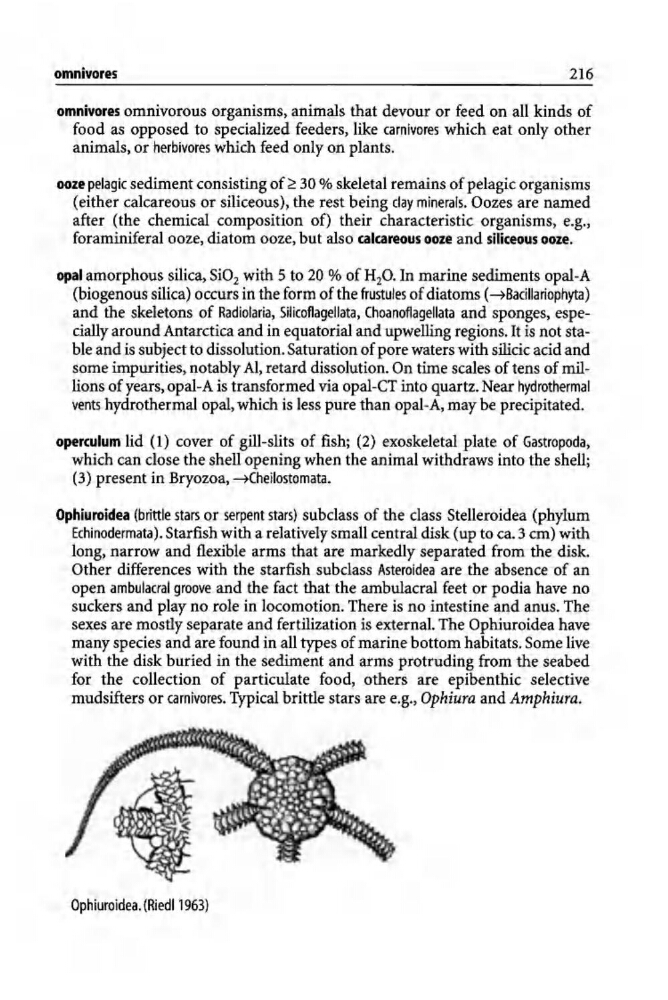
Ophiuroidea (brittle stars or serpent stars) subclass of the class Stelleroidea (phylum
Echinodermata). Starfish with a relatively small central disk (up to ca. 3 cm) with
long, narrow and flexible arms that are markedly separated from the disk.
Other differences with the starfish subclass Asteroidea are the absence of an
open ambulacral groove and the fact that the ambulacral feet or podia have no
suckers and play no role in locomotion. There is no intestine and anus. The
sexes are mostly separate and fertilization is external. The Ophiuroidea have
many species and are found in all types of marine bottom habitats. Some live
with the disk buried in the sediment and arms protruding from the seabed
for the collection of particulate food, others are epibenthic selective
mudsifters or carnivores. Typical brittle stars are e.g., Ophiura and Amphiura.
Ophiuroidea. (Riedl 1963)
216
omnivores omnivorous organisms, animals that devour or feed on all kinds of
food as opposed to specialized feeders, like carnivores which eat only other
animals, or herbivores which feed only on plants.
ooze pelagic sediment consisting of;?: 30 % skeletal remains of pelagic organisms
(either calcareous or siliceous), the rest being clay minerals. Oozes are named
after (the chemical composition of) their characteristic organisms, e.g.,
foraminiferal ooze, diatom ooze, but also calcareous ooze and siliceous ooze.
opal amorphous silica, Si0 2 with 5 to 20 % of H 2 0. In marine sediments opal-A
(biogenous silica) occurs in the form of the frustules of diatoms (~Bacillariophyta)
and the skeletons of Radiolaria, Silicoflagellata, Choanoflagellata and sponges, especially around Antarctica and in equatorial and upwelling regions. It is not stable and is subject to dissolution. Saturation of pore waters with silicic acid and
some impurities, notably Ai, retard dissolution. On time scales of tens of millions of years, opal-A is transformed via opal-CT into quartz. Near hydrothermal
vents hydrothermal opal, which is less pure than opal-A, may be precipitated.
operculum lid (1) cover of gill-slits of fish; (2) exoskeletal plate of Gastropoda,
which can close the shell opening when the animal withdraws into the shell;
(3) present in Bryozoa, ~Cheilostomata.
Ophiuroidea (brittle stars or serpent stars) subclass of the class Stelleroidea (phylum
Echinodermata). Starfish with a relatively small central disk (up to ca. 3 cm) with
long, narrow and flexible arms that are markedly separated from the disk.
Other differences with the starfish subclass Asteroidea are the absence of an
open ambulacral groove and the fact that the ambulacral feet or podia have no
suckers and play no role in locomotion. There is no intestine and anus. The
sexes are mostly separate and fertilization is external. The Ophiuroidea have
many species and are found in all types of marine bottom habitats. Some live
with the disk buried in the sediment and arms protruding from the seabed
for the collection of particulate food, others are epibenthic selective
mudsifters or carnivores. Typical brittle stars are e.g., Ophiura and Amphiura.
Ophiuroidea. (Riedl 1963)