

Ortman line
MAXIMUM IN
S . IIl:Ml SI'HEIlE
S
nON
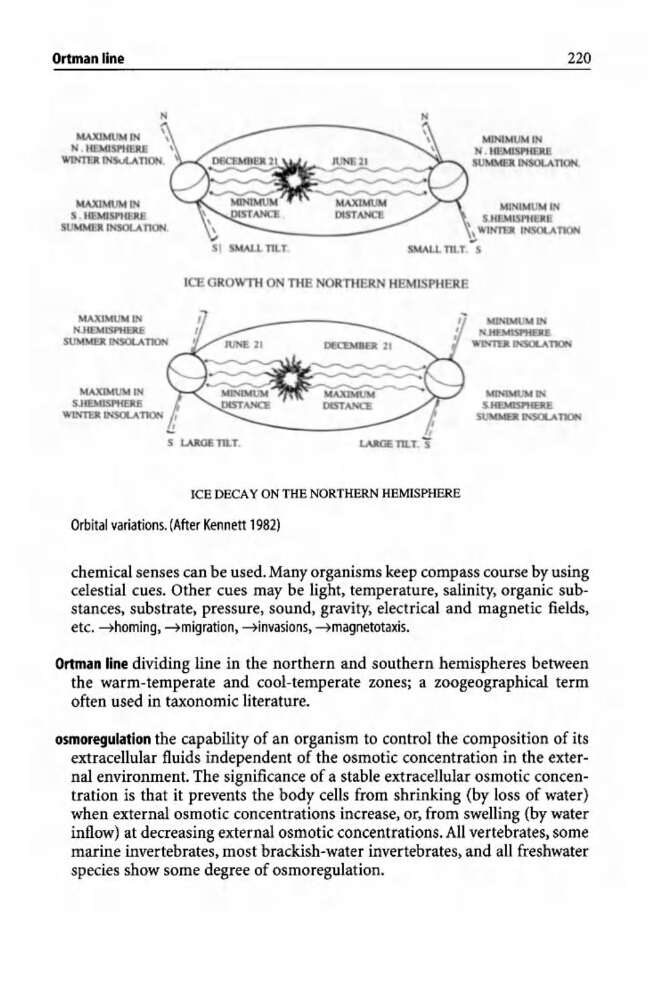
ICE GROWTH 0 THE ORTHERN HEMISPHERE
ICE DECAY ON THE NORTHERN HEMISPHERE
Orbital variations. (After Kennett 1982)
220
chemical senses can be used. Many organisms keep compass course by using
celestial cues. Other cues may be light, temperature, salinity, organic substances, substrate, pressure, sound, gravity, electrical and magnetic fields,
etc. --7homing, --7migration, --7invasions, --7magnetotaxis.
Ortman line dividing line in the northern and southern hemispheres between
the warm-temperate and cool-temperate zones; a zoogeographical term
often used in taxonomic literature.
osmoregulation the capability of an organism to control the composition of its
extracellular fluids independent of the osmotic concentration in the external environment. The significance of a stable extracellular osmotic concentration is that it prevents the body cells from shrinking (by loss of water)
when external osmotic concentrations increase, or, from swelling (by water
inflow) at decreasing external osmotic concentrations. All vertebrates, some
marine invertebrates, most brackish-water invertebrates, and all freshwater
species show some degree of osmoregulation.
MAXIMUM IN
S . IIl:Ml SI'HEIlE
S
nON
ICE GROWTH 0 THE ORTHERN HEMISPHERE
ICE DECAY ON THE NORTHERN HEMISPHERE
Orbital variations. (After Kennett 1982)
220
chemical senses can be used. Many organisms keep compass course by using
celestial cues. Other cues may be light, temperature, salinity, organic substances, substrate, pressure, sound, gravity, electrical and magnetic fields,
etc. --7homing, --7migration, --7invasions, --7magnetotaxis.
Ortman line dividing line in the northern and southern hemispheres between
the warm-temperate and cool-temperate zones; a zoogeographical term
often used in taxonomic literature.
osmoregulation the capability of an organism to control the composition of its
extracellular fluids independent of the osmotic concentration in the external environment. The significance of a stable extracellular osmotic concentration is that it prevents the body cells from shrinking (by loss of water)
when external osmotic concentrations increase, or, from swelling (by water
inflow) at decreasing external osmotic concentrations. All vertebrates, some
marine invertebrates, most brackish-water invertebrates, and all freshwater
species show some degree of osmoregulation.