

easterlies
102
guished from the less dense peripheral mantle, the surface separating them
being known as the Gutenberg discontinuity. The core probably consists of
an iron-nickel alloy and is divisible into a liquid outer core of about 2200 km
in radius and a solid inner core about 1300 km in radius.
easterlies climatic zone with predominant easterly winds. ~climate.
ebb tide period in the tidal cycle between high water and the next low water.
The ebb current is the current during the falling of the sea level. In the case
of a progressive tidal wave, the reversals of the current take place just between
the times of high and low water, and the ebb current cannot well be defined.
ecdysis ~molting.
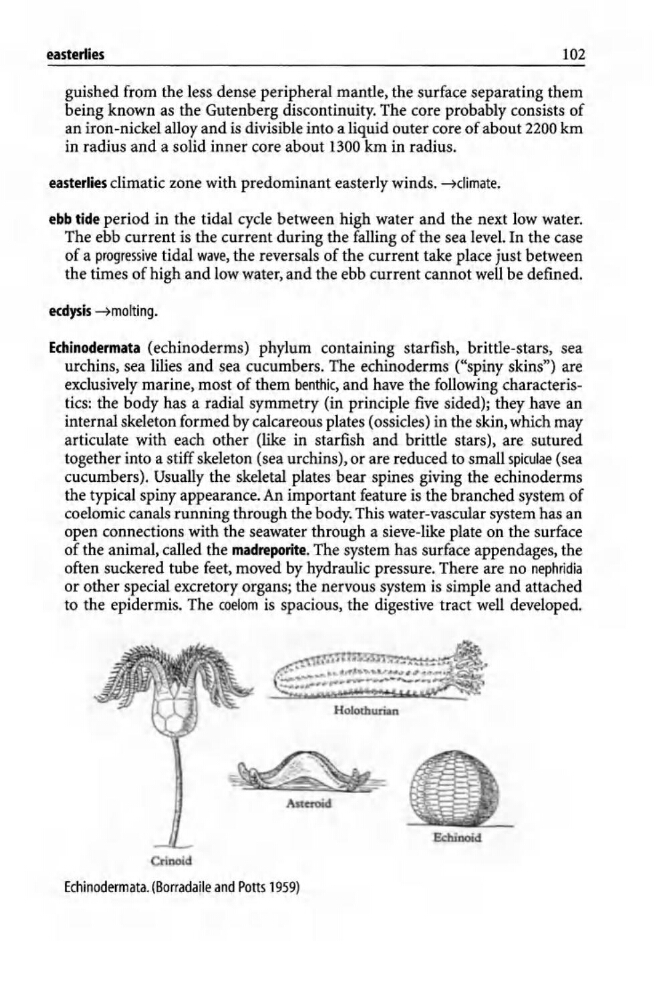
Echinodermata (echinoderms) phylum containing starfish, brittle-stars, sea
urchins, sea lilies and sea cucumbers. The echinoderms ("spiny skins") are
exclusively marine, most of them benthic, and have the following characteristics: the body has a radial symmetry (in principle five sided); they have an
internal skeleton formed by calcareous plates (ossicles) in the skin, which may
articulate with each other (like in starfish and brittle stars), are sutured
together into a stiff skeleton (sea urchins), or are reduced to small spiculae (sea
cucumbers). Usually the skeletal plates bear spines giving the echinoderms
the typical spiny appearance. An important feature is the branched system of
coelomic canals running through the body. This water-vascular system has an
open connections with the seawater through a sieve-like plate on the surface
of the animal, called the madreporite. The system has surface appendages, the
often suckered tube feet, moved by hydraulic pressure. There are no nephridia
or other special excretory organs; the nervous system is simple and attached
to the epidermis. The coelom is spacious, the digestive tract well developed.
HoIOlburian
Asteroid
Echinoid
Crinoid
Echinodermata. (Borradaile and Potts 1959)
102
guished from the less dense peripheral mantle, the surface separating them
being known as the Gutenberg discontinuity. The core probably consists of
an iron-nickel alloy and is divisible into a liquid outer core of about 2200 km
in radius and a solid inner core about 1300 km in radius.
easterlies climatic zone with predominant easterly winds. ~climate.
ebb tide period in the tidal cycle between high water and the next low water.
The ebb current is the current during the falling of the sea level. In the case
of a progressive tidal wave, the reversals of the current take place just between
the times of high and low water, and the ebb current cannot well be defined.
ecdysis ~molting.
Echinodermata (echinoderms) phylum containing starfish, brittle-stars, sea
urchins, sea lilies and sea cucumbers. The echinoderms ("spiny skins") are
exclusively marine, most of them benthic, and have the following characteristics: the body has a radial symmetry (in principle five sided); they have an
internal skeleton formed by calcareous plates (ossicles) in the skin, which may
articulate with each other (like in starfish and brittle stars), are sutured
together into a stiff skeleton (sea urchins), or are reduced to small spiculae (sea
cucumbers). Usually the skeletal plates bear spines giving the echinoderms
the typical spiny appearance. An important feature is the branched system of
coelomic canals running through the body. This water-vascular system has an
open connections with the seawater through a sieve-like plate on the surface
of the animal, called the madreporite. The system has surface appendages, the
often suckered tube feet, moved by hydraulic pressure. There are no nephridia
or other special excretory organs; the nervous system is simple and attached
to the epidermis. The coelom is spacious, the digestive tract well developed.
HoIOlburian
Asteroid
Echinoid
Crinoid
Echinodermata. (Borradaile and Potts 1959)