

101
earth's internal structure
E
earthquake (seismic event) sudden motion or trembling in the earth caused by
volcanic activity or by an abrupt movement of rock masses along fault
planes that results from instantaneous release of slowly accumulated elastic
strain. Earthquakes often lie along the interface of plates, where one plate is
overriding another. ~plate tectonics.
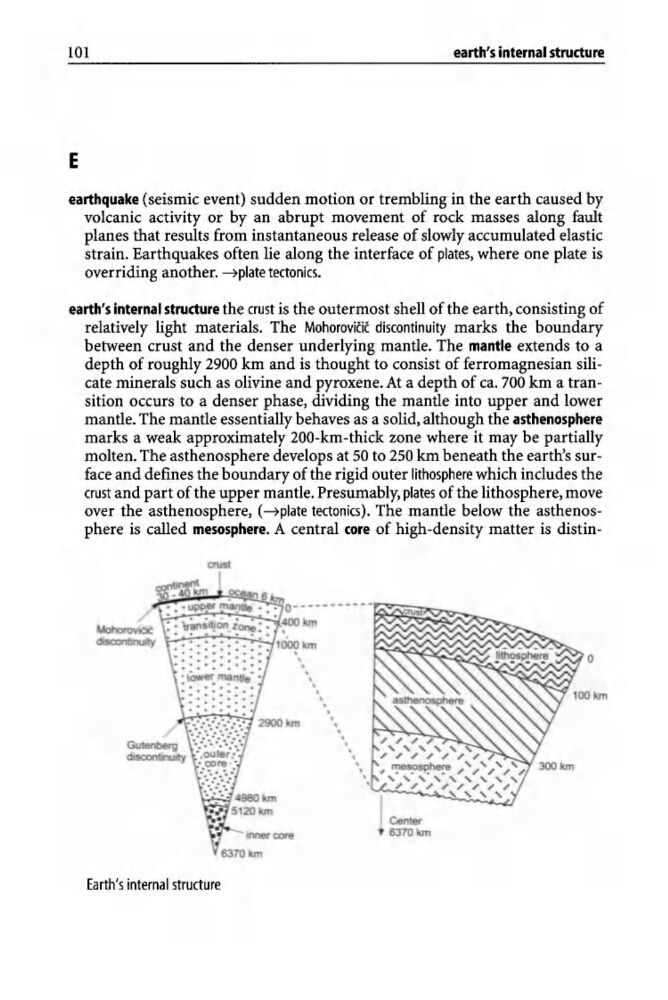
earth's internal structure the crust is the outermost shell of the earth, consisting of
relatively light materials. The Mohorovicic discontinuity marks the boundary
between crust and the denser underlying mantle. The mantle extends to a
depth of roughly 2900 km and is thought to consist offerromagnesian silicate minerals such as olivine and pyroxene. At a depth of ca. 700 km a transition occurs to a denser phase, dividing the mantle into upper and lower
mantle. The mantle essentially behaves as a solid, although the asthenosphere
marks a weak approximately 200-km-thick zone where it may be partially
molten. The asthenosphere develops at 50 to 250 km beneath the earth's surface and defines the boundary of the rigid outer lithosphere which includes the
crust and part of the upper mantle. Presumably, plates of the lithosphere, move
over the asthenosphere, (~plate tectonics). The mantle below the asthenosphere is called mesosphere. A central core of high-density matter is distinEarth's internal structure
earth's internal structure
E
earthquake (seismic event) sudden motion or trembling in the earth caused by
volcanic activity or by an abrupt movement of rock masses along fault
planes that results from instantaneous release of slowly accumulated elastic
strain. Earthquakes often lie along the interface of plates, where one plate is
overriding another. ~plate tectonics.
earth's internal structure the crust is the outermost shell of the earth, consisting of
relatively light materials. The Mohorovicic discontinuity marks the boundary
between crust and the denser underlying mantle. The mantle extends to a
depth of roughly 2900 km and is thought to consist offerromagnesian silicate minerals such as olivine and pyroxene. At a depth of ca. 700 km a transition occurs to a denser phase, dividing the mantle into upper and lower
mantle. The mantle essentially behaves as a solid, although the asthenosphere
marks a weak approximately 200-km-thick zone where it may be partially
molten. The asthenosphere develops at 50 to 250 km beneath the earth's surface and defines the boundary of the rigid outer lithosphere which includes the
crust and part of the upper mantle. Presumably, plates of the lithosphere, move
over the asthenosphere, (~plate tectonics). The mantle below the asthenosphere is called mesosphere. A central core of high-density matter is distinEarth's internal structure