

103
echogram
Most echinoderms live on or in the seabed, at all depths, and can be deposit feeders (irregular sea urchins and most sea cucumbers), carnivores (like the starfish
Asterias) or filter feeders (e.g., sea lilies). Eggs and sperm are normally released
in the water, and from the fertilized eggs hatch the typical planktonic echinoderm larvae (~rneroplankton). The phylum is divided into four classes:
Stelleroidea [with subclasses Asteroidea (starfish) and Ophiuroidea (brittle stars)],
Echinoidea (sea urchins), Holothuroidea (sea cucumbers), and Crinoidea (sea lilies).
Echinoidea class of the phylum Echinoderrnata. Free-moving echinoderms, sea urchins,
heart urchins, and sand dollars. Spherical or sometimes flattened body without arms. The ossicles (or calcareous plates in the skin) are flat and sutured
completely into the typical echinoid stiff skeletal case or test; other ossicles
developed into movable spines that cover the body. Besides such spines, the
echinoids also have podia or tube feet (~Echinoderrnata). For convenience the
class is still often divided into two groups. The Regularia (epibenthic, having a
radial symmetrical test with erect spines), and the Irregularia (infaunal burrowing animals with a bilateral symmetry, and the spines (used for digging)
mostly flat against the test and forming a kind of hair cover). The Regularia
have a typical structure with five dents round the mouth for scraping food
from the substrate, called the lantern of Aristotle. They feed mostly by grazing or
scavenging. The Irregularia or heart urchins, which live in soft bottoms, eat
more or less unsorted sediment containing detritus. Echinoids are found in all
seas and oceans, and are also an important group of fossils.
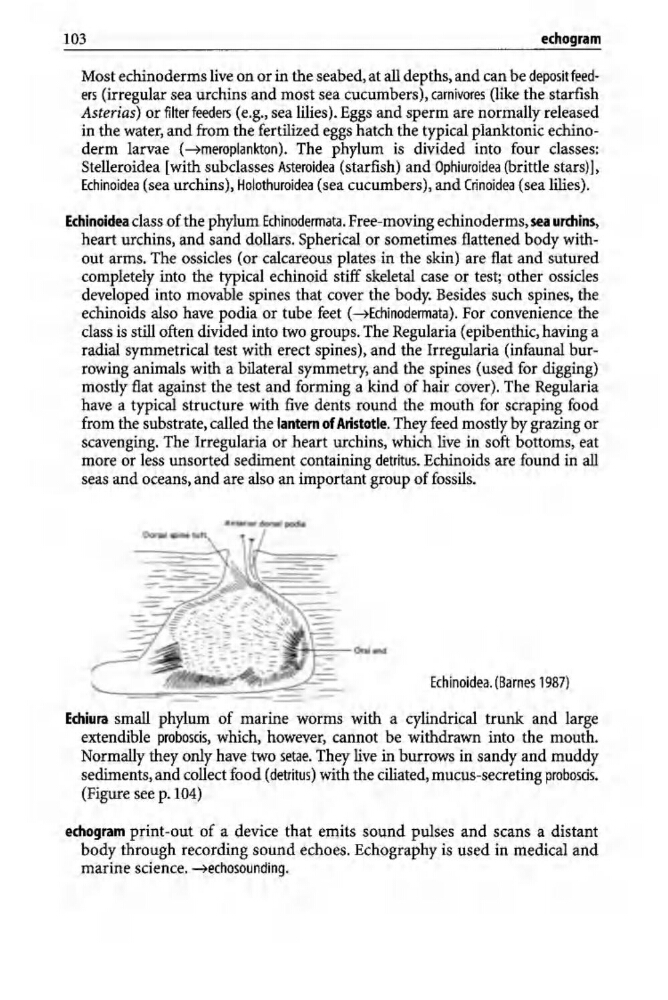
Echinoidea. (Barnes 1987)
Echiura small phylum of marine worms with a cylindrical trunk and large
extendible proboscis, which, however, cannot be withdrawn into the mouth.
Normally they only have two setae. They live in burrows in sandy and muddy
sediments, and collect food (detritus) with the ciliated, mucus-secreting proboscis.
(Figure see p. 104)
echogram print-out of a device that emits sound pulses and scans a distant
body through recording sound echoes. Echography is used in medical and
marine science. ~echosounding.
echogram
Most echinoderms live on or in the seabed, at all depths, and can be deposit feeders (irregular sea urchins and most sea cucumbers), carnivores (like the starfish
Asterias) or filter feeders (e.g., sea lilies). Eggs and sperm are normally released
in the water, and from the fertilized eggs hatch the typical planktonic echinoderm larvae (~rneroplankton). The phylum is divided into four classes:
Stelleroidea [with subclasses Asteroidea (starfish) and Ophiuroidea (brittle stars)],
Echinoidea (sea urchins), Holothuroidea (sea cucumbers), and Crinoidea (sea lilies).
Echinoidea class of the phylum Echinoderrnata. Free-moving echinoderms, sea urchins,
heart urchins, and sand dollars. Spherical or sometimes flattened body without arms. The ossicles (or calcareous plates in the skin) are flat and sutured
completely into the typical echinoid stiff skeletal case or test; other ossicles
developed into movable spines that cover the body. Besides such spines, the
echinoids also have podia or tube feet (~Echinoderrnata). For convenience the
class is still often divided into two groups. The Regularia (epibenthic, having a
radial symmetrical test with erect spines), and the Irregularia (infaunal burrowing animals with a bilateral symmetry, and the spines (used for digging)
mostly flat against the test and forming a kind of hair cover). The Regularia
have a typical structure with five dents round the mouth for scraping food
from the substrate, called the lantern of Aristotle. They feed mostly by grazing or
scavenging. The Irregularia or heart urchins, which live in soft bottoms, eat
more or less unsorted sediment containing detritus. Echinoids are found in all
seas and oceans, and are also an important group of fossils.
Echinoidea. (Barnes 1987)
Echiura small phylum of marine worms with a cylindrical trunk and large
extendible proboscis, which, however, cannot be withdrawn into the mouth.
Normally they only have two setae. They live in burrows in sandy and muddy
sediments, and collect food (detritus) with the ciliated, mucus-secreting proboscis.
(Figure see p. 104)
echogram print-out of a device that emits sound pulses and scans a distant
body through recording sound echoes. Echography is used in medical and
marine science. ~echosounding.