

69
source for a passive system comprised of the the tropical troposphere, plus
the mixed layer of the surrounding oceans with which it is thermodynamically coupled. This problem is in some sense equivalent to the one considered by Hasselmann (1976) in his study of the response of a passive ocean
mixed layer to stochastic atmospheric forcing. For a discussion of Hasselmann's formalism, the reader is referred to chapter 4 and to Frankignoul
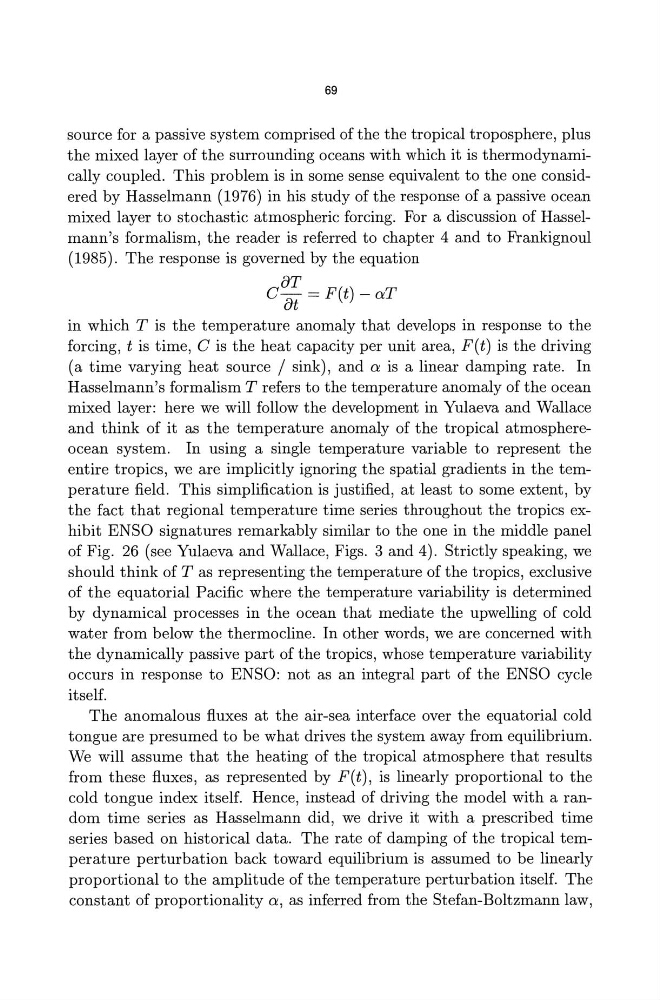
(1985). The response is governed by the equation
aT
C m = F(t) - aT
in which T is the temperature anomaly that develops in response to the
forcing, t is time, C is the heat capacity per unit area, F(t) is the driving
(a time varying heat source / sink), and a is a linear damping rate. In
Hasselmann's formalism T refers to the temperature anomaly of the ocean
mixed layer: here we will follow the development in Yulaeva and Wallace
and think of it as the temperature anomaly of the tropical atmosphereocean system. In using a single temperature variable to represent the
entire tropics, we are implicitly ignoring the spatial gradients in the temperature field. This simplification is justified, at least to some extent, by
the fact that regional temperature time series throughout the tropics exhibit ENSO signatures remarkably similar to the one in the middle panel
of Fig. 26 (see Yulaeva and Wallace, Figs. 3 and 4). Strictly speaking, we
should think of T as representing the temperature of the tropics, exclusive
of the equatorial Pacific where the temperature variability is determined
by dynamical processes in the ocean that mediate the upwelling of cold
water from below the thermocline. In other words, we are concerned with
the dynamically passive part of the tropics, whose temperature variability
occurs in response to ENSO: not as an integral part of the ENSO cycle
itself.
The anomalous fluxes at the air-sea interface over the equatorial cold
tongue are presumed to be what drives the system away from equilibrium.
We will assume that the heating of the tropical atmosphere that results
from these fluxes, as represented by F(t), is linearly proportional to the
cold tongue index itself. Hence, instead of driving the model with a random time series as Hasselmann did, we drive it with a prescribed time
series based on historical data. The rate of damping of the tropical temperature perturbation back toward equilibrium is assumed to be linearly
proportional to the amplitude of the temperature perturbation itself. The
constant of proportionality a, as inferred from the Stefan-Boltzmann law,
source for a passive system comprised of the the tropical troposphere, plus
the mixed layer of the surrounding oceans with which it is thermodynamically coupled. This problem is in some sense equivalent to the one considered by Hasselmann (1976) in his study of the response of a passive ocean
mixed layer to stochastic atmospheric forcing. For a discussion of Hasselmann's formalism, the reader is referred to chapter 4 and to Frankignoul
(1985). The response is governed by the equation
aT
C m = F(t) - aT
in which T is the temperature anomaly that develops in response to the
forcing, t is time, C is the heat capacity per unit area, F(t) is the driving
(a time varying heat source / sink), and a is a linear damping rate. In
Hasselmann's formalism T refers to the temperature anomaly of the ocean
mixed layer: here we will follow the development in Yulaeva and Wallace
and think of it as the temperature anomaly of the tropical atmosphereocean system. In using a single temperature variable to represent the
entire tropics, we are implicitly ignoring the spatial gradients in the temperature field. This simplification is justified, at least to some extent, by
the fact that regional temperature time series throughout the tropics exhibit ENSO signatures remarkably similar to the one in the middle panel
of Fig. 26 (see Yulaeva and Wallace, Figs. 3 and 4). Strictly speaking, we
should think of T as representing the temperature of the tropics, exclusive
of the equatorial Pacific where the temperature variability is determined
by dynamical processes in the ocean that mediate the upwelling of cold
water from below the thermocline. In other words, we are concerned with
the dynamically passive part of the tropics, whose temperature variability
occurs in response to ENSO: not as an integral part of the ENSO cycle
itself.
The anomalous fluxes at the air-sea interface over the equatorial cold
tongue are presumed to be what drives the system away from equilibrium.
We will assume that the heating of the tropical atmosphere that results
from these fluxes, as represented by F(t), is linearly proportional to the
cold tongue index itself. Hence, instead of driving the model with a random time series as Hasselmann did, we drive it with a prescribed time
series based on historical data. The rate of damping of the tropical temperature perturbation back toward equilibrium is assumed to be linearly
proportional to the amplitude of the temperature perturbation itself. The
constant of proportionality a, as inferred from the Stefan-Boltzmann law,