

59
130E
170E
150W
11 0W
70W
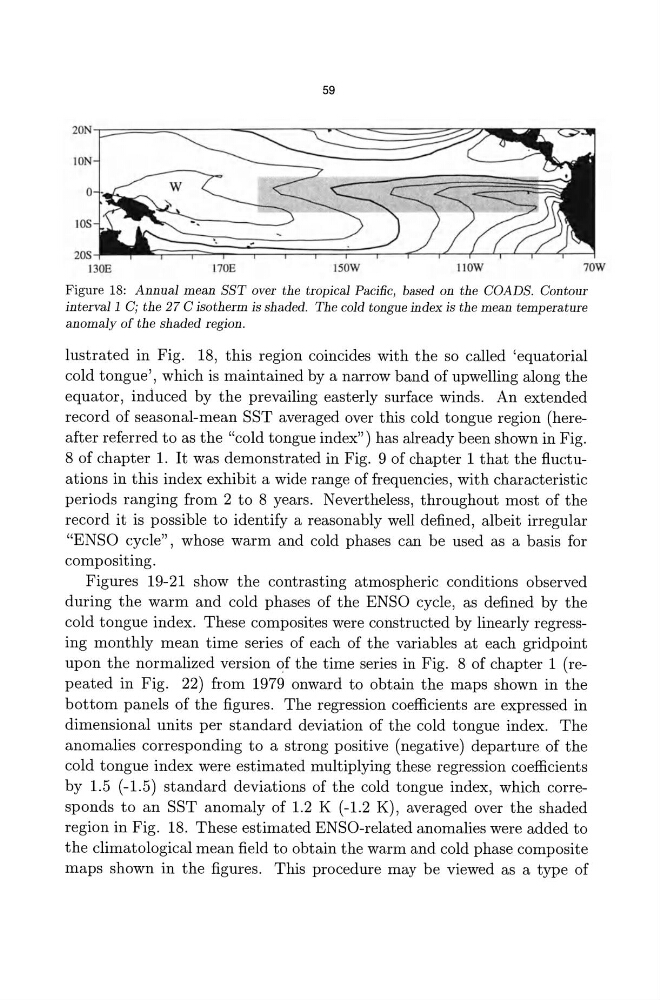
Figure 18: Annual mean SST over the tropical Pacific, based on the COADS. Contour
interval 1 C; the 27 C isotherm is shaded. The cold tongue index is the mean temperature
anomaly of the shaded region.
lustrated in Fig. 18, this region coincides with the so called 'equatorial
cold tongue', which is maintained by a narrow band of upwelling along the
equator, induced by the prevailing easterly surface winds. An extended
record of seasonal-mean SST averaged over this cold tongue region (hereafter referred to as the "cold tongue index") has already been shown in Fig.
8 of chapter 1. It was demonstrated in Fig. 9 of chapter 1 that the fluctuations in this index exhibit a wide range of frequencies, with characteristic
periods ranging from 2 to 8 years. Nevertheless, throughout most of the
record it is possible to identify a reasonably well defined, albeit irregular
"ENSO cycle", whose warm and cold phases can be used as a basis for
compositing.
Figures 19-21 show the contrasting atmospheric conditions observed
during the warm and cold phases of the ENSO cycle, as defined by the
cold tongue index. These composites were constructed by linearly regressing monthly mean time series of each of the variables at each gridpoint
upon the normalized version of the time series in Fig. 8 of chapter 1 (repeated in Fig. 22) from 1979 onward to obtain the maps shown in the
bottom panels of the figures. The regression coefficients are expressed in
dimensional units per standard deviation of the cold tongue index. The
anomalies corresponding to a strong positive (negative) departure of the
cold tongue index were estimated multiplying these regression coefficients
by 1.5 (-1.5) standard deviations of the cold tongue index, which corresponds to an SST anomaly of 1.2 K (-1.2 K), averaged over the shaded
region in Fig. 18. These estimated ENSO-related anomalies were added to
the climatological mean field to obtain the warm and cold phase composite
maps shown in the figures. This procedure may be viewed as a type of
130E
170E
150W
11 0W
70W
Figure 18: Annual mean SST over the tropical Pacific, based on the COADS. Contour
interval 1 C; the 27 C isotherm is shaded. The cold tongue index is the mean temperature
anomaly of the shaded region.
lustrated in Fig. 18, this region coincides with the so called 'equatorial
cold tongue', which is maintained by a narrow band of upwelling along the
equator, induced by the prevailing easterly surface winds. An extended
record of seasonal-mean SST averaged over this cold tongue region (hereafter referred to as the "cold tongue index") has already been shown in Fig.
8 of chapter 1. It was demonstrated in Fig. 9 of chapter 1 that the fluctuations in this index exhibit a wide range of frequencies, with characteristic
periods ranging from 2 to 8 years. Nevertheless, throughout most of the
record it is possible to identify a reasonably well defined, albeit irregular
"ENSO cycle", whose warm and cold phases can be used as a basis for
compositing.
Figures 19-21 show the contrasting atmospheric conditions observed
during the warm and cold phases of the ENSO cycle, as defined by the
cold tongue index. These composites were constructed by linearly regressing monthly mean time series of each of the variables at each gridpoint
upon the normalized version of the time series in Fig. 8 of chapter 1 (repeated in Fig. 22) from 1979 onward to obtain the maps shown in the
bottom panels of the figures. The regression coefficients are expressed in
dimensional units per standard deviation of the cold tongue index. The
anomalies corresponding to a strong positive (negative) departure of the
cold tongue index were estimated multiplying these regression coefficients
by 1.5 (-1.5) standard deviations of the cold tongue index, which corresponds to an SST anomaly of 1.2 K (-1.2 K), averaged over the shaded
region in Fig. 18. These estimated ENSO-related anomalies were added to
the climatological mean field to obtain the warm and cold phase composite
maps shown in the figures. This procedure may be viewed as a type of